[STUDY GUIDE] • HIGH-YIELD PRACTICE & REVIEW EDITION
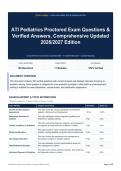
ATI Pediatrics Proctored Exam Questions &
Verified Answers, Comprehensive Updated
2026/2027 Edition
Comprehensive Examination Question Bank • In-Depth Rationales • Concept Mapping
TOTAL QUESTIONS EXAM TOPICS RATIONALES
100 Questions 11 Modules 100% Verified
DOCUMENT OVERVIEW
This document contains 100 verified questions with correct answers and detailed rationales focusing on
pediatric nursing. Each question is designed to cover essential concepts in child health and development,
making it suitable for exam preparation, course review, and certification preparation.
EXAM BLUEPRINT & TOPIC DISTRIBUTION
Systematic breakdown of subject domains and exam coverage.
Topic Module Scope & Core Focus Questions Share (%)
Growth and Development This topic covers the various parameters and milestones
Assessment related to child growth and development. 10 Qs 10.0%
Respiratory Disorders in This topic addresses common respiratory conditions and
Children treatments in pediatric patients. 9 Qs 9.0%
This topic involves the diagnosis, treatment, and management
Cardiac Conditions in Pediatrics of congenital and acquired heart conditions in children. 9 Qs 9.0%
This topic focuses on various endocrine disorders affecting
Endocrine Disorders children, including diabetes and growth hormone deficiencies. 9 Qs 9.0%
This topic involves the assessment and management of
Neurological Disorders neurological conditions in pediatric patients. 9 Qs 9.0%
This topic addresses common gastrointestinal issues and
Gastrointestinal Disorders their management in children. 9 Qs 9.0%
This topic covers various infectious diseases, their symptoms,
Infectious Diseases in Pediatrics and diagnostic criteria in children. 9 Qs 9.0%
Confidential • Student Study Edition • Practice & Review Guide Page 1 of 52
,STUDENT STUDY & MASTERY EDITION PRACTICE & REVIEW GUIDE
Musculoskeletal and Genetic This topic examines musculoskeletal and genetic disorders
Disorders affecting children's physical abilities. 9 Qs 9.0%
This topic focuses on the principles of medication
Medication Management administration and monitoring in pediatric patients. 9 Qs 9.0%
Psychological and Behavioral This topic explores psychological and behavioral health
Health issues in pediatric patients, including ADHD. 9 Qs 9.0%
This topic involves the assessment and management of renal
Renal Disorders conditions in children. 9 Qs 9.0%
Total Exam Coverage 11 Integrated Topic Modules 100 Qs 100.0%
Confidential • Student Study Edition • Practice & Review Guide Page 2 of 52
,STUDENT STUDY & MASTERY EDITION PRACTICE & REVIEW GUIDE
TOPIC 1: GROWTH AND DEVELOPMENT ASSESSMENT
10 Questions • 10.0% of Exam • This topic covers the various parameters and milestones related to child growth and development.
QUESTION 1
A nurse is assessing an infant's growth pattern. Which of the following growth
parameters is NOT typically monitored in the first year of life?
[A] Weight
[B] Length
[C] Head Circumference
[D] Body Mass Index (BMI)
Correct Answer: Body Mass Index (BMI)
Rationale: In the first year of life, weight, length, and head circumference are the primary growth parameters monitored.
BMI is not typically calculated until the child is at least 2 years old.
QUESTION 2
A child is diagnosed with a growth hormone deficiency. Which of the following growth
principles is most directly affected in this condition?
[A] Growth in height
[B] Growth in weight
[C] Proportional growth
[D] Growth velocity
Correct Answer: Growth velocity.
Rationale: Growth hormone deficiency primarily affects growth velocity, leading to a decrease in the rate of growth in height
and weight.
Confidential • Student Study Edition • Practice & Review Guide Page 3 of 52
, STUDENT STUDY & MASTERY EDITION PRACTICE & REVIEW GUIDE
QUESTION 3
A nurse is evaluating the growth and development of a toddler. Which of the following
developmental milestones is typically achieved around 18 months of age?
[A] Walking independently
[B] Pointing to body parts
[C] Using simple sentences
[D] Drawing simple shapes
Correct Answer: Walking independently.
Rationale: Toddlers typically achieve the ability to walk independently around 12-14 months of age, but may not master it
until 18 months.
QUESTION 4
A child is experiencing a growth spurt. Which of the following physiological changes is
most directly related to this event?
[A] Increase in insulin production
[B] Increase in growth hormone production
[C] Increase in thyroid hormone production
[D] Increase in cortisol production
Correct Answer: Increase in growth hormone production.
Rationale: Growth hormone is the primary hormone responsible for growth spurts, stimulating the growth and differentiation
of cells.
Confidential • Student Study Edition • Practice & Review Guide Page 4 of 52
ATI Pediatrics Proctored Exam Questions &
Verified Answers, Comprehensive Updated
2026/2027 Edition
Comprehensive Examination Question Bank • In-Depth Rationales • Concept Mapping
TOTAL QUESTIONS EXAM TOPICS RATIONALES
100 Questions 11 Modules 100% Verified
DOCUMENT OVERVIEW
This document contains 100 verified questions with correct answers and detailed rationales focusing on
pediatric nursing. Each question is designed to cover essential concepts in child health and development,
making it suitable for exam preparation, course review, and certification preparation.
EXAM BLUEPRINT & TOPIC DISTRIBUTION
Systematic breakdown of subject domains and exam coverage.
Topic Module Scope & Core Focus Questions Share (%)
Growth and Development This topic covers the various parameters and milestones
Assessment related to child growth and development. 10 Qs 10.0%
Respiratory Disorders in This topic addresses common respiratory conditions and
Children treatments in pediatric patients. 9 Qs 9.0%
This topic involves the diagnosis, treatment, and management
Cardiac Conditions in Pediatrics of congenital and acquired heart conditions in children. 9 Qs 9.0%
This topic focuses on various endocrine disorders affecting
Endocrine Disorders children, including diabetes and growth hormone deficiencies. 9 Qs 9.0%
This topic involves the assessment and management of
Neurological Disorders neurological conditions in pediatric patients. 9 Qs 9.0%
This topic addresses common gastrointestinal issues and
Gastrointestinal Disorders their management in children. 9 Qs 9.0%
This topic covers various infectious diseases, their symptoms,
Infectious Diseases in Pediatrics and diagnostic criteria in children. 9 Qs 9.0%
Confidential • Student Study Edition • Practice & Review Guide Page 1 of 52
,STUDENT STUDY & MASTERY EDITION PRACTICE & REVIEW GUIDE
Musculoskeletal and Genetic This topic examines musculoskeletal and genetic disorders
Disorders affecting children's physical abilities. 9 Qs 9.0%
This topic focuses on the principles of medication
Medication Management administration and monitoring in pediatric patients. 9 Qs 9.0%
Psychological and Behavioral This topic explores psychological and behavioral health
Health issues in pediatric patients, including ADHD. 9 Qs 9.0%
This topic involves the assessment and management of renal
Renal Disorders conditions in children. 9 Qs 9.0%
Total Exam Coverage 11 Integrated Topic Modules 100 Qs 100.0%
Confidential • Student Study Edition • Practice & Review Guide Page 2 of 52
,STUDENT STUDY & MASTERY EDITION PRACTICE & REVIEW GUIDE
TOPIC 1: GROWTH AND DEVELOPMENT ASSESSMENT
10 Questions • 10.0% of Exam • This topic covers the various parameters and milestones related to child growth and development.
QUESTION 1
A nurse is assessing an infant's growth pattern. Which of the following growth
parameters is NOT typically monitored in the first year of life?
[A] Weight
[B] Length
[C] Head Circumference
[D] Body Mass Index (BMI)
Correct Answer: Body Mass Index (BMI)
Rationale: In the first year of life, weight, length, and head circumference are the primary growth parameters monitored.
BMI is not typically calculated until the child is at least 2 years old.
QUESTION 2
A child is diagnosed with a growth hormone deficiency. Which of the following growth
principles is most directly affected in this condition?
[A] Growth in height
[B] Growth in weight
[C] Proportional growth
[D] Growth velocity
Correct Answer: Growth velocity.
Rationale: Growth hormone deficiency primarily affects growth velocity, leading to a decrease in the rate of growth in height
and weight.
Confidential • Student Study Edition • Practice & Review Guide Page 3 of 52
, STUDENT STUDY & MASTERY EDITION PRACTICE & REVIEW GUIDE
QUESTION 3
A nurse is evaluating the growth and development of a toddler. Which of the following
developmental milestones is typically achieved around 18 months of age?
[A] Walking independently
[B] Pointing to body parts
[C] Using simple sentences
[D] Drawing simple shapes
Correct Answer: Walking independently.
Rationale: Toddlers typically achieve the ability to walk independently around 12-14 months of age, but may not master it
until 18 months.
QUESTION 4
A child is experiencing a growth spurt. Which of the following physiological changes is
most directly related to this event?
[A] Increase in insulin production
[B] Increase in growth hormone production
[C] Increase in thyroid hormone production
[D] Increase in cortisol production
Correct Answer: Increase in growth hormone production.
Rationale: Growth hormone is the primary hormone responsible for growth spurts, stimulating the growth and differentiation
of cells.
Confidential • Student Study Edition • Practice & Review Guide Page 4 of 52