
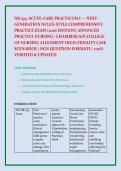
NR 574: ACUTE-CARE PRACTICUM I — NEXT-
GENERATION NCLEX-STYLE COMPREHENSIVE
PRACTICE EXAM (2026 EDITION) ADVANCED
PRACTICE NURSING • CHAMBERLAIN COLLEGE
OF NURSING ALIGNMENT HIGH-FIDELITY CASE
SCENARIOS | NGN QUESTION FORMATS | 100%
VERIFIED & UPDATED
CORE DOMAINS
• Cardiovascular and Pulmonary Acute Care
• Neurological and Endocrine Acute Care
• Gastrointestinal, Renal, and Hematologic Acute Care
• Trauma, Sepsis, and Multisystem Organ Failure
INTRODUCTION
The NR 574 Care acuity Gerontology Generation
Acute Practicum I patient Acute Care NCLEX
practice scenarios. Nurse (NGN)
exam Content Practitioner formats
synthesizes aligns with curriculum, including
clinical Chamberlain emphasizing bowtie,
management College of hemodynamic matrix, cloze,
skills across Nursing's monitoring, and
complex Adult mechanical unfolding
acute care ventilation, case studies,
settings. This sepsis reflecting the
examination management, National
, evaluates and Council of
advanced multisystem State Boards
practice organ of Nursing
nursing dysfunction . Clinical
students' Questions Judgment
ability to incorporate Measurement
assess, Next Model .
prioritize,
and
intervene in
high
SECTION ONE: CARDIOVASCULAR AND PULMONARY ACUTE CARE
(QUESTIONS 1–50)
1. A 72-year-old male is admitted to the ICU with acute decompensated
heart failure. Crackles are audible to the mid-scapular region, and 3+
pitting edema is noted in the lower extremities. What is the priority
nursing intervention for this patient?
A. Administer furosemide 40 mg IV push
B. Place the patient in high-Fowler's position
C. Prepare for endotracheal intubation
D. Obtain a stat 12-lead ECG
RATIONALE: High-Fowler's position reduces venous return (preload) and
improves diaphragmatic excursion, providing immediate symptomatic relief.
Airway and positioning are the first steps before medications. Furosemide is
critical but not the very first action if the patient is severely hypoxemic and in
respiratory distress .
2. A patient in the ICU has a central venous pressure (CVP) of 2 mm Hg
and is hypotensive. What does this finding most likely indicate?
, A. Hypovolemia or decreased venous return
B. Fluid overload
C. Left ventricular failure
D. Increased afterload only
RATIONALE: A low CVP reflects reduced right-sided preload and is
consistent with hypovolemia or decreased venous return. Volume
resuscitation is typically indicated after confirming the clinical context .
3. Which hemodynamic profile is most consistent with cardiogenic
shock?
A. High cardiac output, low systemic vascular resistance
B. High cardiac output, high systemic vascular resistance
C. Low cardiac output, high systemic vascular resistance, elevated
pulmonary artery wedge pressure
D. Normal cardiac output with low wedge pressure
RATIONALE: Cardiogenic shock is characterized by pump failure:
reduced cardiac output, compensatory vasoconstriction (high SVR), and
elevated left-sided filling pressures (high PAWP) .
4. A patient with acute decompensated heart failure is receiving
nitroprusside. What is the primary therapeutic goal of this
medication?
A. Increase preload
B. Reduce afterload through arterial vasodilation
C. Increase myocardial contractility directly
D. Provide rate control
RATIONALE: Nitroprusside is a potent arterial (and venous) vasodilator
used to reduce afterload, thereby improving forward stroke volume in
GENERATION NCLEX-STYLE COMPREHENSIVE
PRACTICE EXAM (2026 EDITION) ADVANCED
PRACTICE NURSING • CHAMBERLAIN COLLEGE
OF NURSING ALIGNMENT HIGH-FIDELITY CASE
SCENARIOS | NGN QUESTION FORMATS | 100%
VERIFIED & UPDATED
CORE DOMAINS
• Cardiovascular and Pulmonary Acute Care
• Neurological and Endocrine Acute Care
• Gastrointestinal, Renal, and Hematologic Acute Care
• Trauma, Sepsis, and Multisystem Organ Failure
INTRODUCTION
The NR 574 Care acuity Gerontology Generation
Acute Practicum I patient Acute Care NCLEX
practice scenarios. Nurse (NGN)
exam Content Practitioner formats
synthesizes aligns with curriculum, including
clinical Chamberlain emphasizing bowtie,
management College of hemodynamic matrix, cloze,
skills across Nursing's monitoring, and
complex Adult mechanical unfolding
acute care ventilation, case studies,
settings. This sepsis reflecting the
examination management, National
, evaluates and Council of
advanced multisystem State Boards
practice organ of Nursing
nursing dysfunction . Clinical
students' Questions Judgment
ability to incorporate Measurement
assess, Next Model .
prioritize,
and
intervene in
high
SECTION ONE: CARDIOVASCULAR AND PULMONARY ACUTE CARE
(QUESTIONS 1–50)
1. A 72-year-old male is admitted to the ICU with acute decompensated
heart failure. Crackles are audible to the mid-scapular region, and 3+
pitting edema is noted in the lower extremities. What is the priority
nursing intervention for this patient?
A. Administer furosemide 40 mg IV push
B. Place the patient in high-Fowler's position
C. Prepare for endotracheal intubation
D. Obtain a stat 12-lead ECG
RATIONALE: High-Fowler's position reduces venous return (preload) and
improves diaphragmatic excursion, providing immediate symptomatic relief.
Airway and positioning are the first steps before medications. Furosemide is
critical but not the very first action if the patient is severely hypoxemic and in
respiratory distress .
2. A patient in the ICU has a central venous pressure (CVP) of 2 mm Hg
and is hypotensive. What does this finding most likely indicate?
, A. Hypovolemia or decreased venous return
B. Fluid overload
C. Left ventricular failure
D. Increased afterload only
RATIONALE: A low CVP reflects reduced right-sided preload and is
consistent with hypovolemia or decreased venous return. Volume
resuscitation is typically indicated after confirming the clinical context .
3. Which hemodynamic profile is most consistent with cardiogenic
shock?
A. High cardiac output, low systemic vascular resistance
B. High cardiac output, high systemic vascular resistance
C. Low cardiac output, high systemic vascular resistance, elevated
pulmonary artery wedge pressure
D. Normal cardiac output with low wedge pressure
RATIONALE: Cardiogenic shock is characterized by pump failure:
reduced cardiac output, compensatory vasoconstriction (high SVR), and
elevated left-sided filling pressures (high PAWP) .
4. A patient with acute decompensated heart failure is receiving
nitroprusside. What is the primary therapeutic goal of this
medication?
A. Increase preload
B. Reduce afterload through arterial vasodilation
C. Increase myocardial contractility directly
D. Provide rate control
RATIONALE: Nitroprusside is a potent arterial (and venous) vasodilator
used to reduce afterload, thereby improving forward stroke volume in

