
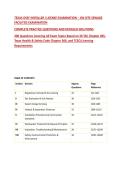
TEXAS OSSF INSTALLER I LICENSE EXAMINATION – ON-SITE SEWAGE
FACILITIES EXAMINATION
COMPLETE PRACTICE QUESTIONS AND DETAILED SOLUTIONS
200 Questions Covering All Exam Topics Based on 30 TAC Chapter 285,
Texas Health & Safety Code Chapter 366, and TCEQ Licensing
Requirements
TABLE OF CONTENTS
Section Domain Approx. Page
Questions Reference
I Regulatory Framework & Licensing 25 Q1–Q25
II Site Evaluation & Soil Analysis 30 Q26–Q55
III System Design & Sizing 30 Q56–Q85
IV Setback & Separation Distances 25 Q86–Q110
V Installation Procedures & Construction 35 Q111–Q145
Standards
VI Wastewater Treatment & Disposal Principles 25 Q146–Q170
VII Inspection, Troubleshooting & Maintenance 20 Q171–Q190
VIII Safety, Environmental Protection & 10 Q191–Q200
Enforcement
,SECTION I: REGULATORY FRAMEWORK & LICENSING (Q1–Q25)
1. Which Texas state statute grants the Texas Commission on
Environmental Quality (TCEQ) the authority to regulate On-Site
Sewage Facilities?
A. Texas Water Code Title 7
B. Title 30, Texas Administrative Code Chapter 285
C. Title 5, Texas Health and Safety Code Chapter 366
D. Clean Water Act Section 402
Answer: C
Rationale: Title 5, Texas Health and Safety Code Chapter 366 is the
enabling statute that establishes OSSF regulations and the authority of
TCEQ. 30 TAC Chapter 285 contains the actual rules, but Chapter 366 is
the underlying state law.
2. What is the maximum daily flow that an OSSF system is permitted
to treat under Texas regulations?
A. 1,000 gallons per day
B. 2,500 gallons per day
C. 5,000 gallons per day
D. 10,000 gallons per day
Answer: C
Rationale: An on-site sewage facility (OSSF) can treat up to 5,000 gallons
of sewage per day and is used only for disposal of sewage produced on
a site where any part of the system is located.
,3. Before statewide regulations were established in Texas, which
entity was primarily responsible for OSSF oversight?
A. Texas Department of Health
B. Local government
C. Texas Commission on Environmental Quality
D. Environmental Protection Agency
Answer: B
Rationale: Before statewide regulation began in September 1989, local
governments were the primary authorities for OSSF oversight.
4. A local government entity authorized by TCEQ to administer the
OSSF program within its jurisdiction is called a(n):
A. Authorized Agent
B. Local Enforcement Agency
C. Designated Representative
D. Environmental Health Office
Answer: A
Rationale: An Authorized Agent is a local governmental entity, such as a
county or municipality, that has been delegated authority by TCEQ to
implement and enforce OSSF rules.
5. What is the minimum lot size typically required for a standard OSSF
system under Texas regulations?
, A. Quarter acre
B. One acre
C. Half acre
D. Two acres
Answer: C
Rationale: State regulations generally require a minimum of one-half
acre for a standard OSSF system, though local jurisdictions may impose
stricter requirements.
6. The specific state law that first authorized statewide regulation of
OSSFs in Texas was:
A. Senate Bill 101
B. Clean Water Act
C. Texas Water Code Title 7
D. House Bill 1875
Answer: D
Rationale: House Bill 1875 (HB 1875) was the legislation that gave TCEQ
the authority to implement statewide regulation of OSSFs.
7. What is the term for the individual appointed by an Authorized
Agent to enforce OSSF regulations locally?
A. Site Inspector
B. Designated Representative
C. Professional Engineer
D. Licensed Installer
FACILITIES EXAMINATION
COMPLETE PRACTICE QUESTIONS AND DETAILED SOLUTIONS
200 Questions Covering All Exam Topics Based on 30 TAC Chapter 285,
Texas Health & Safety Code Chapter 366, and TCEQ Licensing
Requirements
TABLE OF CONTENTS
Section Domain Approx. Page
Questions Reference
I Regulatory Framework & Licensing 25 Q1–Q25
II Site Evaluation & Soil Analysis 30 Q26–Q55
III System Design & Sizing 30 Q56–Q85
IV Setback & Separation Distances 25 Q86–Q110
V Installation Procedures & Construction 35 Q111–Q145
Standards
VI Wastewater Treatment & Disposal Principles 25 Q146–Q170
VII Inspection, Troubleshooting & Maintenance 20 Q171–Q190
VIII Safety, Environmental Protection & 10 Q191–Q200
Enforcement
,SECTION I: REGULATORY FRAMEWORK & LICENSING (Q1–Q25)
1. Which Texas state statute grants the Texas Commission on
Environmental Quality (TCEQ) the authority to regulate On-Site
Sewage Facilities?
A. Texas Water Code Title 7
B. Title 30, Texas Administrative Code Chapter 285
C. Title 5, Texas Health and Safety Code Chapter 366
D. Clean Water Act Section 402
Answer: C
Rationale: Title 5, Texas Health and Safety Code Chapter 366 is the
enabling statute that establishes OSSF regulations and the authority of
TCEQ. 30 TAC Chapter 285 contains the actual rules, but Chapter 366 is
the underlying state law.
2. What is the maximum daily flow that an OSSF system is permitted
to treat under Texas regulations?
A. 1,000 gallons per day
B. 2,500 gallons per day
C. 5,000 gallons per day
D. 10,000 gallons per day
Answer: C
Rationale: An on-site sewage facility (OSSF) can treat up to 5,000 gallons
of sewage per day and is used only for disposal of sewage produced on
a site where any part of the system is located.
,3. Before statewide regulations were established in Texas, which
entity was primarily responsible for OSSF oversight?
A. Texas Department of Health
B. Local government
C. Texas Commission on Environmental Quality
D. Environmental Protection Agency
Answer: B
Rationale: Before statewide regulation began in September 1989, local
governments were the primary authorities for OSSF oversight.
4. A local government entity authorized by TCEQ to administer the
OSSF program within its jurisdiction is called a(n):
A. Authorized Agent
B. Local Enforcement Agency
C. Designated Representative
D. Environmental Health Office
Answer: A
Rationale: An Authorized Agent is a local governmental entity, such as a
county or municipality, that has been delegated authority by TCEQ to
implement and enforce OSSF rules.
5. What is the minimum lot size typically required for a standard OSSF
system under Texas regulations?
, A. Quarter acre
B. One acre
C. Half acre
D. Two acres
Answer: C
Rationale: State regulations generally require a minimum of one-half
acre for a standard OSSF system, though local jurisdictions may impose
stricter requirements.
6. The specific state law that first authorized statewide regulation of
OSSFs in Texas was:
A. Senate Bill 101
B. Clean Water Act
C. Texas Water Code Title 7
D. House Bill 1875
Answer: D
Rationale: House Bill 1875 (HB 1875) was the legislation that gave TCEQ
the authority to implement statewide regulation of OSSFs.
7. What is the term for the individual appointed by an Authorized
Agent to enforce OSSF regulations locally?
A. Site Inspector
B. Designated Representative
C. Professional Engineer
D. Licensed Installer

