[STUDY GUIDE] • HIGH-YIELD PRACTICE & REVIEW EDITION
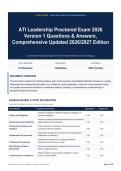
ATI Leadership Proctored Exam 2026
Version 1 Questions & Answers,
Comprehensive Updated 2026/2027 Edition
Comprehensive Examination Question Bank • In-Depth Rationales • Concept Mapping
TOTAL QUESTIONS EXAM TOPICS RATIONALES
97 Questions 14 Modules 100% Verified
DOCUMENT OVERVIEW
This document contains 97 verified questions with correct answers and detailed rationales focused on nursing
leadership and management principles. It is suitable for exam preparation, review for newly licensed nurses,
and quality improvement initiatives in healthcare settings, ensuring a comprehensive understanding of
essential leadership concepts.
EXAM BLUEPRINT & TOPIC DISTRIBUTION
Systematic breakdown of subject domains and exam coverage.
Topic Module Scope & Core Focus Questions Share (%)
Examines strategies for effective staffing and delegation in
Staffing and Delegation nursing management. 7 Qs 7.2%
Focuses on quality improvement projects aimed at enhancing
Quality Improvement Initiatives patient safety and care standards. 7 Qs 7.2%
Performance Evaluation and Covers methods for evaluating nursing performance and
Feedback providing constructive feedback. 7 Qs 7.2%
Analyzes the importance of teamwork and interdisciplinary
Collaboration and Teamwork collaboration in healthcare. 7 Qs 7.2%
Highlights the significance of ongoing professional
Professional Development development and training for nurses. 7 Qs 7.2%
Client Acuity and Needs Discusses considerations for assessing client acuity and
Assessment needs in staffing decisions. 7 Qs 7.2%
Explores effective communication strategies in nursing
Communication in Healthcare practice, including SBAR. 7 Qs 7.2%
Confidential • Student Study Edition • Practice & Review Guide Page 1 of 50
,STUDENT STUDY & MASTERY EDITION PRACTICE & REVIEW GUIDE
Focuses on the roles of orientation and mentorship for newly
Orientation and Mentorship licensed nurses. 7 Qs 7.2%
Examines risk management strategies to minimize errors and
Risk Management enhance safety. 7 Qs 7.2%
Analyzes strategies for effective task prioritization in nursing
Task Prioritization practice. 7 Qs 7.2%
Covers effective patient education techniques for various
Patient Education conditions. 7 Qs 7.2%
Focuses on nursing interventions for clients with complex
Interventions for Complex Cases medical conditions. 7 Qs 7.2%
Investigates methods for assessing and improving client
Client Satisfaction and Feedback satisfaction in healthcare. 7 Qs 7.2%
Explores the process of developing and implementing
Healthcare Policy Development healthcare policies. 6 Qs 6.2%
Total Exam Coverage 14 Integrated Topic Modules 97 Qs 100.0%
Confidential • Student Study Edition • Practice & Review Guide Page 2 of 50
,STUDENT STUDY & MASTERY EDITION PRACTICE & REVIEW GUIDE
TOPIC 1: STAFFING AND DELEGATION
7 Questions • 7.2% of Exam • Examines strategies for effective staffing and delegation in nursing management.
QUESTION 1
A nurse manager is planning a change in the staffing pattern for a busy medical unit.
The change will involve assigning more responsibility to the team leaders, which may
affect the workload of the registered nurses. What is the most appropriate action for the
nurse manager to take before implementing the change?
[A] Conduct a needs assessment to identify staff training needs related to the change.
[B] Meet with the registered nurses to discuss the change and answer their questions.
[C] Develop a new job description for the team leaders that outlines their new responsibilities.
[D] Notify the facility administration about the planned change and seek their approval.
Correct Answer: OptionA.
Rationale: A needs assessment is necessary to identify staff training needs and ensure a smooth transition to the new
staffing pattern.
QUESTION 2
A nurse is planning to delegate a task to a certified nursing assistant (CNA). The task
involves administering medication to a client who has a complex medical condition.
What is the most critical factor for the nurse to consider before delegating the task?
[A] The CNA's level of experience and training related to medication administration.
[B] The client's medical condition and potential risks associated with medication administration.
[C] The availability of resources and equipment needed for the task.
[D] The CNA's ability to communicate effectively with the client.
Correct Answer: OptionB.
Rationale: The nurse must consider the client's medical condition and potential risks associated with medication
administration before delegating the task.
Confidential • Student Study Edition • Practice & Review Guide Page 3 of 50
, STUDENT STUDY & MASTERY EDITION PRACTICE & REVIEW GUIDE
QUESTION 3
A nurse manager is preparing a presentation to the hospital administration about
implementing a new staffing model. The nurse manager wants to emphasize the
benefits of the new model to improve patient satisfaction and reduce nurse turnover.
Which of the following data should the nurse manager include in the presentation?
[A] Current nurse-to-patient ratios and staffing patterns
[B] Data from patient satisfaction surveys and nurse turnover rates
[C] Information about the hospital's current budget and financial constraints
[D] A detailed description of the new staffing model and its implementation timeline
Correct Answer: OptionB.
Rationale: Data from patient satisfaction surveys and nurse turnover rates will help the administration understand the
benefits of the new staffing model.
QUESTION 4
A nurse manager is reviewing the work schedule for the upcoming week and notices
that several nurses have requested time off during peak hours. Which of the following
actions should the nurse manager take to address the staffing shortage?
[A] Call in additional staff to cover the shifts
[B] Reassign nurses to different shifts to ensure adequate coverage
[C] Negotiate with the nurses to see if they can switch their time off to less busy shifts
[D] Postpone non-essential tasks and duties until the staffing shortage is resolved
Correct Answer: OptionB.
Rationale: Reassigning nurses to different shifts ensures that there is adequate coverage during peak hours and minimizes
the impact on client care.
Confidential • Student Study Edition • Practice & Review Guide Page 4 of 50
ATI Leadership Proctored Exam 2026
Version 1 Questions & Answers,
Comprehensive Updated 2026/2027 Edition
Comprehensive Examination Question Bank • In-Depth Rationales • Concept Mapping
TOTAL QUESTIONS EXAM TOPICS RATIONALES
97 Questions 14 Modules 100% Verified
DOCUMENT OVERVIEW
This document contains 97 verified questions with correct answers and detailed rationales focused on nursing
leadership and management principles. It is suitable for exam preparation, review for newly licensed nurses,
and quality improvement initiatives in healthcare settings, ensuring a comprehensive understanding of
essential leadership concepts.
EXAM BLUEPRINT & TOPIC DISTRIBUTION
Systematic breakdown of subject domains and exam coverage.
Topic Module Scope & Core Focus Questions Share (%)
Examines strategies for effective staffing and delegation in
Staffing and Delegation nursing management. 7 Qs 7.2%
Focuses on quality improvement projects aimed at enhancing
Quality Improvement Initiatives patient safety and care standards. 7 Qs 7.2%
Performance Evaluation and Covers methods for evaluating nursing performance and
Feedback providing constructive feedback. 7 Qs 7.2%
Analyzes the importance of teamwork and interdisciplinary
Collaboration and Teamwork collaboration in healthcare. 7 Qs 7.2%
Highlights the significance of ongoing professional
Professional Development development and training for nurses. 7 Qs 7.2%
Client Acuity and Needs Discusses considerations for assessing client acuity and
Assessment needs in staffing decisions. 7 Qs 7.2%
Explores effective communication strategies in nursing
Communication in Healthcare practice, including SBAR. 7 Qs 7.2%
Confidential • Student Study Edition • Practice & Review Guide Page 1 of 50
,STUDENT STUDY & MASTERY EDITION PRACTICE & REVIEW GUIDE
Focuses on the roles of orientation and mentorship for newly
Orientation and Mentorship licensed nurses. 7 Qs 7.2%
Examines risk management strategies to minimize errors and
Risk Management enhance safety. 7 Qs 7.2%
Analyzes strategies for effective task prioritization in nursing
Task Prioritization practice. 7 Qs 7.2%
Covers effective patient education techniques for various
Patient Education conditions. 7 Qs 7.2%
Focuses on nursing interventions for clients with complex
Interventions for Complex Cases medical conditions. 7 Qs 7.2%
Investigates methods for assessing and improving client
Client Satisfaction and Feedback satisfaction in healthcare. 7 Qs 7.2%
Explores the process of developing and implementing
Healthcare Policy Development healthcare policies. 6 Qs 6.2%
Total Exam Coverage 14 Integrated Topic Modules 97 Qs 100.0%
Confidential • Student Study Edition • Practice & Review Guide Page 2 of 50
,STUDENT STUDY & MASTERY EDITION PRACTICE & REVIEW GUIDE
TOPIC 1: STAFFING AND DELEGATION
7 Questions • 7.2% of Exam • Examines strategies for effective staffing and delegation in nursing management.
QUESTION 1
A nurse manager is planning a change in the staffing pattern for a busy medical unit.
The change will involve assigning more responsibility to the team leaders, which may
affect the workload of the registered nurses. What is the most appropriate action for the
nurse manager to take before implementing the change?
[A] Conduct a needs assessment to identify staff training needs related to the change.
[B] Meet with the registered nurses to discuss the change and answer their questions.
[C] Develop a new job description for the team leaders that outlines their new responsibilities.
[D] Notify the facility administration about the planned change and seek their approval.
Correct Answer: OptionA.
Rationale: A needs assessment is necessary to identify staff training needs and ensure a smooth transition to the new
staffing pattern.
QUESTION 2
A nurse is planning to delegate a task to a certified nursing assistant (CNA). The task
involves administering medication to a client who has a complex medical condition.
What is the most critical factor for the nurse to consider before delegating the task?
[A] The CNA's level of experience and training related to medication administration.
[B] The client's medical condition and potential risks associated with medication administration.
[C] The availability of resources and equipment needed for the task.
[D] The CNA's ability to communicate effectively with the client.
Correct Answer: OptionB.
Rationale: The nurse must consider the client's medical condition and potential risks associated with medication
administration before delegating the task.
Confidential • Student Study Edition • Practice & Review Guide Page 3 of 50
, STUDENT STUDY & MASTERY EDITION PRACTICE & REVIEW GUIDE
QUESTION 3
A nurse manager is preparing a presentation to the hospital administration about
implementing a new staffing model. The nurse manager wants to emphasize the
benefits of the new model to improve patient satisfaction and reduce nurse turnover.
Which of the following data should the nurse manager include in the presentation?
[A] Current nurse-to-patient ratios and staffing patterns
[B] Data from patient satisfaction surveys and nurse turnover rates
[C] Information about the hospital's current budget and financial constraints
[D] A detailed description of the new staffing model and its implementation timeline
Correct Answer: OptionB.
Rationale: Data from patient satisfaction surveys and nurse turnover rates will help the administration understand the
benefits of the new staffing model.
QUESTION 4
A nurse manager is reviewing the work schedule for the upcoming week and notices
that several nurses have requested time off during peak hours. Which of the following
actions should the nurse manager take to address the staffing shortage?
[A] Call in additional staff to cover the shifts
[B] Reassign nurses to different shifts to ensure adequate coverage
[C] Negotiate with the nurses to see if they can switch their time off to less busy shifts
[D] Postpone non-essential tasks and duties until the staffing shortage is resolved
Correct Answer: OptionB.
Rationale: Reassigning nurses to different shifts ensures that there is adequate coverage during peak hours and minimizes
the impact on client care.
Confidential • Student Study Edition • Practice & Review Guide Page 4 of 50