
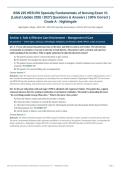
BSN 225 HESI RN Specialty Fundamentals of Nursing Exam V1
(Latest Update ) Questions & Answers | 100% Correct |
Grade A - Nightingale
Nightingale College • BSN 225 • HESI RN Specialty Examination • NCLEX-RN Test Plan Aligned
Section 1: Safe & Effective Care Environment – Management of Care
(20 questions — Client rights, advocacy, ethical/legal, delegation, prioritization, SBAR, HIPAA, scope of practice)
Q1: A 17-year-old unmarried patient presents to the labor and delivery unit in active labor. The obstetrician
recommends an emergency cesarean section due to fetal distress. The patient is alert, oriented, and expresses
understanding of the procedure. Who is legally authorized to sign the informed consent?
A. The patient's parents must be contacted by phone to give consent.
B. The hospital's risk manager must grant emergency consent.
C. The patient, because emancipated minors and mature minors in emergency obstetric situations may consent to their own
treatment. *[CORRECT]*
D. The patient's 19-year-old sibling who accompanied her.
Correct Answer: C
Rationale: Under the mature minor doctrine and most state Nurse Practice Acts, a pregnant minor or a minor seeking obstetric care is
often considered emancipated for the purpose of consenting to her own medical treatment. Nightingale College BSN 225 curriculum
and HESI RN Specialty standards emphasize that nurses must verify consent is obtained by the provider, ensure the patient
demonstrates understanding, and document the process. Parents are not required in this obstetric emergency context.
Q2: An 82-year-old patient with end-stage COPD is admitted with respiratory failure. The patient has a signed,
witnessed advance directive stating no intubation or mechanical ventilation. The family is demanding the nurse
"do everything possible to keep Mom alive." What is the nurse's best action?
A. Honor the family's request and notify the provider to intubate.
B. Contact the ethics committee to override the advance directive.
C. Advocate for the patient's documented wishes by informing the provider and educating the family about the Patient
Self-Determination Act. *[CORRECT]*
D. Ask the family to obtain a court order before any action is taken.
Correct Answer: C
Rationale: The Patient Self-Determination Act (PSDA) requires healthcare facilities to honor a patient's executed advance directive.
The nurse's professional obligation under autonomy and fidelity is to advocate for the patient's documented wishes, not substitute the
family's preferences. Nightingale College BSN 225 curriculum aligns with the HESI RN Specialty and NCLEX-RN test plan
emphasizing advocacy, ethical principles, and the legal primacy of patient autonomy.
BSN 225 HESI RN Specialty Fundamentals of Nursing Exam V1 — Nightingale College Page 1
, Q3: A registered nurse on a 32-bed medical-surgical unit is caring for four clients. Which of the following tasks is
most appropriate to delegate to the unlicensed assistive personnel (UAP)?
A. Teaching a newly diagnosed diabetic patient how to self-administer insulin.
B. Assessing a postoperative patient's incision site for signs of infection.
C. Ambulating a stable patient who is 24 hours post-appendectomy for the first time after surgery. *[CORRECT]*
D. Re-evaluating and adjusting the rate of a patient's patient-controlled analgesia (PCA) pump.
Correct Answer: C
Rationale: According to the ANA Principles of Delegation and the Nightingale College BSN 225 curriculum, UAP scope of practice
includes routine activities of daily living, ambulation of stable patients, and basic hygiene. Teaching, assessment, and adjusting
medication delivery systems require nursing judgment and licensure, and must be performed by the RN. The HESI RN Specialty exam
tests the 5 Rights of Delegation: right task, right circumstance, right person, right direction, right supervision.
Q4: The charge nurse is making room assignments for four newly admitted clients. Which client should be
assigned to the ICU-trained RN with the most experience?
A. A 68-year-old admitted with community-acquired pneumonia, oxygen saturation 94% on 2 L nasal cannula.
B. A 54-year-old admitted with acute pancreatitis, complaining of severe epigastric pain rated 8/10.
C. A 45-year-old admitted 2 hours ago with suspected meningococcal meningitis who is now confused, febrile at 39.5°C,
and has a new petechial rash. *[CORRECT]*
D. A 72-year-old admitted with dehydration, receiving IV fluids at 125 mL/hr, with a sodium of 138 mEq/L.
Correct Answer: C
Rationale: Using the ABC plus acuity prioritization framework and the Nightingale College BSN 225 clinical reasoning model,
suspected meningococcal meningitis with altered mental status, fever, and petechial rash represents an immediate life-threatening
condition requiring droplet precautions, IV antibiotics within 30 minutes, and close neurological monitoring. The HESI RN Specialty
exam prioritizes patients with the highest acuity and risk of rapid deterioration. The other patients are stable with manageable
conditions.
Q5: A nurse is caring for a prominent local politician. The nurse's neighbor, who works at the same hospital's
billing department, stops the nurse in the hallway and asks, "Is it true he's in for a cocaine overdose? I heard the
ER was crazy last night." What is the most appropriate response by the nurse?
A. Confirm only the admission, but deny the diagnosis to protect patient privacy.
B. Politely decline to discuss any patient information, citing HIPAA confidentiality rules. *[CORRECT]*
C. Share only general information because the neighbor is also a hospital employee.
D. Report the neighbor to the supervisor and continue the conversation casually.
Correct Answer: B
Rationale: HIPAA's Privacy Rule prohibits sharing protected health information (PHI) with anyone not directly involved in the
patient's care, including other hospital employees outside the care team on a need-to-know basis. The minimum necessary standard
applies even within the organization. Nightingale College BSN 225 curriculum and HESI RN Specialty standards emphasize that any
disclosure of PHI without authorization is a reportable breach.
BSN 225 HESI RN Specialty Fundamentals of Nursing Exam V1 — Nightingale College Page 2
, Q6: A new graduate nurse administers 10 units of regular insulin subcutaneously to a patient with type 2 diabetes
instead of the prescribed 4 units. The patient's blood glucose is 180 mg/dL. After notifying the provider and
monitoring the patient, what is the nurse's next most important action?
A. Document the error and the provider notification in the medical record, and complete a separate incident report
referencing the patient's clinical response. *[CORRECT]*
B. Wait to see if the patient becomes hypoglycemic before completing any paperwork.
C. Document the error in the patient's chart but do not file an incident report to avoid disciplinary action.
D. Have a more experienced nurse complete the incident report so the new graduate is not implicated.
Correct Answer: A
Rationale: The Nightingale College BSN 225 curriculum and HESI RN Specialty exam require accurate, timely documentation in both
the medical record (clinical facts and provider notification) and a separate incident report (for quality improvement and root cause
analysis). Incident reports are NOT part of the medical record and should not reference blame. Failure to report medication errors
violates patient safety principles and the ANA Code of Ethics.
Q7: A nurse is calling a provider about a patient whose blood pressure has dropped from 132/84 to 88/52 mmHg
over the past 2 hours, with a heart rate of 118 bpm and worsening lethargy. Using SBAR format, which statement
is the most appropriate opening of the call?
A. "I'm calling to report a change in Mr. Lee's vital signs; can you come see him?"
B. "I'm calling about Mr. Lee in Room 412, a 68-year-old post-op colectomy patient whose BP has dropped from 132/84 to
88/52 and HR is 118 with new lethargy; I'm concerned about hypovolemia or bleeding and would like orders for a stat
CBC, BMP, and a 500 mL normal saline bolus." *[CORRECT]*
C. "Something is wrong with my patient and I think you need to come look at him right away."
D. "Mr. Lee in Room 412 is crashing. What should I do?"
Correct Answer: B
Rationale: SBAR (Situation, Background, Assessment, Recommendation) is the standardized communication tool emphasized in the
Nightingale College BSN 225 curriculum and validated by The Joint Commission as a patient safety strategy. The correct option
concisely identifies the patient (S), relevant history (B), the nurse's clinical assessment (A), and a specific request (R). Vague or
unstructured communication is a leading cause of failure-to-rescue events.
Q8: A 56-year-old patient with stage IV lung cancer refuses a blood transfusion, stating, "I am a Jehovah's Witness
and accepting blood violates my faith." Hemoglobin is 5.8 g/dL. The oncologist insists the transfusion is lifesaving.
What ethical principle must the nurse uphold?
A. Beneficence, because saving the patient's life supersedes personal belief.
B. Nonmaleficence, because allowing the patient to die is harm.
C. Autonomy, because a competent adult has the right to refuse any treatment, even if it results in death. *[CORRECT]*
D. Justice, because all patients should receive the same standard of care.
Correct Answer: C
Rationale: Autonomy, a foundational principle in the ANA Code of Ethics and the Nightingale College BSN 225 curriculum, holds that
a competent adult patient has the unconditional right to refuse treatment, including lifesaving interventions. Beneficence and
nonmaleficence guide nursing actions but cannot override autonomous refusal. The HESI RN Specialty exam frequently tests this
ethical conflict scenario.
BSN 225 HESI RN Specialty Fundamentals of Nursing Exam V1 — Nightingale College Page 3
, Q9: Which of the following elements must be present to establish nursing malpractice? Select the option that lists
all four required elements.
A. Duty, breach of duty, causation, and damages. *[CORRECT]*
B. Intent, negligence, harm, and witness corroboration.
C. Duty, intent, harm, and punitive damages.
D. Breach of contract, harm, foreseeability, and financial loss.
Correct Answer: A
Rationale: The four elements required to prove nursing malpractice are: (1) Duty—the nurse owed the patient a duty of care; (2)
Breach of duty—the nurse failed to meet the standard of care; (3) Causation—the breach directly caused the harm; and (4)
Damages—actual harm or injury occurred. This framework is emphasized in the Nightingale College BSN 225 legal/ethical module
and the HESI RN Specialty exam.
Q10: A 3-year-old is brought to the emergency department by the mother with a fractured left humerus. The
mother states, "She fell off the couch." On assessment, the nurse notes multiple bruises in various stages of healing
on the toddler's back, buttocks, and posterior thighs, and the child appears fearful and withdrawn. What is the
nurse's priority action?
A. Confront the mother about suspected abuse before doing anything else.
B. Wait for social services to make a determination before reporting.
C. Document findings objectively, ensure the child's immediate safety, and report suspected child abuse to Child
Protective Services as mandated by state law. *[CORRECT]*
D. Discharge the child with a follow-up appointment in one week to monitor healing.
Correct Answer: C
Rationale: Nurses are mandated reporters under all state Nurse Practice Acts. The Nightingale College BSN 225 curriculum and
HESI RN Specialty exam emphasize that any suspicion of child abuse—based on inconsistent history, injuries incompatible with the
stated mechanism, or patterned bruising—requires immediate reporting to CPS or law enforcement. Failure to report is a criminal
offense. Documentation must be objective and factual.
Q11: The RN is caring for a group of six clients on a medical-surgical unit and is working with one LPN. Which
client should the RN assign to the LPN?
A. A newly admitted patient with acute GI bleeding who requires IV fluid resuscitation and continuous monitoring.
B. A patient who is 2 days post-CVA with stable vital signs, receiving tube feedings and oral medications.
*[CORRECT]*
C. A patient who returned from a thoracotomy 4 hours ago and has a chest tube with intermittent bubbling.
D. A patient with new-onset atrial fibrillation with RVR requiring IV diltiazem titration.
Correct Answer: B
Rationale: The Nightingale College BSN 225 curriculum aligns LPN scope with the NCSBN: LPNs may care for stable patients with
predictable outcomes and may administer oral medications, subcutaneous insulin, and tube feedings. Unstable, newly admitted, or
complex patients requiring frequent assessment, IV titration, or rapid clinical judgment must be assigned to the RN. The HESI RN
Specialty exam uses the 5 Rights of Delegation.
BSN 225 HESI RN Specialty Fundamentals of Nursing Exam V1 — Nightingale College Page 4
(Latest Update ) Questions & Answers | 100% Correct |
Grade A - Nightingale
Nightingale College • BSN 225 • HESI RN Specialty Examination • NCLEX-RN Test Plan Aligned
Section 1: Safe & Effective Care Environment – Management of Care
(20 questions — Client rights, advocacy, ethical/legal, delegation, prioritization, SBAR, HIPAA, scope of practice)
Q1: A 17-year-old unmarried patient presents to the labor and delivery unit in active labor. The obstetrician
recommends an emergency cesarean section due to fetal distress. The patient is alert, oriented, and expresses
understanding of the procedure. Who is legally authorized to sign the informed consent?
A. The patient's parents must be contacted by phone to give consent.
B. The hospital's risk manager must grant emergency consent.
C. The patient, because emancipated minors and mature minors in emergency obstetric situations may consent to their own
treatment. *[CORRECT]*
D. The patient's 19-year-old sibling who accompanied her.
Correct Answer: C
Rationale: Under the mature minor doctrine and most state Nurse Practice Acts, a pregnant minor or a minor seeking obstetric care is
often considered emancipated for the purpose of consenting to her own medical treatment. Nightingale College BSN 225 curriculum
and HESI RN Specialty standards emphasize that nurses must verify consent is obtained by the provider, ensure the patient
demonstrates understanding, and document the process. Parents are not required in this obstetric emergency context.
Q2: An 82-year-old patient with end-stage COPD is admitted with respiratory failure. The patient has a signed,
witnessed advance directive stating no intubation or mechanical ventilation. The family is demanding the nurse
"do everything possible to keep Mom alive." What is the nurse's best action?
A. Honor the family's request and notify the provider to intubate.
B. Contact the ethics committee to override the advance directive.
C. Advocate for the patient's documented wishes by informing the provider and educating the family about the Patient
Self-Determination Act. *[CORRECT]*
D. Ask the family to obtain a court order before any action is taken.
Correct Answer: C
Rationale: The Patient Self-Determination Act (PSDA) requires healthcare facilities to honor a patient's executed advance directive.
The nurse's professional obligation under autonomy and fidelity is to advocate for the patient's documented wishes, not substitute the
family's preferences. Nightingale College BSN 225 curriculum aligns with the HESI RN Specialty and NCLEX-RN test plan
emphasizing advocacy, ethical principles, and the legal primacy of patient autonomy.
BSN 225 HESI RN Specialty Fundamentals of Nursing Exam V1 — Nightingale College Page 1
, Q3: A registered nurse on a 32-bed medical-surgical unit is caring for four clients. Which of the following tasks is
most appropriate to delegate to the unlicensed assistive personnel (UAP)?
A. Teaching a newly diagnosed diabetic patient how to self-administer insulin.
B. Assessing a postoperative patient's incision site for signs of infection.
C. Ambulating a stable patient who is 24 hours post-appendectomy for the first time after surgery. *[CORRECT]*
D. Re-evaluating and adjusting the rate of a patient's patient-controlled analgesia (PCA) pump.
Correct Answer: C
Rationale: According to the ANA Principles of Delegation and the Nightingale College BSN 225 curriculum, UAP scope of practice
includes routine activities of daily living, ambulation of stable patients, and basic hygiene. Teaching, assessment, and adjusting
medication delivery systems require nursing judgment and licensure, and must be performed by the RN. The HESI RN Specialty exam
tests the 5 Rights of Delegation: right task, right circumstance, right person, right direction, right supervision.
Q4: The charge nurse is making room assignments for four newly admitted clients. Which client should be
assigned to the ICU-trained RN with the most experience?
A. A 68-year-old admitted with community-acquired pneumonia, oxygen saturation 94% on 2 L nasal cannula.
B. A 54-year-old admitted with acute pancreatitis, complaining of severe epigastric pain rated 8/10.
C. A 45-year-old admitted 2 hours ago with suspected meningococcal meningitis who is now confused, febrile at 39.5°C,
and has a new petechial rash. *[CORRECT]*
D. A 72-year-old admitted with dehydration, receiving IV fluids at 125 mL/hr, with a sodium of 138 mEq/L.
Correct Answer: C
Rationale: Using the ABC plus acuity prioritization framework and the Nightingale College BSN 225 clinical reasoning model,
suspected meningococcal meningitis with altered mental status, fever, and petechial rash represents an immediate life-threatening
condition requiring droplet precautions, IV antibiotics within 30 minutes, and close neurological monitoring. The HESI RN Specialty
exam prioritizes patients with the highest acuity and risk of rapid deterioration. The other patients are stable with manageable
conditions.
Q5: A nurse is caring for a prominent local politician. The nurse's neighbor, who works at the same hospital's
billing department, stops the nurse in the hallway and asks, "Is it true he's in for a cocaine overdose? I heard the
ER was crazy last night." What is the most appropriate response by the nurse?
A. Confirm only the admission, but deny the diagnosis to protect patient privacy.
B. Politely decline to discuss any patient information, citing HIPAA confidentiality rules. *[CORRECT]*
C. Share only general information because the neighbor is also a hospital employee.
D. Report the neighbor to the supervisor and continue the conversation casually.
Correct Answer: B
Rationale: HIPAA's Privacy Rule prohibits sharing protected health information (PHI) with anyone not directly involved in the
patient's care, including other hospital employees outside the care team on a need-to-know basis. The minimum necessary standard
applies even within the organization. Nightingale College BSN 225 curriculum and HESI RN Specialty standards emphasize that any
disclosure of PHI without authorization is a reportable breach.
BSN 225 HESI RN Specialty Fundamentals of Nursing Exam V1 — Nightingale College Page 2
, Q6: A new graduate nurse administers 10 units of regular insulin subcutaneously to a patient with type 2 diabetes
instead of the prescribed 4 units. The patient's blood glucose is 180 mg/dL. After notifying the provider and
monitoring the patient, what is the nurse's next most important action?
A. Document the error and the provider notification in the medical record, and complete a separate incident report
referencing the patient's clinical response. *[CORRECT]*
B. Wait to see if the patient becomes hypoglycemic before completing any paperwork.
C. Document the error in the patient's chart but do not file an incident report to avoid disciplinary action.
D. Have a more experienced nurse complete the incident report so the new graduate is not implicated.
Correct Answer: A
Rationale: The Nightingale College BSN 225 curriculum and HESI RN Specialty exam require accurate, timely documentation in both
the medical record (clinical facts and provider notification) and a separate incident report (for quality improvement and root cause
analysis). Incident reports are NOT part of the medical record and should not reference blame. Failure to report medication errors
violates patient safety principles and the ANA Code of Ethics.
Q7: A nurse is calling a provider about a patient whose blood pressure has dropped from 132/84 to 88/52 mmHg
over the past 2 hours, with a heart rate of 118 bpm and worsening lethargy. Using SBAR format, which statement
is the most appropriate opening of the call?
A. "I'm calling to report a change in Mr. Lee's vital signs; can you come see him?"
B. "I'm calling about Mr. Lee in Room 412, a 68-year-old post-op colectomy patient whose BP has dropped from 132/84 to
88/52 and HR is 118 with new lethargy; I'm concerned about hypovolemia or bleeding and would like orders for a stat
CBC, BMP, and a 500 mL normal saline bolus." *[CORRECT]*
C. "Something is wrong with my patient and I think you need to come look at him right away."
D. "Mr. Lee in Room 412 is crashing. What should I do?"
Correct Answer: B
Rationale: SBAR (Situation, Background, Assessment, Recommendation) is the standardized communication tool emphasized in the
Nightingale College BSN 225 curriculum and validated by The Joint Commission as a patient safety strategy. The correct option
concisely identifies the patient (S), relevant history (B), the nurse's clinical assessment (A), and a specific request (R). Vague or
unstructured communication is a leading cause of failure-to-rescue events.
Q8: A 56-year-old patient with stage IV lung cancer refuses a blood transfusion, stating, "I am a Jehovah's Witness
and accepting blood violates my faith." Hemoglobin is 5.8 g/dL. The oncologist insists the transfusion is lifesaving.
What ethical principle must the nurse uphold?
A. Beneficence, because saving the patient's life supersedes personal belief.
B. Nonmaleficence, because allowing the patient to die is harm.
C. Autonomy, because a competent adult has the right to refuse any treatment, even if it results in death. *[CORRECT]*
D. Justice, because all patients should receive the same standard of care.
Correct Answer: C
Rationale: Autonomy, a foundational principle in the ANA Code of Ethics and the Nightingale College BSN 225 curriculum, holds that
a competent adult patient has the unconditional right to refuse treatment, including lifesaving interventions. Beneficence and
nonmaleficence guide nursing actions but cannot override autonomous refusal. The HESI RN Specialty exam frequently tests this
ethical conflict scenario.
BSN 225 HESI RN Specialty Fundamentals of Nursing Exam V1 — Nightingale College Page 3
, Q9: Which of the following elements must be present to establish nursing malpractice? Select the option that lists
all four required elements.
A. Duty, breach of duty, causation, and damages. *[CORRECT]*
B. Intent, negligence, harm, and witness corroboration.
C. Duty, intent, harm, and punitive damages.
D. Breach of contract, harm, foreseeability, and financial loss.
Correct Answer: A
Rationale: The four elements required to prove nursing malpractice are: (1) Duty—the nurse owed the patient a duty of care; (2)
Breach of duty—the nurse failed to meet the standard of care; (3) Causation—the breach directly caused the harm; and (4)
Damages—actual harm or injury occurred. This framework is emphasized in the Nightingale College BSN 225 legal/ethical module
and the HESI RN Specialty exam.
Q10: A 3-year-old is brought to the emergency department by the mother with a fractured left humerus. The
mother states, "She fell off the couch." On assessment, the nurse notes multiple bruises in various stages of healing
on the toddler's back, buttocks, and posterior thighs, and the child appears fearful and withdrawn. What is the
nurse's priority action?
A. Confront the mother about suspected abuse before doing anything else.
B. Wait for social services to make a determination before reporting.
C. Document findings objectively, ensure the child's immediate safety, and report suspected child abuse to Child
Protective Services as mandated by state law. *[CORRECT]*
D. Discharge the child with a follow-up appointment in one week to monitor healing.
Correct Answer: C
Rationale: Nurses are mandated reporters under all state Nurse Practice Acts. The Nightingale College BSN 225 curriculum and
HESI RN Specialty exam emphasize that any suspicion of child abuse—based on inconsistent history, injuries incompatible with the
stated mechanism, or patterned bruising—requires immediate reporting to CPS or law enforcement. Failure to report is a criminal
offense. Documentation must be objective and factual.
Q11: The RN is caring for a group of six clients on a medical-surgical unit and is working with one LPN. Which
client should the RN assign to the LPN?
A. A newly admitted patient with acute GI bleeding who requires IV fluid resuscitation and continuous monitoring.
B. A patient who is 2 days post-CVA with stable vital signs, receiving tube feedings and oral medications.
*[CORRECT]*
C. A patient who returned from a thoracotomy 4 hours ago and has a chest tube with intermittent bubbling.
D. A patient with new-onset atrial fibrillation with RVR requiring IV diltiazem titration.
Correct Answer: B
Rationale: The Nightingale College BSN 225 curriculum aligns LPN scope with the NCSBN: LPNs may care for stable patients with
predictable outcomes and may administer oral medications, subcutaneous insulin, and tube feedings. Unstable, newly admitted, or
complex patients requiring frequent assessment, IV titration, or rapid clinical judgment must be assigned to the RN. The HESI RN
Specialty exam uses the 5 Rights of Delegation.
BSN 225 HESI RN Specialty Fundamentals of Nursing Exam V1 — Nightingale College Page 4

