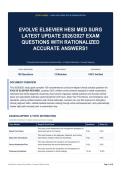
[STUDY GUIDE] • HIGH-YIELD PRACTICE & REVIEW EDITION
EVOLVE ELSEVIER HESI MED SURG
LATEST UPDATE 2026/2027 EXAM
QUESTIONS WITH RATIONALIZED
ACCURATE ANSWERS1
Comprehensive Examination Question Bank • In-Depth Rationales • Concept Mapping
TOTAL QUESTIONS EXAM TOPICS RATIONALES
100 Questions 12 Modules 100% Verified
DOCUMENT OVERVIEW
This 2026/2027 study guide compiles 100 comprehensive curriculum-aligned clinical practice questions for
EVOLVE ELSEVIER HESI MED, coupling 100% verified correct answers alongside in-depth explanatory
rationales that clarify diagnostic reasoning. Each section organizes related questions into focused clinical
topics and specialized subtopics spanning Spinal Cord Injury, Deep Vein Thrombosis, and emergency care
standards, pairing verified solutions with clinical rationales. Learners can use this resource to strengthen
clinical judgment skills, validate bedside decision-making through active self-assessment, and systematically
master high-yield concepts prior to examination day.
EXAM BLUEPRINT & TOPIC DISTRIBUTION
Systematic breakdown of subject domains and exam coverage.
Topic Module Scope & Core Focus Questions Share (%)
This topic covers assessment and management strategies for
Spinal Cord Injury clients with spinal cord injuries. 9 Qs 9.0%
This topic focuses on the diagnosis, treatment, and nursing
Deep Vein Thrombosis interventions related to deep vein thrombosis. 9 Qs 9.0%
This topic addresses the evaluation and management of
Severe Abdominal Pain clients presenting with severe abdominal pain. 8 Qs 8.0%
This topic examines the recognition and management of
Pulmonary Embolism pulmonary embolism in clinical settings. 10 Qs 10.0%
Confidential • Student Study Edition • Practice & Review Guide Page 1 of 49
,STUDENT STUDY & MASTERY EDITION PRACTICE & REVIEW GUIDE
Fluid Management and This topic explores fluid resuscitation techniques and
Resuscitation management of fluid overload in various conditions. 8 Qs 8.0%
This topic focuses on the management of diabetes-related
complications, including hyperglycemia and diabetic
Diabetes Management ketoacidosis. 8 Qs 8.0%
This topic covers the assessment and treatment of clients with
Heart Failure heart failure, including medication management. 8 Qs 8.0%
This topic addresses the assessment and management of
Respiratory Distress clients experiencing respiratory distress. 8 Qs 8.0%
This topic examines nursing considerations and complications
Surgical Care and Complications related to surgical procedures. 8 Qs 8.0%
Acute Conditions and This topic focuses on the management of acute medical
Emergencies conditions and emergencies in nursing practice. 8 Qs 8.0%
This topic covers the interpretation of laboratory results and
Laboratory and Diagnostic Tests their implications for nursing care. 8 Qs 8.0%
Medication Administration and This topic explores the administration of medications and the
Side Effects potential side effects associated with them. 8 Qs 8.0%
Total Exam Coverage 12 Integrated Topic Modules 100 Qs 100.0%
Confidential • Student Study Edition • Practice & Review Guide Page 2 of 49
,STUDENT STUDY & MASTERY EDITION PRACTICE & REVIEW GUIDE
TOPIC 1: SPINAL CORD INJURY
9 Questions • 9.0% of Exam • This topic covers assessment and management strategies for clients with spinal cord injuries.
QUESTION 1
A client is diagnosed with a spinal cord injury at the level of T6. Which assessment
finding is expected?
[A] Paralysis of the upper extremities
[B] Loss of sensation in the lower extremities
[C] Urinary retention
[D] Decreased reflexes in the lower extremities
Correct Answer: B.
Rationale: A spinal cord injury at T6 results in loss of sensation in the lower extremities.
QUESTION 2
A client is diagnosed with a spinal cord injury and is at risk for developing a urinary
tract infection. Which intervention should the nurse implement to prevent this
complication?
[A] Use a urinary catheter with a closed drainage system
[B] Encourage the client to drink plenty of fluids
[C] Perform intermittent catheterization
[D] Use antibiotics prophylactically
Correct Answer: A.
Rationale: Using a closed drainage system reduces the risk of infection.
Confidential • Student Study Edition • Practice & Review Guide Page 3 of 49
, STUDENT STUDY & MASTERY EDITION PRACTICE & REVIEW GUIDE
QUESTION 3
A client with a history of myocardial infarction is prescribed a beta-blocker. Which of
the following is a primary benefit of beta-blocker therapy in this client?
[A] Increased cardiac contractility
[B] Decreased systemic vascular resistance
[C] Reduced myocardial oxygen demand
[D] Enhanced renal function
Correct Answer: C.
Rationale: Beta-blockers reduce myocardial oxygen demand by decreasing heart rate and contractility.
QUESTION 4
A client with a spinal cord injury is at risk for developing autonomic dysreflexia. Which
symptom would indicate the onset of autonomic dysreflexia?
[A] Hypotension
[B] Bradycardia
[C] Headache
[D] Hypertension
Correct Answer: D.
Rationale: Hypertension is a key indicator of autonomic dysreflexia. This condition is a life-threatening emergency.
QUESTION 5
A client is diagnosed with a pituitary tumor and is experiencing symptoms of
hypopituitarism. Which laboratory test result would the nurse expect to find?
[A] Elevated serum cortisol level
[B] Decreased serum thyroid-stimulating hormone (TSH) level
[C] Increased serum growth hormone level
[D] Low serum follicle-stimulating hormone (FSH) level
Correct Answer: B.
Rationale: Hypopituitarism is characterized by decreased hormone production. Decreased TSH levels indicate
hypothyroidism.
Confidential • Student Study Edition • Practice & Review Guide Page 4 of 49
EVOLVE ELSEVIER HESI MED SURG
LATEST UPDATE 2026/2027 EXAM
QUESTIONS WITH RATIONALIZED
ACCURATE ANSWERS1
Comprehensive Examination Question Bank • In-Depth Rationales • Concept Mapping
TOTAL QUESTIONS EXAM TOPICS RATIONALES
100 Questions 12 Modules 100% Verified
DOCUMENT OVERVIEW
This 2026/2027 study guide compiles 100 comprehensive curriculum-aligned clinical practice questions for
EVOLVE ELSEVIER HESI MED, coupling 100% verified correct answers alongside in-depth explanatory
rationales that clarify diagnostic reasoning. Each section organizes related questions into focused clinical
topics and specialized subtopics spanning Spinal Cord Injury, Deep Vein Thrombosis, and emergency care
standards, pairing verified solutions with clinical rationales. Learners can use this resource to strengthen
clinical judgment skills, validate bedside decision-making through active self-assessment, and systematically
master high-yield concepts prior to examination day.
EXAM BLUEPRINT & TOPIC DISTRIBUTION
Systematic breakdown of subject domains and exam coverage.
Topic Module Scope & Core Focus Questions Share (%)
This topic covers assessment and management strategies for
Spinal Cord Injury clients with spinal cord injuries. 9 Qs 9.0%
This topic focuses on the diagnosis, treatment, and nursing
Deep Vein Thrombosis interventions related to deep vein thrombosis. 9 Qs 9.0%
This topic addresses the evaluation and management of
Severe Abdominal Pain clients presenting with severe abdominal pain. 8 Qs 8.0%
This topic examines the recognition and management of
Pulmonary Embolism pulmonary embolism in clinical settings. 10 Qs 10.0%
Confidential • Student Study Edition • Practice & Review Guide Page 1 of 49
,STUDENT STUDY & MASTERY EDITION PRACTICE & REVIEW GUIDE
Fluid Management and This topic explores fluid resuscitation techniques and
Resuscitation management of fluid overload in various conditions. 8 Qs 8.0%
This topic focuses on the management of diabetes-related
complications, including hyperglycemia and diabetic
Diabetes Management ketoacidosis. 8 Qs 8.0%
This topic covers the assessment and treatment of clients with
Heart Failure heart failure, including medication management. 8 Qs 8.0%
This topic addresses the assessment and management of
Respiratory Distress clients experiencing respiratory distress. 8 Qs 8.0%
This topic examines nursing considerations and complications
Surgical Care and Complications related to surgical procedures. 8 Qs 8.0%
Acute Conditions and This topic focuses on the management of acute medical
Emergencies conditions and emergencies in nursing practice. 8 Qs 8.0%
This topic covers the interpretation of laboratory results and
Laboratory and Diagnostic Tests their implications for nursing care. 8 Qs 8.0%
Medication Administration and This topic explores the administration of medications and the
Side Effects potential side effects associated with them. 8 Qs 8.0%
Total Exam Coverage 12 Integrated Topic Modules 100 Qs 100.0%
Confidential • Student Study Edition • Practice & Review Guide Page 2 of 49
,STUDENT STUDY & MASTERY EDITION PRACTICE & REVIEW GUIDE
TOPIC 1: SPINAL CORD INJURY
9 Questions • 9.0% of Exam • This topic covers assessment and management strategies for clients with spinal cord injuries.
QUESTION 1
A client is diagnosed with a spinal cord injury at the level of T6. Which assessment
finding is expected?
[A] Paralysis of the upper extremities
[B] Loss of sensation in the lower extremities
[C] Urinary retention
[D] Decreased reflexes in the lower extremities
Correct Answer: B.
Rationale: A spinal cord injury at T6 results in loss of sensation in the lower extremities.
QUESTION 2
A client is diagnosed with a spinal cord injury and is at risk for developing a urinary
tract infection. Which intervention should the nurse implement to prevent this
complication?
[A] Use a urinary catheter with a closed drainage system
[B] Encourage the client to drink plenty of fluids
[C] Perform intermittent catheterization
[D] Use antibiotics prophylactically
Correct Answer: A.
Rationale: Using a closed drainage system reduces the risk of infection.
Confidential • Student Study Edition • Practice & Review Guide Page 3 of 49
, STUDENT STUDY & MASTERY EDITION PRACTICE & REVIEW GUIDE
QUESTION 3
A client with a history of myocardial infarction is prescribed a beta-blocker. Which of
the following is a primary benefit of beta-blocker therapy in this client?
[A] Increased cardiac contractility
[B] Decreased systemic vascular resistance
[C] Reduced myocardial oxygen demand
[D] Enhanced renal function
Correct Answer: C.
Rationale: Beta-blockers reduce myocardial oxygen demand by decreasing heart rate and contractility.
QUESTION 4
A client with a spinal cord injury is at risk for developing autonomic dysreflexia. Which
symptom would indicate the onset of autonomic dysreflexia?
[A] Hypotension
[B] Bradycardia
[C] Headache
[D] Hypertension
Correct Answer: D.
Rationale: Hypertension is a key indicator of autonomic dysreflexia. This condition is a life-threatening emergency.
QUESTION 5
A client is diagnosed with a pituitary tumor and is experiencing symptoms of
hypopituitarism. Which laboratory test result would the nurse expect to find?
[A] Elevated serum cortisol level
[B] Decreased serum thyroid-stimulating hormone (TSH) level
[C] Increased serum growth hormone level
[D] Low serum follicle-stimulating hormone (FSH) level
Correct Answer: B.
Rationale: Hypopituitarism is characterized by decreased hormone production. Decreased TSH levels indicate
hypothyroidism.
Confidential • Student Study Edition • Practice & Review Guide Page 4 of 49