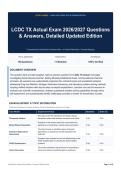
[STUDY GUIDE] • HIGH-YIELD PRACTICE & REVIEW EDITION
LCDC TX Actual Exam 2026/2027 Questions
& Answers, Detailed Updated Edition
Comprehensive Examination Question Bank • In-Depth Rationales • Concept Mapping
TOTAL QUESTIONS EXAM TOPICS RATIONALES
86 Questions 11 Modules 100% Verified
DOCUMENT OVERVIEW
This question bank provides targeted, rigorous practice questions for LCDC TX Actual, thoroughly
investigating Social Security Number, Setting Mutually-Established Goals, and foundational chemical
principles. All questions are systematically organized into coherent topics and specialized subtopics
addressing Drug Use Relative, Michigan Alcoholism Screening, and laboratory problem-solving methods,
coupling verified solutions with step-by-step conceptual explanations. Learners can use this resource to
evaluate core scientific competencies, sharpen quantitative problem-solving capabilities through active
self-assessment, and systematically identify challenging concepts to master for examination success.
EXAM BLUEPRINT & TOPIC DISTRIBUTION
Systematic breakdown of subject domains, clinical competencies, and exam coverage.
Topic Module Scope & Core Focus Questions Share (%)
This topic covers the importance of building a strong
Therapeutic Alliance therapeutic relationship between counselors and clients. 8 Qs 9.3%
Questions in this section assess the components and
Mental Status Examination significance of conducting a mental status examination. 8 Qs 9.3%
This topic focuses on identifying signs of physical
Substance Dependence dependence on substances and the implications for
Assessment treatment. 8 Qs 9.3%
Questions here evaluate the use and effectiveness of the
CAGE questionnaire in screening for alcohol-related
CAGE Questionnaire problems. 8 Qs 9.3%
This section addresses best practices for responding to
Crisis Intervention clients who disclose suicidal thoughts or behaviors. 8 Qs 9.3%
Confidential • Student Study Edition • Practice & Review Guide Page 1 of 45
,STUDENT STUDY & MASTERY EDITION PRACTICE & REVIEW GUIDE
This topic covers the requirements and best practices for
Release of Information preparing a release of information form. 8 Qs 9.3%
Questions in this area focus on the development of effective
Treatment Planning treatment plans based on client assessments. 8 Qs 9.3%
This topic explores the role of family and significant others in
Family Involvement in Treatment the recovery process. 8 Qs 9.3%
Questions here address the complexities of treating clients
Dual Diagnosis Considerations with co-occurring mental health and substance use disorders. 8 Qs 9.3%
This section evaluates research findings on the effectiveness
Research and Effectiveness of of various treatment modalities, including therapeutic
Treatment Models communities. 7 Qs 8.1%
Client Autonomy and This topic emphasizes the importance of client involvement in
Collaboration goal setting and treatment decisions. 7 Qs 8.1%
Total Exam Coverage 11 Integrated Topic Modules 86 Qs 100.0%
Confidential • Student Study Edition • Practice & Review Guide Page 2 of 45
,STUDENT STUDY & MASTERY EDITION PRACTICE & REVIEW GUIDE
TOPIC 1: THERAPEUTIC ALLIANCE
8 Questions • 9.3% of Exam • This topic covers the importance of building a strong therapeutic relationship between counselors and
clients.
QUESTION 1
In establishing a strong therapeutic alliance and a spirit of collaboration between the
counselor and the client, which approach best reflects this goal? The method should
promote shared responsibility and mutual commitment to the treatment plan while
respecting both professional expertise and client autonomy.
[A] Therapist determines all treatment goals without client input
[B] Client determines all treatment goals without therapist input
[C] Therapist and client jointly establish treatment goals
[D] Goals are dictated by insurance guidelines
Correct Answer: Therapist and client jointly establish treatment goals.
Rationale: Jointly establishing goals enhances alliance by ensuring both parties are invested and share responsibility for
outcomes.
QUESTION 2
A counselor seeks to strengthen the therapeutic alliance and promote collaboration
with a client. The counselor wants the client to feel heard, participate in treatment
planning, and perceive the relationship as a partnership rather than a hierarchy. Which
of the following strategies most directly supports this goal according to LCDC TX
guidelines?
[A] Setting mutually-established goals
[B] Using confrontational techniques
[C] Providing only clinician-directed treatment plan
[D] Limiting client input
Correct Answer: Setting mutually-established goals.
Rationale: Mutually-established goals involve the client in planning, enhancing trust and collaboration, which is the core
method for reinforcing the therapeutic alliance.
Confidential • Student Study Edition • Practice & Review Guide Page 3 of 45
, STUDENT STUDY & MASTERY EDITION PRACTICE & REVIEW GUIDE
QUESTION 3
A counselor is meeting with a new client who has expressed skepticism about
treatment. To strengthen the therapeutic alliance and promote collaboration, the
counselor decides to use a specific technique that involves both parties agreeing on
the direction of therapy. Which of the following actions best exemplifies this
technique?
[A] Providing the client with a detailed treatment plan without client input
[B] Setting mutually-established goals with the client at the outset of therapy
[C] Assigning homework that the client must complete before the next session
[D] Focusing solely on the counselor's preferred therapeutic model
Correct Answer: Setting mutually-established goals with the client at the outset of therapy.
Rationale: Collaboratively creating goals directly reinforces alliance and encourages client ownership of the treatment
process, fostering a spirit of partnership.
QUESTION 4
In establishing a strong therapeutic alliance, counselors often use a specific
collaborative technique that involves both client and therapist agreeing on treatment
direction. Which of the following best describes this method?
[A] Setting mutually-established goals
[B] Providing extensive psychoeducation at the outset
[C] Conducting a lengthy intake interview
[D] Using confrontational techniques to challenge the client
Correct Answer: Setting mutually-established goals.
Rationale: Mutually-established goals create shared purpose, enhancing collaboration and strengthening the therapeutic
alliance between counselor and client.
Confidential • Student Study Edition • Practice & Review Guide Page 4 of 45
LCDC TX Actual Exam 2026/2027 Questions
& Answers, Detailed Updated Edition
Comprehensive Examination Question Bank • In-Depth Rationales • Concept Mapping
TOTAL QUESTIONS EXAM TOPICS RATIONALES
86 Questions 11 Modules 100% Verified
DOCUMENT OVERVIEW
This question bank provides targeted, rigorous practice questions for LCDC TX Actual, thoroughly
investigating Social Security Number, Setting Mutually-Established Goals, and foundational chemical
principles. All questions are systematically organized into coherent topics and specialized subtopics
addressing Drug Use Relative, Michigan Alcoholism Screening, and laboratory problem-solving methods,
coupling verified solutions with step-by-step conceptual explanations. Learners can use this resource to
evaluate core scientific competencies, sharpen quantitative problem-solving capabilities through active
self-assessment, and systematically identify challenging concepts to master for examination success.
EXAM BLUEPRINT & TOPIC DISTRIBUTION
Systematic breakdown of subject domains, clinical competencies, and exam coverage.
Topic Module Scope & Core Focus Questions Share (%)
This topic covers the importance of building a strong
Therapeutic Alliance therapeutic relationship between counselors and clients. 8 Qs 9.3%
Questions in this section assess the components and
Mental Status Examination significance of conducting a mental status examination. 8 Qs 9.3%
This topic focuses on identifying signs of physical
Substance Dependence dependence on substances and the implications for
Assessment treatment. 8 Qs 9.3%
Questions here evaluate the use and effectiveness of the
CAGE questionnaire in screening for alcohol-related
CAGE Questionnaire problems. 8 Qs 9.3%
This section addresses best practices for responding to
Crisis Intervention clients who disclose suicidal thoughts or behaviors. 8 Qs 9.3%
Confidential • Student Study Edition • Practice & Review Guide Page 1 of 45
,STUDENT STUDY & MASTERY EDITION PRACTICE & REVIEW GUIDE
This topic covers the requirements and best practices for
Release of Information preparing a release of information form. 8 Qs 9.3%
Questions in this area focus on the development of effective
Treatment Planning treatment plans based on client assessments. 8 Qs 9.3%
This topic explores the role of family and significant others in
Family Involvement in Treatment the recovery process. 8 Qs 9.3%
Questions here address the complexities of treating clients
Dual Diagnosis Considerations with co-occurring mental health and substance use disorders. 8 Qs 9.3%
This section evaluates research findings on the effectiveness
Research and Effectiveness of of various treatment modalities, including therapeutic
Treatment Models communities. 7 Qs 8.1%
Client Autonomy and This topic emphasizes the importance of client involvement in
Collaboration goal setting and treatment decisions. 7 Qs 8.1%
Total Exam Coverage 11 Integrated Topic Modules 86 Qs 100.0%
Confidential • Student Study Edition • Practice & Review Guide Page 2 of 45
,STUDENT STUDY & MASTERY EDITION PRACTICE & REVIEW GUIDE
TOPIC 1: THERAPEUTIC ALLIANCE
8 Questions • 9.3% of Exam • This topic covers the importance of building a strong therapeutic relationship between counselors and
clients.
QUESTION 1
In establishing a strong therapeutic alliance and a spirit of collaboration between the
counselor and the client, which approach best reflects this goal? The method should
promote shared responsibility and mutual commitment to the treatment plan while
respecting both professional expertise and client autonomy.
[A] Therapist determines all treatment goals without client input
[B] Client determines all treatment goals without therapist input
[C] Therapist and client jointly establish treatment goals
[D] Goals are dictated by insurance guidelines
Correct Answer: Therapist and client jointly establish treatment goals.
Rationale: Jointly establishing goals enhances alliance by ensuring both parties are invested and share responsibility for
outcomes.
QUESTION 2
A counselor seeks to strengthen the therapeutic alliance and promote collaboration
with a client. The counselor wants the client to feel heard, participate in treatment
planning, and perceive the relationship as a partnership rather than a hierarchy. Which
of the following strategies most directly supports this goal according to LCDC TX
guidelines?
[A] Setting mutually-established goals
[B] Using confrontational techniques
[C] Providing only clinician-directed treatment plan
[D] Limiting client input
Correct Answer: Setting mutually-established goals.
Rationale: Mutually-established goals involve the client in planning, enhancing trust and collaboration, which is the core
method for reinforcing the therapeutic alliance.
Confidential • Student Study Edition • Practice & Review Guide Page 3 of 45
, STUDENT STUDY & MASTERY EDITION PRACTICE & REVIEW GUIDE
QUESTION 3
A counselor is meeting with a new client who has expressed skepticism about
treatment. To strengthen the therapeutic alliance and promote collaboration, the
counselor decides to use a specific technique that involves both parties agreeing on
the direction of therapy. Which of the following actions best exemplifies this
technique?
[A] Providing the client with a detailed treatment plan without client input
[B] Setting mutually-established goals with the client at the outset of therapy
[C] Assigning homework that the client must complete before the next session
[D] Focusing solely on the counselor's preferred therapeutic model
Correct Answer: Setting mutually-established goals with the client at the outset of therapy.
Rationale: Collaboratively creating goals directly reinforces alliance and encourages client ownership of the treatment
process, fostering a spirit of partnership.
QUESTION 4
In establishing a strong therapeutic alliance, counselors often use a specific
collaborative technique that involves both client and therapist agreeing on treatment
direction. Which of the following best describes this method?
[A] Setting mutually-established goals
[B] Providing extensive psychoeducation at the outset
[C] Conducting a lengthy intake interview
[D] Using confrontational techniques to challenge the client
Correct Answer: Setting mutually-established goals.
Rationale: Mutually-established goals create shared purpose, enhancing collaboration and strengthening the therapeutic
alliance between counselor and client.
Confidential • Student Study Edition • Practice & Review Guide Page 4 of 45