
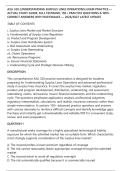
ASLI 320 (UNDERSTANDING SURPLUS LINES OPERATIONS) EXAM PRACTICE —
ACTUAL STUDY GUIDE, FULL TESTBANK, 150+ PRACTICE QUESTIONS & 100%
CORRECT ANSWERS WITH RATIONALES — 2026/2027 LATEST UPDATE
TABLE OF CONTENTS
i. Surplus Lines Market and Market Structure
ii. Fundamentals of Surplus Lines Regulation
iii. Product and Program Development
iv. Surplus Lines Distribution System
v. Risk Assessment and Underwriting
vi. Surplus Lines Ratemaking
vii. Claims Operations
viii. Reinsurance Programs
ix. Insurer Financial Statements
x. Underwriting Cycle and Strategic Decision-Making
DESCRIPTION
This comprehensive ASLI 320 practice examination is designed for students
preparing for Understanding Surplus Lines Operations and advanced professional
study in surplus lines insurance. It covers the surplus lines market, regulation,
product and program development, distribution, underwriting, risk assessment,
ratemaking, claims, reinsurance, insurer financial statements, and the underwriting
cycle. The questions emphasize application, analysis, professional judgment,
regulatory interpretation, calculations, and realistic insurance scenarios rather than
simple memorization. It contains 100+ advanced practice questions and answers
with concise rationales to reinforce difficult concepts and identify knowledge gaps.
Purchase and instantly get a downloadable and editable PDF for convenient study,
review, and exam preparation.
QUESTION 1
A manufacturer seeks coverage for a highly specialized technological liability
exposure for which the admitted market has no suitable form. Which characteristic
most strongly supports consideration of the surplus lines market?
A. The insured prefers a lower premium regardless of coverage
B. The risk cannot reasonably obtain appropriate coverage through the admitted
market
C. The insured wants to avoid all regulatory oversight
D. The risk automatically qualifies because it is commercially insured
,🔴 Correct Answer: B. The risk cannot reasonably obtain appropriate coverage
through the admitted market.
🔵 Explanation: Surplus lines insurance is designed to address risks for which
appropriate coverage may be unavailable or difficult to obtain in the admitted
market. The fundamental purpose is to provide capacity and coverage flexibility for
unusual, specialized, or otherwise hard-to-place risks.
QUESTION 2
Which statement best explains why surplus lines insurers are commonly described
as nonadmitted insurers?
A. They are not subject to any insurance regulation
B. They are prohibited from conducting insurance business
C. They are not authorized to transact insurance in the particular jurisdiction
through the standard admitted process
D. They operate exclusively outside the United States
🔴 Correct Answer: C. They are not authorized to transact insurance in the
particular jurisdiction through the standard admitted process.
🔵 Explanation: Nonadmitted status refers to the insurer's authorization status in a
jurisdiction. It does not mean that the insurer is unregulated or necessarily located
outside the United States.
QUESTION 3
An insured has a complex risk involving emerging technology and rapidly
changing loss exposures. The retail producer cannot locate an appropriate
admitted policy. What is the most appropriate next consideration?
A. Place the risk immediately with any nonadmitted insurer
B. Determine whether applicable surplus lines eligibility requirements are satisfied
C. Remove all exclusions from the admitted policy
D. Assume that surplus lines coverage is automatically permissible
🔴 Correct Answer: B. Determine whether applicable surplus lines eligibility
requirements are satisfied.
🔵 Explanation: Surplus lines placement is subject to applicable eligibility,
regulatory, and placement requirements. The inability to find appropriate admitted
coverage is an important consideration but does not eliminate compliance
obligations.
QUESTION 4
,A surplus lines market exists primarily because conventional admitted markets
may be unable or unwilling to provide adequate coverage for certain risks. Which
market function follows most directly from this characteristic?
A. Elimination of underwriting uncertainty
B. Expansion of available insurance capacity and coverage solutions
C. Elimination of insurance regulation
D. Guarantee of lower premiums
🔴 Correct Answer: B. Expansion of available insurance capacity and coverage
solutions.
🔵 Explanation: The surplus lines market provides an alternative source of capacity
for difficult, unusual, emerging, or specialized exposures. It does not guarantee lower
premiums or eliminate underwriting uncertainty.
QUESTION 5
An insurer develops a policy specifically for an emerging liability exposure that
admitted insurers have historically excluded. Which surplus lines function is most
directly illustrated?
A. Product innovation
B. Loss reserving
C. Financial reporting
D. Claims auditing
🔴 Correct Answer: A. Product innovation.
🔵 Explanation: Surplus lines insurers often have greater flexibility to develop
specialized products for emerging or unusual exposures. Product innovation can help
address coverage gaps in the conventional market.
QUESTION 6
Which characteristic is most consistent with a surplus lines risk?
A. Highly standardized exposure with abundant admitted capacity
B. Unusual exposure requiring specialized underwriting
C. Risk that automatically qualifies solely because the insured is wealthy
D. Risk for which the insured refuses to provide underwriting information
🔴 Correct Answer: B. Unusual exposure requiring specialized underwriting.
🔵 Explanation: Surplus lines commonly serve specialized or difficult-to-place risks
, requiring customized underwriting analysis. Financial size alone does not determine
surplus lines eligibility.
QUESTION 7
A producer tells an insured that surplus lines coverage is always superior because
it offers broader coverage than admitted insurance. What is the principal problem
with this statement?
A. Surplus lines insurers cannot provide broad coverage
B. Coverage breadth depends on the specific policy and risk, not merely the
insurer's market status
C. Admitted insurers cannot customize coverage
D. Surplus lines policies are legally required to be narrower
🔴 Correct Answer: B. Coverage breadth depends on the specific policy and
risk, not merely the insurer's market status.
🔵 Explanation: Surplus lines policies can be highly customized, but neither
admitted nor nonadmitted status automatically determines whether coverage is
broader or narrower.
QUESTION 8
A surplus lines insurer agrees to write a highly specialized risk after reviewing
information that indicates substantial uncertainty regarding expected losses.
Which underwriting principle is most relevant?
A. Greater uncertainty generally requires more sophisticated risk selection and
pricing
B. Uncertainty eliminates the need for underwriting
C. Uncertainty guarantees a profitable account
D. Uncertainty makes loss control irrelevant
🔴 Correct Answer: A. Greater uncertainty generally requires more
sophisticated risk selection and pricing.
🔵 Explanation: Specialized risks frequently contain limited or imperfect historical
data. Underwriters therefore need to evaluate exposure characteristics, uncertainty,
controls, trends, and available data carefully.
QUESTION 9
Why is the surplus lines market particularly important for emerging risks?
ACTUAL STUDY GUIDE, FULL TESTBANK, 150+ PRACTICE QUESTIONS & 100%
CORRECT ANSWERS WITH RATIONALES — 2026/2027 LATEST UPDATE
TABLE OF CONTENTS
i. Surplus Lines Market and Market Structure
ii. Fundamentals of Surplus Lines Regulation
iii. Product and Program Development
iv. Surplus Lines Distribution System
v. Risk Assessment and Underwriting
vi. Surplus Lines Ratemaking
vii. Claims Operations
viii. Reinsurance Programs
ix. Insurer Financial Statements
x. Underwriting Cycle and Strategic Decision-Making
DESCRIPTION
This comprehensive ASLI 320 practice examination is designed for students
preparing for Understanding Surplus Lines Operations and advanced professional
study in surplus lines insurance. It covers the surplus lines market, regulation,
product and program development, distribution, underwriting, risk assessment,
ratemaking, claims, reinsurance, insurer financial statements, and the underwriting
cycle. The questions emphasize application, analysis, professional judgment,
regulatory interpretation, calculations, and realistic insurance scenarios rather than
simple memorization. It contains 100+ advanced practice questions and answers
with concise rationales to reinforce difficult concepts and identify knowledge gaps.
Purchase and instantly get a downloadable and editable PDF for convenient study,
review, and exam preparation.
QUESTION 1
A manufacturer seeks coverage for a highly specialized technological liability
exposure for which the admitted market has no suitable form. Which characteristic
most strongly supports consideration of the surplus lines market?
A. The insured prefers a lower premium regardless of coverage
B. The risk cannot reasonably obtain appropriate coverage through the admitted
market
C. The insured wants to avoid all regulatory oversight
D. The risk automatically qualifies because it is commercially insured
,🔴 Correct Answer: B. The risk cannot reasonably obtain appropriate coverage
through the admitted market.
🔵 Explanation: Surplus lines insurance is designed to address risks for which
appropriate coverage may be unavailable or difficult to obtain in the admitted
market. The fundamental purpose is to provide capacity and coverage flexibility for
unusual, specialized, or otherwise hard-to-place risks.
QUESTION 2
Which statement best explains why surplus lines insurers are commonly described
as nonadmitted insurers?
A. They are not subject to any insurance regulation
B. They are prohibited from conducting insurance business
C. They are not authorized to transact insurance in the particular jurisdiction
through the standard admitted process
D. They operate exclusively outside the United States
🔴 Correct Answer: C. They are not authorized to transact insurance in the
particular jurisdiction through the standard admitted process.
🔵 Explanation: Nonadmitted status refers to the insurer's authorization status in a
jurisdiction. It does not mean that the insurer is unregulated or necessarily located
outside the United States.
QUESTION 3
An insured has a complex risk involving emerging technology and rapidly
changing loss exposures. The retail producer cannot locate an appropriate
admitted policy. What is the most appropriate next consideration?
A. Place the risk immediately with any nonadmitted insurer
B. Determine whether applicable surplus lines eligibility requirements are satisfied
C. Remove all exclusions from the admitted policy
D. Assume that surplus lines coverage is automatically permissible
🔴 Correct Answer: B. Determine whether applicable surplus lines eligibility
requirements are satisfied.
🔵 Explanation: Surplus lines placement is subject to applicable eligibility,
regulatory, and placement requirements. The inability to find appropriate admitted
coverage is an important consideration but does not eliminate compliance
obligations.
QUESTION 4
,A surplus lines market exists primarily because conventional admitted markets
may be unable or unwilling to provide adequate coverage for certain risks. Which
market function follows most directly from this characteristic?
A. Elimination of underwriting uncertainty
B. Expansion of available insurance capacity and coverage solutions
C. Elimination of insurance regulation
D. Guarantee of lower premiums
🔴 Correct Answer: B. Expansion of available insurance capacity and coverage
solutions.
🔵 Explanation: The surplus lines market provides an alternative source of capacity
for difficult, unusual, emerging, or specialized exposures. It does not guarantee lower
premiums or eliminate underwriting uncertainty.
QUESTION 5
An insurer develops a policy specifically for an emerging liability exposure that
admitted insurers have historically excluded. Which surplus lines function is most
directly illustrated?
A. Product innovation
B. Loss reserving
C. Financial reporting
D. Claims auditing
🔴 Correct Answer: A. Product innovation.
🔵 Explanation: Surplus lines insurers often have greater flexibility to develop
specialized products for emerging or unusual exposures. Product innovation can help
address coverage gaps in the conventional market.
QUESTION 6
Which characteristic is most consistent with a surplus lines risk?
A. Highly standardized exposure with abundant admitted capacity
B. Unusual exposure requiring specialized underwriting
C. Risk that automatically qualifies solely because the insured is wealthy
D. Risk for which the insured refuses to provide underwriting information
🔴 Correct Answer: B. Unusual exposure requiring specialized underwriting.
🔵 Explanation: Surplus lines commonly serve specialized or difficult-to-place risks
, requiring customized underwriting analysis. Financial size alone does not determine
surplus lines eligibility.
QUESTION 7
A producer tells an insured that surplus lines coverage is always superior because
it offers broader coverage than admitted insurance. What is the principal problem
with this statement?
A. Surplus lines insurers cannot provide broad coverage
B. Coverage breadth depends on the specific policy and risk, not merely the
insurer's market status
C. Admitted insurers cannot customize coverage
D. Surplus lines policies are legally required to be narrower
🔴 Correct Answer: B. Coverage breadth depends on the specific policy and
risk, not merely the insurer's market status.
🔵 Explanation: Surplus lines policies can be highly customized, but neither
admitted nor nonadmitted status automatically determines whether coverage is
broader or narrower.
QUESTION 8
A surplus lines insurer agrees to write a highly specialized risk after reviewing
information that indicates substantial uncertainty regarding expected losses.
Which underwriting principle is most relevant?
A. Greater uncertainty generally requires more sophisticated risk selection and
pricing
B. Uncertainty eliminates the need for underwriting
C. Uncertainty guarantees a profitable account
D. Uncertainty makes loss control irrelevant
🔴 Correct Answer: A. Greater uncertainty generally requires more
sophisticated risk selection and pricing.
🔵 Explanation: Specialized risks frequently contain limited or imperfect historical
data. Underwriters therefore need to evaluate exposure characteristics, uncertainty,
controls, trends, and available data carefully.
QUESTION 9
Why is the surplus lines market particularly important for emerging risks?

