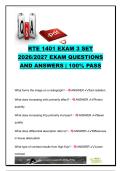
This RTE 1401 Exam 3 Set 2026/2027 study resource contains 100+ exam-style questions with answers focused on radiographic exposure, image formation and image-quality principles. Across 11 pages, the material covers mAs and photon quantity, kVp and beam quality, differential absorption, radiographic contrast, quantum noise, scatter radiation, collimation, grids, SID, OID, magnification, spatial resolution, focal-spot size, patient dose and exposure technique. The cover page identifies the document as an RTE 1401 Exam 3 Set for the 2026/2027 academic period.
The exposure-factor questions establish the relationships among mAs, kVp and receptor exposure. According to the document, increasing mAs increases photon quantity and receptor exposure, while insufficient mAs can produce quantum noise or a grainy image. Increasing kVp primarily increases beam quality and penetration, while higher-kVp techniques are associated with a longer scale and lower subject contrast. The resource repeatedly reinforces that mAs controls beam quantity while kVp controls beam quality.
A major portion examines scatter radiation and contrast control. Compton interaction is identified as the principal source of scatter, while increased field size, greater part thickness and higher kVp are associated with increased scatter production. Scatter reaching the image receptor produces fog and reduces contrast, potentially making pathology more difficult to visualize. Collimation is repeatedly identified as an effective method of limiting scatter production, improving contrast and reducing patient exposure, while grids improve image quality by absorbing scatter but require increased exposure.
The document also provides concentrated revision of radiographic geometry and spatial resolution. Increasing OID is associated with greater magnification, reduced detail and increased distortion risk, whereas increasing SID decreases magnification and can improve recorded detail. Smaller focal spots improve spatial resolution, while larger focal spots reduce detail. Shape distortion is connected with misalignment of the central ray, anatomical part and image receptor, and proper alignment is identified as the corrective principle.
The image formation and differential absorption questions explain that exit radiation reaching the image receptor forms the radiographic image and that differences in tissue attenuation create visible contrast. The material contrasts high-contrast images with fewer shades of gray and low-contrast images with a longer gray scale, while relating these appearances to kVp, scatter and anatomical visualization. High-contrast imaging is associated in the document with bone detail, whereas lower-contrast imaging is linked with visualization of soft-tissue differences.
The later pages integrate these concepts with patient thickness, dose and image optimization. Thicker body parts increase attenuation and Compton scatter and may require higher exposure factors. Increased mAs increases radiation dose but improves signal-to-noise ratio and reduces quantum noise, while increased field size increases both scatter and patient exposure. The document concludes by emphasizing proper exposure and scatter control as central determinants of overall radiographic image quality.
Relevant Students: This document is particularly relevant to students enrolled in RTE 1401 or equivalent radiographic physics and imaging courses, especially radiography and radiologic technology students preparing for Exam 3 in 2026/2027. It is useful for targeted revision of exposure factors, scatter control, radiographic contrast, image geometry, spatial resolution, differential absorption and patient-dose concepts. The uploaded document does not identify a university or college, so no institution has been assigned without source evidence.
Keywords: RTE 1401 Exam 3, RTE 1401 Exam 3 Set, RTE , RTE 1401 questions and answers, radiographic physics Exam 3, radiography exam questions, radiologic technology exam, mAs radiography, kVp radiography, photon quantity, beam quality, radiographic contrast, differential absorption, exit radiation, receptor exposure, quantum noise, radiographic noise, scatter radiation, Compton scatter, scatter control, collimation radiography, radiographic grids, patient radiation dose, spatial resolution, focal spot size, SID radiography, OID radiography, radiographic magnification, size distortion, shape distortion, image quality radiography, long scale contrast, short scale contrast, field size radiography, patient thickness attenuation, signal to noise ratio, radiography practice questions, radiologic technology study guide
Vista previa del contenido
RTE 1401 EXAM 3 SET
2026/2027 EXAM QUESTIONS
AND ANSWERS | 100% PASS
What forms the image on a radiograph? - ANSWER ✔✔Exit radiation
What does increasing mAs primarily affect? - ANSWER ✔✔Photon
quantity
What does increasing kVp primarily increase? - ANSWER ✔✔Beam
quality
What does differential absorption refer to? - ANSWER ✔✔Differences
in tissue attenuation
What type of contrast results from high kVp? - ANSWER ✔✔Lower
contrast
, What may low mAs result in? - ANSWER ✔✔Quantum noise
What causes quantum noise? - ANSWER ✔✔Insufficient photons
reaching the IR
What does increasing OID cause? - ANSWER ✔✔Increased
magnification
What most improves spatial resolution? - ANSWER ✔✔Smaller focal
spot
What does scatter radiation primarily affect? - ANSWER ✔✔Contrast
What is the most effective way to reduce scatter? - ANSWER
✔✔Collimation
How do grids improve image quality? - ANSWER ✔✔By absorbing
scatter
What exposure adjustment is required when using a grid? - ANSWER
✔✔Increased mAs
What does increasing field size cause? - ANSWER ✔✔Increased
scatter
Which exposure factor most influences contrast? - ANSWER ✔✔kVp