
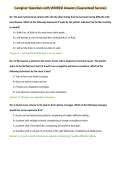
Caregiver Questions with VERIFIED Answers (Guaranteed Success)
Q1: The post hysterectomy patient with calls the clinic stating that she has been having difficulty with
incontinence. Which of the following statements if made by the patient, indicates that further teaching
is needed?
A. I drink 8 oz. of fluid on the even hours while awake.
B. I will attempt to void 30 minutes after drinking 200 cc. of fluid
C. I will only drink fluid when I eat my meals
D. I will set the timer to remind me when to void.
Answer: C. I will only drink fluid when I eat my meals
Q2: An RN assesses a patient in the Cancer Center with a diagnosis of terminal cancer. The patient
states to the RN that he is short of breath, has no appetite and hurts everywhere. Which of the
following statements by the nurse is best?
A. Tell me how your family is coping
B. Show me where it does not hurt
C. I'll teach you relaxation techniques
D. Your physician should increase your pain medication.
Answer: C. I'll teach you relaxation techniques
Q3: A clinical nurse returns to the desk to find 4 phone messages. Which of the following messages
should the nurse respond to first?
A. A post cervical laminectomy patient complaining of sudden difficulty talking.
B. A patient with multiple sclerosis complaining of change in peripheral vision.
C. A patient with a herniated disc complaining of consistent back pain.
D. A patient with a cast due to a fracture of the right tibial bone complaining of tingling toes..
Answer: A. A post cervical laminectomy patient complaining of sudden difficulty talking.
,Q4: A 75 year old patient complains to the clinical nurse that he is having difficulty sleeping. Which of
the following actions by the nurse is most appropriate?
A. Determine the patient's usual sleeping and waking patterns.
B. Suggest that the client abstain from alcohol and caffeine before bed time.
C. Recommend that client establish a bedtime routine.
D. Ask how much sleep the client required before retirement..
Answer: A. Determine the patient's usual sleeping and waking patterns.
Q5: The nurse cares for a patient several hours after a thyroidectomy. The RN observes that the patient
is diaphoretic and confused. The vital signs are: Temp = 102° (38.9 ° C); BP is 160/90; pulse is 110,
respiration is 22. The nurse expects the physician to order which of the following?
A. NPO, Dextran 10 ml/kg. IV, 02 4 L/min.
B. Propranolol (Inderal) 1 mg. IV, D5W 125 cc/hr IV, propylthiaouracil (PTU) 200 mg po qld.
C. Levothyroxine Sodium (Synthroid) 100 mcg IV, Lactated Ringer's 125 cc/hr IV, and ciprofloxacin
(cipro) 500 mg. po bid.
D. Morphine sulfate 2.5 mg. IV q. 4 hrs. prn, 0.9% NACl..
Answer: B. Propranolol (Inderal) 1 mg. IV, D5W 125 cc/hr IV, propylthiaouracil (PTU) 200 mg po qld.
Q6: A 63 year old female patient contacts the clinic to report that she is has been extremely fatigued, is
sleeping 12 hours a night, is always cold and her hair is falling out. Which of the following responses by
the nurse is most appropriate?
A. You will have more energy if you walk 30 min every day.
B. You don't need to worry. Sleeping a lot is good for you.
C. Come in and see your health care provider today.
D. You should eat more green leafy vegetables..
Answer: C. Come in and see your health care provider today.
,Q7: The RN performs blood pressure screening at the local community center. Which of the following
individuals is most likely to suffer from a cerebrovascular accident?
A. A 30 year old man who is an account executive
B. A 40 year old man who jogs four times a week.
C. A 60 year old man whose father had a stroke.
D. A 75 year old man who takes multi-vitamins..
Answer: C. A 60 year old man whose father had a stroke.
Q8: For the patient with a new tracheostomy, the nurse must be alert to which early complication?
A. Decannulation
B. Infection
C. Bleeding
D. Tracheomalacia.
Answer: C. Bleeding
Q9: When a pulse oximetry monitor indicates that a patient has a drop in SpO2 from 96% to 85% over 4
hours, the nurse will first: 1. Request an order for stat ABGs 2. Start the patient on oxygen by NC at
2L/minute 3. Notify the physician of the change 4. Check the position of the probe on patient's finger
or earlobe.
Answer: 4 Pulse oximetry is inaccurate if the probe is loose, or in the presence of poor circulation, nail
polish, or dark skin pigmentation.
Q10: To decrease a patient's shortness of breath and a sense of impending doom during an asthma
attack, the nurse will:
A. Place the patient on a cardiac monitor and observe from the nurses' station.
B. Let the patient rest alone in a quiet, calm environment.
C. Reassure the patient that the doctor will arrive soon
D. Stay with the patient and encourage pursed-lip breathing..
Answer: D. Stay with the patient and encourage pursed-lip breathing..
, Q11: A 68 year old woman is admitted to the surgical unit after a gastric resection for gastric cancer.
She states that she doesn't want anyone to see her in this condition, even her husband. This nurse's
best response is:
A. "Patients' rights protect your privacy. I won't allow anyone in."
B. "I've seen gastric cancer patients who look much worse. Don't worry."
C. "Would you like to talk to a social worker?"
D. "What about your condition worries you?".
Answer: D. "What about your condition worries you?".
Q12: A patient with a tricuspid valve disorder will have impaired blood flow between the:
A. Vena cava and right atrium
B. Left atrium and left ventricle
C. Right atrium and right ventricle
D. Right ventricle and pulmonary artery.
Answer: C. Right atrium and right ventricle
Q13: If the Purkinje system is damaged, conduction of the electrical impulse is impaired through the:
A. Atria
B. AV node
C. Ventricles
D. Bundle of His.
Answer: C. Ventricles
Q14: The P-wave on an EKG is representative of:
A. Ventricular depolarization
B. Atrial depolarization
C. Atrial repolarization
D. Ventricular repolarization.
Answer: B. Atrial depolarization
Q1: The post hysterectomy patient with calls the clinic stating that she has been having difficulty with
incontinence. Which of the following statements if made by the patient, indicates that further teaching
is needed?
A. I drink 8 oz. of fluid on the even hours while awake.
B. I will attempt to void 30 minutes after drinking 200 cc. of fluid
C. I will only drink fluid when I eat my meals
D. I will set the timer to remind me when to void.
Answer: C. I will only drink fluid when I eat my meals
Q2: An RN assesses a patient in the Cancer Center with a diagnosis of terminal cancer. The patient
states to the RN that he is short of breath, has no appetite and hurts everywhere. Which of the
following statements by the nurse is best?
A. Tell me how your family is coping
B. Show me where it does not hurt
C. I'll teach you relaxation techniques
D. Your physician should increase your pain medication.
Answer: C. I'll teach you relaxation techniques
Q3: A clinical nurse returns to the desk to find 4 phone messages. Which of the following messages
should the nurse respond to first?
A. A post cervical laminectomy patient complaining of sudden difficulty talking.
B. A patient with multiple sclerosis complaining of change in peripheral vision.
C. A patient with a herniated disc complaining of consistent back pain.
D. A patient with a cast due to a fracture of the right tibial bone complaining of tingling toes..
Answer: A. A post cervical laminectomy patient complaining of sudden difficulty talking.
,Q4: A 75 year old patient complains to the clinical nurse that he is having difficulty sleeping. Which of
the following actions by the nurse is most appropriate?
A. Determine the patient's usual sleeping and waking patterns.
B. Suggest that the client abstain from alcohol and caffeine before bed time.
C. Recommend that client establish a bedtime routine.
D. Ask how much sleep the client required before retirement..
Answer: A. Determine the patient's usual sleeping and waking patterns.
Q5: The nurse cares for a patient several hours after a thyroidectomy. The RN observes that the patient
is diaphoretic and confused. The vital signs are: Temp = 102° (38.9 ° C); BP is 160/90; pulse is 110,
respiration is 22. The nurse expects the physician to order which of the following?
A. NPO, Dextran 10 ml/kg. IV, 02 4 L/min.
B. Propranolol (Inderal) 1 mg. IV, D5W 125 cc/hr IV, propylthiaouracil (PTU) 200 mg po qld.
C. Levothyroxine Sodium (Synthroid) 100 mcg IV, Lactated Ringer's 125 cc/hr IV, and ciprofloxacin
(cipro) 500 mg. po bid.
D. Morphine sulfate 2.5 mg. IV q. 4 hrs. prn, 0.9% NACl..
Answer: B. Propranolol (Inderal) 1 mg. IV, D5W 125 cc/hr IV, propylthiaouracil (PTU) 200 mg po qld.
Q6: A 63 year old female patient contacts the clinic to report that she is has been extremely fatigued, is
sleeping 12 hours a night, is always cold and her hair is falling out. Which of the following responses by
the nurse is most appropriate?
A. You will have more energy if you walk 30 min every day.
B. You don't need to worry. Sleeping a lot is good for you.
C. Come in and see your health care provider today.
D. You should eat more green leafy vegetables..
Answer: C. Come in and see your health care provider today.
,Q7: The RN performs blood pressure screening at the local community center. Which of the following
individuals is most likely to suffer from a cerebrovascular accident?
A. A 30 year old man who is an account executive
B. A 40 year old man who jogs four times a week.
C. A 60 year old man whose father had a stroke.
D. A 75 year old man who takes multi-vitamins..
Answer: C. A 60 year old man whose father had a stroke.
Q8: For the patient with a new tracheostomy, the nurse must be alert to which early complication?
A. Decannulation
B. Infection
C. Bleeding
D. Tracheomalacia.
Answer: C. Bleeding
Q9: When a pulse oximetry monitor indicates that a patient has a drop in SpO2 from 96% to 85% over 4
hours, the nurse will first: 1. Request an order for stat ABGs 2. Start the patient on oxygen by NC at
2L/minute 3. Notify the physician of the change 4. Check the position of the probe on patient's finger
or earlobe.
Answer: 4 Pulse oximetry is inaccurate if the probe is loose, or in the presence of poor circulation, nail
polish, or dark skin pigmentation.
Q10: To decrease a patient's shortness of breath and a sense of impending doom during an asthma
attack, the nurse will:
A. Place the patient on a cardiac monitor and observe from the nurses' station.
B. Let the patient rest alone in a quiet, calm environment.
C. Reassure the patient that the doctor will arrive soon
D. Stay with the patient and encourage pursed-lip breathing..
Answer: D. Stay with the patient and encourage pursed-lip breathing..
, Q11: A 68 year old woman is admitted to the surgical unit after a gastric resection for gastric cancer.
She states that she doesn't want anyone to see her in this condition, even her husband. This nurse's
best response is:
A. "Patients' rights protect your privacy. I won't allow anyone in."
B. "I've seen gastric cancer patients who look much worse. Don't worry."
C. "Would you like to talk to a social worker?"
D. "What about your condition worries you?".
Answer: D. "What about your condition worries you?".
Q12: A patient with a tricuspid valve disorder will have impaired blood flow between the:
A. Vena cava and right atrium
B. Left atrium and left ventricle
C. Right atrium and right ventricle
D. Right ventricle and pulmonary artery.
Answer: C. Right atrium and right ventricle
Q13: If the Purkinje system is damaged, conduction of the electrical impulse is impaired through the:
A. Atria
B. AV node
C. Ventricles
D. Bundle of His.
Answer: C. Ventricles
Q14: The P-wave on an EKG is representative of:
A. Ventricular depolarization
B. Atrial depolarization
C. Atrial repolarization
D. Ventricular repolarization.
Answer: B. Atrial depolarization

