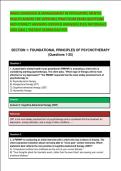
NR605 DIAGNOSIS & MANAGEMENT IN PSYCHIATRIC MENTAL
HEALTH ACROSS THE LIFESPAN I PRACTICUM EXAM QUESTIONS
AND CORRECT ANSWERS (VERIFIED ANSWERS) PLUS RATIONALES
2026 Q&A | INSTANT DOWNLOAD PDF
SECTION 1: FOUNDATIONAL PRINCIPLES OF PSYCHOTHERAPY
(Questions 1-25)
Question 1
1. A psychiatric-mental health nurse practitioner (PMHNP) is evaluating a client who is
considering starting psychotherapy. The client asks, "Which type of therapy will be most
effective for my depression?" The PMHNP responds that the most widely practiced form of
psychotherapy is:
A) Psychodynamic therapy
B) Interpersonal therapy (IPT)
C) Cognitive-behavioral therapy (CBT)
D) Humanistic therapy
Answer
Answer C: Cognitive-behavioral therapy (CBT)
Rationale
CBT is the most widely practiced form of psychotherapy and is considered first-line treatment for
depression, anxiety disorders, and a range of other conditions. ---
Question 2
2. A PMHNP is conducting an initial interview with a client who has a history of trauma. The
client expresses frustration about not being able to "move past" certain memories. Which
statement best reflects the core premise of cognitive-behavioral therapy (CBT)?
A) "Unresolved conflicts from childhood are the root of your current distress."
B) "Your thoughts about the traumatic event, rather than the event itself, are causing your current
emotional distress."
,C) "You must fully experience and release the emotions associated with the memory to heal."
D) "Your symptoms are the result of a chemical imbalance in your brain."
Answer
Answer B: "Your thoughts about the traumatic event, rather than the event itself, are causing
your current emotional distress."
Rationale
A fundamental principle of CBT is that an individual's interpretation of an event significantly influences
their emotional and behavioral responses. ---
Question 3
3. A client with major depressive disorder tells the PMHNP, "I'm a failure. I got a B on my exam,
but I should have gotten an A. I always mess everything up." The PMHNP recognizes this as
which type of cognitive distortion?
A) Catastrophizing
B) Personalization
C) All-or-nothing thinking
D) Mind reading
Answer
Answer C: All-or-nothing thinking
Rationale
All-or-nothing thinking involves seeing situations in extreme, absolute terms. The client believes that
because they did not achieve a perfect score, they are a complete failure. ---
Question 4
4. During a therapy session, a client with social anxiety states, "I know everyone at the party
thought I was awkward and laughed at me. I just know it." The PMHNP identifies this as which
cognitive distortion?
A) Overgeneralization
B) Emotional reasoning
C) Mind reading
D) Filtering
,Answer
Answer C: Mind reading
Rationale
Mind reading is the cognitive distortion where a person assumes they know what others are thinking,
often assuming negative judgments without objective evidence. ---
Question 5
5. A PMHNP is using solution-focused therapy with a client. Which statement or question is
congruent with SFT?
A) "What was your childhood relationship with your parents like?"
B) "Tell me about a time when things were better."
C) "Why do you think you developed this problem?"
D) "Let's explore the root cause of your anxiety."
Answer
Answer B: "Tell me about a time when things were better."
Rationale
Solution-focused therapy focuses on exceptions to the problem and client strengths rather than
exploring root causes or childhood experiences. ---
Question 6
6. A client tells the PMHNP, "I'm going to fail this class and then I'll never get into graduate
school and my life will be ruined." The PMHNP uses decatastrophizing to challenge this
thought. Which question is most appropriate?
A) "What evidence do you have that you will fail?"
B) "What would you do if that worst-case scenario actually happened?"
C) "Who told you that you would fail?"
D) "Have you failed a class before?"
Answer
Answer B: "What would you do if that worst-case scenario actually happened?"
, Rationale
Decatastrophizing involves exploring the feared outcome and developing a plan to address it, which
decreases anxiety. ---
Question 7
7. According to Peplau, what is essential to create the nurse-client relationship?
A) Strict boundaries
B) Shared goals
C) Formal structure
D) Therapeutic neutrality
Answer
Answer B: Shared goals
Rationale
Peplau's interpersonal theory emphasizes that the nurse-client relationship is built on shared goals
and collaborative work. ---
Question 8
8. Which theorist focused on the role of maternal deprivation in a young child's development
and maternal-child bonding?
A) Sigmund Freud
B) Erik Erikson
C) John Bowlby
D) Harry Stack Sullivan
Answer
Answer C: John Bowlby
Rationale
John Bowlby developed attachment theory, which focuses on the role of maternal deprivation and the
importance of early bonding. ---