
NURS 6521 Advanced Pharmacology — Final Exam ( Edition) Walden University
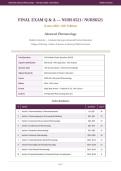
FINAL EXAM Q & A — NURS 6521 / NURS6521
(Latest Edition)
Advanced Pharmacology
Walden University — Graduate Nursing & Advanced Practice Education
College of Nursing · Master of Science in Nursing (MSN) Curriculum
Total Questions 150 Multiple-Choice Questions (MCQ)
Cognitive Distribution 20% Recall · 50% Application · 30% Analysis
Question Style 75% Scenario-Based · 25% Direct Knowledge
Aligned Standards AACN Essentials of Master’s Education
Course NURS 6521 Advanced Pharmacology
Edition Latest
Format Single Best Answer · 4 Options (A–D) · One Correct
Sections 10 Integrated Pharmacology Domains
Section Breakdown
# Section Questions Count
1 Section 1: Pharmacokinetics & Pharmacodynamics Q1–Q20 20
2 Section 2: Pharmacogenomics & Personalized Medicine Q21–Q35 15
3 Section 3: Autonomic Nervous System Pharmacology Q36–Q50 15
4 Section 4: Cardiovascular Pharmacology Q51–Q70 20
5 Section 5: Respiratory Pharmacology Q71–Q82 12
6 Section 6: Endocrine Pharmacology Q83–Q100 18
7 Section 7: Gastrointestinal & Renal Pharmacology Q101–Q115 15
8 Section 8: Neurological & Psychopharmacology Q116–Q130 15
9 Section 9: Anti-infective Pharmacology Q131–Q142 12
10 Section 10: Special Populations & Advanced Practice Considerations Q143–Q150 8
Page 1
,NURS 6521 Advanced Pharmacology — Final Exam ( Edition) Walden University
TOTAL 150
Each question is followed by the correct answer and a 2–4 sentence rationale anchored in the NURS 6521 curriculum, AACN
Essentials of Master’s Education, and advanced pharmacology competencies ( edition).
Page 2
,NURS 6521 Advanced Pharmacology — Final Exam ( Edition) Walden University
Section 1: Pharmacokinetics & Pharmacodynamics
Questions 1–20 · Count: 20 · Cognitive Mix: Recall · Application · Analysis
Q1: A 68-year-old patient is prescribed oral propranolol 40 mg twice daily. The drug has a hepatic extraction
ratio of 0.85 and an oral bioavailability of approximately 25%. Which pharmacokinetic property best explains
the discrepancy between the oral dose and systemic exposure?
A. Renal tubular secretion reduces active drug concentration before systemic absorption
B. Extensive first-pass hepatic metabolism limits systemic drug availability *[CORRECT]*
C. High plasma protein binding decreases the free fraction available to receptors
D. P-glycoprotein efflux in the intestinal lumen blocks drug absorption
Correct Answer: B
Rationale: Propranolol has a high hepatic extraction ratio (~0.85), meaning the liver removes a large fraction of the drug
during the first pass from the portal circulation before it reaches systemic circulation, reducing oral bioavailability to ~25%.
This is a classic NURS 6521 example of the first-pass effect. Renal secretion, protein binding, and P-glycoprotein do not
primarily explain this bioavailability loss for propranolol.
Q2: A drug with a half-life of 12 hours is initiated at a maintenance dose. Approximately how long will it take to
reach approximately 94% of steady-state plasma concentration?
A. 12 hours (one half-life)
B. 24 hours (two half-lives)
C. 36 hours (three half-lives)
D. 60 hours (five half-lives) *[CORRECT]*
Correct Answer: D
Rationale: Steady state is approached exponentially: 50% after 1 half-life, 75% after 2, 87.5% after 3, 93.75% after 4, and
96.9% after 5 half-lives. To reach ~94% (roughly 4 half-lives = 48 hours; 5 half-lives = 60 hours gives ~97%), the best answer
among the choices is 60 hours. The AACN pharmacology competency emphasizes that clinicians typically wait 4-5 half-lives
before assuming steady state and adjusting therapy.
Q3: A patient with status epilepticus requires IV phenytoin. The loading dose is 20 mg/kg. The patient weighs
70 kg, volume of distribution (Vd) is 0.7 L/kg, and target plasma level is 20 mg/L. Which calculation correctly
determines the loading dose based on Vd and target concentration?
A. Loading dose = Target concentration × Vd × body weight = 20 mg/L × 0.7 L/kg × 70 kg = 980 mg *[CORRECT]*
B. Loading dose = Maintenance dose × half-life = 100 mg × 12 h = 1200 mg
C. Loading dose = Target concentration × clearance = 20 mg/L × 5 L/h = 100 mg
D. Loading dose = Bioavailability × oral dose = 0.9 × 1000 mg = 900 mg
Correct Answer: A
Rationale: The loading dose formula is LD = Cp(target) × Vd, where Vd may be expressed per kg and multiplied by body
weight. Here, 20 mg/L × 0.7 L/kg × 70 kg = 980 mg. This rapidly achieves therapeutic plasma concentration without waiting
for steady state. The other formulas confuse clearance, half-life, and bioavailability, which are not the determinants of
loading dose.
Q4: A patient taking digoxin (therapeutic range 0.5-2.0 ng/mL; toxic >2.4 ng/mL) presents with nausea, visual
disturbances, and bradycardia. The drug has a narrow therapeutic index. Which concept best explains the
patient's presentation?
Page 3
, NURS 6521 Advanced Pharmacology — Final Exam ( Edition) Walden University
A. Idiosyncratic reaction due to genetic polymorphism
B. Type E adverse reaction from cumulative toxicity near the narrow therapeutic index *[CORRECT]*
C. Allergic IgE-mediated hypersensitivity to cardiac glycosides
D. Tachyphylaxis from rapid receptor desensitization
Correct Answer: B
Rationale: Digoxin has a narrow therapeutic index where the toxic dose is close to the therapeutic dose, making cumulative
toxicity (Type E, extended use) a common risk, especially with renal impairment or hypokalemia. The classic signs (GI
disturbance, visual halos/yellow vision, bradycardia) reflect dose-related toxicity, not idiosyncratic, allergic, or tachyphylactic
mechanisms. The NURS 6521 curriculum stresses monitoring serum levels and potassium for digoxin safety.
Q5: A patient on warfarin (highly protein-bound, 99%) is started on sulfamethoxazole-trimethoprim, which is
also highly protein-bound. What is the most likely pharmacokinetic consequence and clinical effect?
A. Increased warfarin metabolism leading to subtherapeutic INR
B. Displacement of warfarin from albumin, transiently raising free warfarin and increasing INR/bleeding risk
*[CORRECT]*
C. Decreased warfarin absorption due to gastric pH changes
D. Enhanced renal clearance of warfarin reducing anticoagulant effect
Correct Answer: B
Rationale: Highly protein-bound drugs can displace one another from albumin, transiently increasing the free (active)
fraction. For warfarin, this displacement—combined with CYP2C9 inhibition by sulfamethoxazole—raises INR and bleeding
risk. The AACN competency emphasizes identifying protein-binding displacement and metabolic inhibition interactions for
narrow-therapeutic-index drugs. Absorption and renal clearance changes are not the primary mechanism here.
Q6: A drug binds to a receptor but produces no intrinsic activity, while blocking the endogenous ligand from
binding. Which pharmacologic descriptor best characterizes this drug?
A. Partial agonist with low efficacy
B. Full agonist with high potency
C. Competitive antagonist with zero intrinsic efficacy *[CORRECT]*
D. Inverse agonist with negative efficacy
Correct Answer: C
Rationale: A drug with zero intrinsic activity that blocks the endogenous ligand is a competitive antagonist; it occupies the
receptor without activating it and can be overcome by increasing agonist concentration. Partial agonists have intermediate
efficacy; full agonists have maximal efficacy; inverse agonists reduce constitutive receptor activity below baseline. The NURS
6521 curriculum uses this distinction to explain beta-blockers, naloxone, and similar agents.
Q7: A 55-year-old with CKD stage 4 (eGFR 22 mL/min/1.73m²) requires vancomycin. Which pharmacokinetic
parameter is most directly affected, requiring dose adjustment?
A. Absorption from the IV site
B. Volume of distribution
C. Renal clearance and elimination half-life *[CORRECT]*
D. Hepatic first-pass metabolism
Correct Answer: C
Rationale: Vancomycin is primarily renally cleared; reduced GFR decreases clearance and prolongs half-life, necessitating
extended dosing intervals and therapeutic drug monitoring of troughs. Absorption (IV route bypasses first-pass), Vd, and
hepatic metabolism are not the primary determinants of vancomycin dose adjustment. The AACN competency requires renal
dose adjustment for renally cleared medications to avoid toxicity.
Page 4
FINAL EXAM Q & A — NURS 6521 / NURS6521
(Latest Edition)
Advanced Pharmacology
Walden University — Graduate Nursing & Advanced Practice Education
College of Nursing · Master of Science in Nursing (MSN) Curriculum
Total Questions 150 Multiple-Choice Questions (MCQ)
Cognitive Distribution 20% Recall · 50% Application · 30% Analysis
Question Style 75% Scenario-Based · 25% Direct Knowledge
Aligned Standards AACN Essentials of Master’s Education
Course NURS 6521 Advanced Pharmacology
Edition Latest
Format Single Best Answer · 4 Options (A–D) · One Correct
Sections 10 Integrated Pharmacology Domains
Section Breakdown
# Section Questions Count
1 Section 1: Pharmacokinetics & Pharmacodynamics Q1–Q20 20
2 Section 2: Pharmacogenomics & Personalized Medicine Q21–Q35 15
3 Section 3: Autonomic Nervous System Pharmacology Q36–Q50 15
4 Section 4: Cardiovascular Pharmacology Q51–Q70 20
5 Section 5: Respiratory Pharmacology Q71–Q82 12
6 Section 6: Endocrine Pharmacology Q83–Q100 18
7 Section 7: Gastrointestinal & Renal Pharmacology Q101–Q115 15
8 Section 8: Neurological & Psychopharmacology Q116–Q130 15
9 Section 9: Anti-infective Pharmacology Q131–Q142 12
10 Section 10: Special Populations & Advanced Practice Considerations Q143–Q150 8
Page 1
,NURS 6521 Advanced Pharmacology — Final Exam ( Edition) Walden University
TOTAL 150
Each question is followed by the correct answer and a 2–4 sentence rationale anchored in the NURS 6521 curriculum, AACN
Essentials of Master’s Education, and advanced pharmacology competencies ( edition).
Page 2
,NURS 6521 Advanced Pharmacology — Final Exam ( Edition) Walden University
Section 1: Pharmacokinetics & Pharmacodynamics
Questions 1–20 · Count: 20 · Cognitive Mix: Recall · Application · Analysis
Q1: A 68-year-old patient is prescribed oral propranolol 40 mg twice daily. The drug has a hepatic extraction
ratio of 0.85 and an oral bioavailability of approximately 25%. Which pharmacokinetic property best explains
the discrepancy between the oral dose and systemic exposure?
A. Renal tubular secretion reduces active drug concentration before systemic absorption
B. Extensive first-pass hepatic metabolism limits systemic drug availability *[CORRECT]*
C. High plasma protein binding decreases the free fraction available to receptors
D. P-glycoprotein efflux in the intestinal lumen blocks drug absorption
Correct Answer: B
Rationale: Propranolol has a high hepatic extraction ratio (~0.85), meaning the liver removes a large fraction of the drug
during the first pass from the portal circulation before it reaches systemic circulation, reducing oral bioavailability to ~25%.
This is a classic NURS 6521 example of the first-pass effect. Renal secretion, protein binding, and P-glycoprotein do not
primarily explain this bioavailability loss for propranolol.
Q2: A drug with a half-life of 12 hours is initiated at a maintenance dose. Approximately how long will it take to
reach approximately 94% of steady-state plasma concentration?
A. 12 hours (one half-life)
B. 24 hours (two half-lives)
C. 36 hours (three half-lives)
D. 60 hours (five half-lives) *[CORRECT]*
Correct Answer: D
Rationale: Steady state is approached exponentially: 50% after 1 half-life, 75% after 2, 87.5% after 3, 93.75% after 4, and
96.9% after 5 half-lives. To reach ~94% (roughly 4 half-lives = 48 hours; 5 half-lives = 60 hours gives ~97%), the best answer
among the choices is 60 hours. The AACN pharmacology competency emphasizes that clinicians typically wait 4-5 half-lives
before assuming steady state and adjusting therapy.
Q3: A patient with status epilepticus requires IV phenytoin. The loading dose is 20 mg/kg. The patient weighs
70 kg, volume of distribution (Vd) is 0.7 L/kg, and target plasma level is 20 mg/L. Which calculation correctly
determines the loading dose based on Vd and target concentration?
A. Loading dose = Target concentration × Vd × body weight = 20 mg/L × 0.7 L/kg × 70 kg = 980 mg *[CORRECT]*
B. Loading dose = Maintenance dose × half-life = 100 mg × 12 h = 1200 mg
C. Loading dose = Target concentration × clearance = 20 mg/L × 5 L/h = 100 mg
D. Loading dose = Bioavailability × oral dose = 0.9 × 1000 mg = 900 mg
Correct Answer: A
Rationale: The loading dose formula is LD = Cp(target) × Vd, where Vd may be expressed per kg and multiplied by body
weight. Here, 20 mg/L × 0.7 L/kg × 70 kg = 980 mg. This rapidly achieves therapeutic plasma concentration without waiting
for steady state. The other formulas confuse clearance, half-life, and bioavailability, which are not the determinants of
loading dose.
Q4: A patient taking digoxin (therapeutic range 0.5-2.0 ng/mL; toxic >2.4 ng/mL) presents with nausea, visual
disturbances, and bradycardia. The drug has a narrow therapeutic index. Which concept best explains the
patient's presentation?
Page 3
, NURS 6521 Advanced Pharmacology — Final Exam ( Edition) Walden University
A. Idiosyncratic reaction due to genetic polymorphism
B. Type E adverse reaction from cumulative toxicity near the narrow therapeutic index *[CORRECT]*
C. Allergic IgE-mediated hypersensitivity to cardiac glycosides
D. Tachyphylaxis from rapid receptor desensitization
Correct Answer: B
Rationale: Digoxin has a narrow therapeutic index where the toxic dose is close to the therapeutic dose, making cumulative
toxicity (Type E, extended use) a common risk, especially with renal impairment or hypokalemia. The classic signs (GI
disturbance, visual halos/yellow vision, bradycardia) reflect dose-related toxicity, not idiosyncratic, allergic, or tachyphylactic
mechanisms. The NURS 6521 curriculum stresses monitoring serum levels and potassium for digoxin safety.
Q5: A patient on warfarin (highly protein-bound, 99%) is started on sulfamethoxazole-trimethoprim, which is
also highly protein-bound. What is the most likely pharmacokinetic consequence and clinical effect?
A. Increased warfarin metabolism leading to subtherapeutic INR
B. Displacement of warfarin from albumin, transiently raising free warfarin and increasing INR/bleeding risk
*[CORRECT]*
C. Decreased warfarin absorption due to gastric pH changes
D. Enhanced renal clearance of warfarin reducing anticoagulant effect
Correct Answer: B
Rationale: Highly protein-bound drugs can displace one another from albumin, transiently increasing the free (active)
fraction. For warfarin, this displacement—combined with CYP2C9 inhibition by sulfamethoxazole—raises INR and bleeding
risk. The AACN competency emphasizes identifying protein-binding displacement and metabolic inhibition interactions for
narrow-therapeutic-index drugs. Absorption and renal clearance changes are not the primary mechanism here.
Q6: A drug binds to a receptor but produces no intrinsic activity, while blocking the endogenous ligand from
binding. Which pharmacologic descriptor best characterizes this drug?
A. Partial agonist with low efficacy
B. Full agonist with high potency
C. Competitive antagonist with zero intrinsic efficacy *[CORRECT]*
D. Inverse agonist with negative efficacy
Correct Answer: C
Rationale: A drug with zero intrinsic activity that blocks the endogenous ligand is a competitive antagonist; it occupies the
receptor without activating it and can be overcome by increasing agonist concentration. Partial agonists have intermediate
efficacy; full agonists have maximal efficacy; inverse agonists reduce constitutive receptor activity below baseline. The NURS
6521 curriculum uses this distinction to explain beta-blockers, naloxone, and similar agents.
Q7: A 55-year-old with CKD stage 4 (eGFR 22 mL/min/1.73m²) requires vancomycin. Which pharmacokinetic
parameter is most directly affected, requiring dose adjustment?
A. Absorption from the IV site
B. Volume of distribution
C. Renal clearance and elimination half-life *[CORRECT]*
D. Hepatic first-pass metabolism
Correct Answer: C
Rationale: Vancomycin is primarily renally cleared; reduced GFR decreases clearance and prolongs half-life, necessitating
extended dosing intervals and therapeutic drug monitoring of troughs. Absorption (IV route bypasses first-pass), Vd, and
hepatic metabolism are not the primary determinants of vancomycin dose adjustment. The AACN competency requires renal
dose adjustment for renally cleared medications to avoid toxicity.
Page 4

