
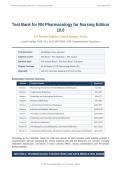
ATI RN Pharmacology Edition 10.0 - Content Mastery Series Latest Update 2026
Test Bank for RN Pharmacology for Nursing Edition
10.0
ATI Review Module Content Mastery Series
Latest Update 2026 | ALL 48 CHAPTERS | 240 Comprehensive Questions
Total Questions: 240 Multiple-Choice Questions
Cognitive Levels: 30% Recall | 50% Application | 20% Analysis
Question Style: 75% Scenario-Based | 25% Direct Recall / Calculation
Chapter Coverage: All 48 Chapters of ATI Pharmacology Edition 10.0
Alignment: 2026 ATI Curriculum Standards & NCLEX Test Plan
Examination Sections Overview
Section Content Domain Questions
Section 1 Pharmacology Foundations and Safe Medication Administration Q1-Q20
Section 2 Cardiovascular Medications Q21-Q55
Section 3 Hematologic and Anticoagulant Medications Q56-Q72
Section 4 Respiratory Medications Q73-Q88
Section 5 Gastrointestinal and Nutritional Medications Q89-Q105
Section 6 Endocrine and Metabolic Medications Q106-Q135
Section 7 Neurological and Musculoskeletal Medications Q136-Q160
Section 8 Psychotropic and Central Nervous System Medications Q161-Q180
Section 9 Anti-Infective Medications Q181-Q210
Section 10 Pain Management, Anti-Inflammatory, and Immune Medications Q211-Q225
Section 11 Comprehensive Pharmacology, Medication Calculations, and Lifespan Considerations Q226-Q240
Instructions to the Candidate: Select the ONE best answer for each question. Each question provides a
comprehensive rationale explaining the correct response and why the distractors are incorrect, including
medication classification, mechanism of action, adverse effects, nursing considerations, and ATI-specific
testing strategies.
SECTION 1: PHARMACOLOGY FOUNDATIONS AND SAFE MEDICATION ADMINISTRATION
ATI RN Pharmacology Edition 10.0 Test Bank | Page 1
,ATI RN Pharmacology Edition 10.0 - Content Mastery Series Latest Update 2026
Chapters Covered: Chapters 1-5 | Question Range: Q1-Q20 | Domain Focus: Pharmacokinetics, Pharmacodynamics, Six
Rights, Medication Safety, Error Prevention
Q1: A nurse is preparing to administer medications to a client. The provider has ordered a medication that
has a low therapeutic index. Which statement by the nurse best demonstrates understanding of this concept?
A. This medication has a wide safety margin between the therapeutic dose and the toxic dose.
B. I will need to monitor plasma drug levels closely because the difference between a therapeutic and toxic dose
is very small. [CORRECT]
C. This medication does not require any specific monitoring because it is naturally excreted by the kidneys.
D. The medication will achieve its peak effect within minutes of administration.
Correct Answer: B
Rationale: A low therapeutic index (TI) means the ratio of the lethal dose (or toxic dose) to the effective dose is small, indicating
a narrow margin of safety. Drugs such as digoxin, lithium, warfarin, and aminoglycosides require close plasma-level monitoring.
Option A describes a high TI. Option C is incorrect because low-TI drugs require enhanced monitoring regardless of elimination
route. Option D refers to onset, not TI. ATI testing strategy: identify narrow-therapeutic-index drugs as high-alert medications
requiring serum drug level monitoring.
Q2: A nurse is teaching a client about pharmacokinetics. Which client statement indicates the need for further
teaching regarding drug absorption?
A. Taking my antacid with my azithromycin might change how well the antibiotic works.
B. I should take my levothyroxine on an empty stomach to improve absorption.
C. My intravenous medication will be absorbed more slowly than my oral medication. [CORRECT]
D. Food in my stomach can sometimes decrease how much medication my body absorbs.
Correct Answer: C
Rationale: Intravenous medications bypass the absorption phase because they are placed directly into the circulation, achieving
immediate bioavailability, whereas oral medications must be absorbed through the GI tract. Therefore, IV medications are
absorbed faster, not slower. Options A, B, and D are all correct statements about absorption: antacids can chelate antibiotics,
levothyroxine absorption is reduced by food, and food can alter absorption of many drugs. ATI testing strategy: understand the
ADME processes (Absorption, Distribution, Metabolism, Excretion) and how the route affects pharmacokinetics.
Q3: A nurse is administering medications to an older adult client. The nurse recognizes that age-related
changes in pharmacokinetics place this client at higher risk for drug toxicity. Which physiologic change most
directly affects drug metabolism in the older adult?
A. Decreased gastric acidity slowing drug absorption
B. Decreased glomerular filtration rate slowing drug excretion
C. Decreased hepatic blood flow and enzyme activity slowing drug metabolism [CORRECT]
D. Increased body fat prolonging drug distribution
Correct Answer: C
Rationale: Drug metabolism primarily occurs in the liver via hepatic enzymes (cytochrome P450 system). Older adults
experience decreased hepatic blood flow and reduced enzyme activity, prolonging the half-life of hepatically metabolized drugs
such as benzodiazepines, opioids, and many cardiovascular agents. Option A affects absorption. Option B affects excretion
(although important, it does not address metabolism). Option D affects distribution of lipophilic drugs. ATI testing strategy:
identify the specific pharmacokinetic phase affected by each age-related change to anticipate medication responses in older
adults.
ATI RN Pharmacology Edition 10.0 Test Bank | Page 2
,ATI RN Pharmacology Edition 10.0 - Content Mastery Series Latest Update 2026
Q4: A nurse is preparing to administer a medication via the intramuscular (IM) route. The nurse understands
that which factor most significantly affects the rate of drug absorption from an IM injection?
A. The client's dietary intake of vitamin K
B. The blood flow to the injection site [CORRECT]
C. The client's concurrent use of topical corticosteroids
D. The client's serum sodium level
Correct Answer: B
Rationale: Blood flow to the injection site is the primary determinant of IM drug absorption. Sites with greater perfusion (deltoid
> vastus lateralis > gluteal in most adults) absorb medications more rapidly. This is why the vastus lateralis is preferred for
infants and emergency medications when rapid absorption is needed. Option A relates to warfarin interactions, not IM absorption.
Option C affects dermal atrophy, not IM uptake. Option D has no direct impact on IM absorption. ATI testing strategy: when
selecting injection sites, consider the medication's onset and the patient's muscle perfusion.
Q5: A nurse is caring for a client who is receiving a medication that is a competitive antagonist at the receptor
site. Which statement by the nurse correctly describes this drug's pharmacodynamic action?
A. The drug directly activates the receptor to produce a maximal response.
B. The drug binds to the receptor but produces no intrinsic activity, blocking the agonist from binding.
[CORRECT]
C. The drug increases the number of available receptors on the cell surface.
D. The drug alters the receptor's genetic expression to enhance its function.
Correct Answer: B
Rationale: A competitive antagonist binds to the same receptor site as the agonist but has no intrinsic activity of its own, thereby
blocking the agonist's effect. The antagonism can be overcome by increasing the agonist concentration. Examples include
naloxone (opioid antagonist) and beta-blockers (antagonists at beta-adrenergic receptors). Option A describes a full agonist.
Option C describes receptor upregulation, a chronic adaptation. Option D describes genomic pharmacodynamics. ATI testing
strategy: differentiate agonists, partial agonists, antagonists, and inverse agonists when analyzing drug-receptor interactions.
Q6: A nurse is preparing to administer medications and is reviewing the Six Rights of medication
administration. Which action by the nurse demonstrates proper application of the 'Right Route' principle?
A. Asking the client to state their name and date of birth before giving medications.
B. Confirming that the ordered medication is being given by the route specified in the medication order.
[CORRECT]
C. Documenting the medication in the medical record immediately after administration.
D. Checking the medication label three times before administering the drug.
Correct Answer: B
Rationale: The Right Route requires the nurse to verify that the medication is being administered via the exact route specified in
the medication order (PO, IV, IM, SQ, etc.). Giving a medication by the wrong route (such as administering an IV-only
medication orally) can cause severe harm or death. Option A demonstrates Right Patient. Option C demonstrates Right
Documentation. Option D is a component of medication safety but not specifically the Right Route. ATI testing strategy: the Six
Rights are Right Medication, Right Dose, Right Patient, Right Route, Right Time, and Right Documentation; some references
add Right Reason and Right Response.
ATI RN Pharmacology Edition 10.0 Test Bank | Page 3
, ATI RN Pharmacology Edition 10.0 - Content Mastery Series Latest Update 2026
Q7: A nurse is caring for a client who receives multiple medications. The nurse understands that medication
reconciliation should be performed at which times?
A. Only at the time of hospital admission.
B. At admission, during transitions of care, and at discharge. [CORRECT]
C. Only when a medication error has occurred.
D. Once per shift by the charge nurse.
Correct Answer: B
Rationale: Medication reconciliation is the process of comparing the client's current medications with newly prescribed
medications and is performed at every transition of care: admission, transfer between units, and discharge. The Joint Commission
requires this process to prevent medication discrepancies, omissions, and interactions. Options A and C limit reconciliation to a
single event, missing critical transitions. Option D describes a different process. ATI testing strategy: medication reconciliation is
a high-priority safety intervention performed across the continuum of care, not just at one point in time.
Q8: A nurse is reviewing a client's medication list and notes that two medications have look-alike/sound-alike
(LASA) names: hydroxyzine and hydralazine. Which strategy should the nurse implement to prevent a
medication error?
A. Administer both medications together to reduce the number of doses given.
B. Use tall man lettering (e.g., hydrOXYzine and hydrALAzine) and verify the indication before
administration. [CORRECT]
C. Ask the client to choose which medication they prefer to take.
D. Administer the medications at separate times without verifying the order.
Correct Answer: B
Rationale: Tall man lettering capitalizes the distinguishing letters of LASA drug names to draw attention to the differences,
reducing error rates. The nurse should also verify the indication: hydrOXYzine is an antihistamine used for anxiety or itching,
while hydrALAzine is a vasodilator used for hypertension. Option A increases error risk. Option C is inappropriate; the client
cannot determine medication appropriateness. Option D bypasses safety checks. ATI testing strategy: LASA medications are
high-alert, and tall man lettering plus indication verification are evidence-based error-reduction strategies recommended by
ISMP.
Q9: A nurse is teaching a client about a newly prescribed medication that has a first-pass effect. Which
explanation by the nurse is most accurate?
A. The medication is metabolized by the liver before reaching systemic circulation, reducing its active
concentration. [CORRECT]
B. The medication acts immediately on the brain to produce a calming effect.
C. The medication is excreted unchanged by the kidneys within the first hour.
D. The medication should only be taken with food to enhance its action.
Correct Answer: A
Rationale: The first-pass effect (presystemic metabolism) occurs when orally administered drugs are absorbed through the GI
tract and transported via the portal vein to the liver, where a significant portion is metabolized before reaching systemic
circulation. This reduces the bioavailability of many oral medications such as morphine, propranolol, and nitroglycerin (which is
why nitroglycerin is given sublingually). Option B describes a CNS effect, not first-pass. Option C describes renal excretion.
Option D relates to absorption irritation, not first-pass metabolism. ATI testing strategy: routes that bypass the first-pass effect
(sublingual, IV, IM, subcutaneous, rectal) achieve higher bioavailability.
ATI RN Pharmacology Edition 10.0 Test Bank | Page 4
Test Bank for RN Pharmacology for Nursing Edition
10.0
ATI Review Module Content Mastery Series
Latest Update 2026 | ALL 48 CHAPTERS | 240 Comprehensive Questions
Total Questions: 240 Multiple-Choice Questions
Cognitive Levels: 30% Recall | 50% Application | 20% Analysis
Question Style: 75% Scenario-Based | 25% Direct Recall / Calculation
Chapter Coverage: All 48 Chapters of ATI Pharmacology Edition 10.0
Alignment: 2026 ATI Curriculum Standards & NCLEX Test Plan
Examination Sections Overview
Section Content Domain Questions
Section 1 Pharmacology Foundations and Safe Medication Administration Q1-Q20
Section 2 Cardiovascular Medications Q21-Q55
Section 3 Hematologic and Anticoagulant Medications Q56-Q72
Section 4 Respiratory Medications Q73-Q88
Section 5 Gastrointestinal and Nutritional Medications Q89-Q105
Section 6 Endocrine and Metabolic Medications Q106-Q135
Section 7 Neurological and Musculoskeletal Medications Q136-Q160
Section 8 Psychotropic and Central Nervous System Medications Q161-Q180
Section 9 Anti-Infective Medications Q181-Q210
Section 10 Pain Management, Anti-Inflammatory, and Immune Medications Q211-Q225
Section 11 Comprehensive Pharmacology, Medication Calculations, and Lifespan Considerations Q226-Q240
Instructions to the Candidate: Select the ONE best answer for each question. Each question provides a
comprehensive rationale explaining the correct response and why the distractors are incorrect, including
medication classification, mechanism of action, adverse effects, nursing considerations, and ATI-specific
testing strategies.
SECTION 1: PHARMACOLOGY FOUNDATIONS AND SAFE MEDICATION ADMINISTRATION
ATI RN Pharmacology Edition 10.0 Test Bank | Page 1
,ATI RN Pharmacology Edition 10.0 - Content Mastery Series Latest Update 2026
Chapters Covered: Chapters 1-5 | Question Range: Q1-Q20 | Domain Focus: Pharmacokinetics, Pharmacodynamics, Six
Rights, Medication Safety, Error Prevention
Q1: A nurse is preparing to administer medications to a client. The provider has ordered a medication that
has a low therapeutic index. Which statement by the nurse best demonstrates understanding of this concept?
A. This medication has a wide safety margin between the therapeutic dose and the toxic dose.
B. I will need to monitor plasma drug levels closely because the difference between a therapeutic and toxic dose
is very small. [CORRECT]
C. This medication does not require any specific monitoring because it is naturally excreted by the kidneys.
D. The medication will achieve its peak effect within minutes of administration.
Correct Answer: B
Rationale: A low therapeutic index (TI) means the ratio of the lethal dose (or toxic dose) to the effective dose is small, indicating
a narrow margin of safety. Drugs such as digoxin, lithium, warfarin, and aminoglycosides require close plasma-level monitoring.
Option A describes a high TI. Option C is incorrect because low-TI drugs require enhanced monitoring regardless of elimination
route. Option D refers to onset, not TI. ATI testing strategy: identify narrow-therapeutic-index drugs as high-alert medications
requiring serum drug level monitoring.
Q2: A nurse is teaching a client about pharmacokinetics. Which client statement indicates the need for further
teaching regarding drug absorption?
A. Taking my antacid with my azithromycin might change how well the antibiotic works.
B. I should take my levothyroxine on an empty stomach to improve absorption.
C. My intravenous medication will be absorbed more slowly than my oral medication. [CORRECT]
D. Food in my stomach can sometimes decrease how much medication my body absorbs.
Correct Answer: C
Rationale: Intravenous medications bypass the absorption phase because they are placed directly into the circulation, achieving
immediate bioavailability, whereas oral medications must be absorbed through the GI tract. Therefore, IV medications are
absorbed faster, not slower. Options A, B, and D are all correct statements about absorption: antacids can chelate antibiotics,
levothyroxine absorption is reduced by food, and food can alter absorption of many drugs. ATI testing strategy: understand the
ADME processes (Absorption, Distribution, Metabolism, Excretion) and how the route affects pharmacokinetics.
Q3: A nurse is administering medications to an older adult client. The nurse recognizes that age-related
changes in pharmacokinetics place this client at higher risk for drug toxicity. Which physiologic change most
directly affects drug metabolism in the older adult?
A. Decreased gastric acidity slowing drug absorption
B. Decreased glomerular filtration rate slowing drug excretion
C. Decreased hepatic blood flow and enzyme activity slowing drug metabolism [CORRECT]
D. Increased body fat prolonging drug distribution
Correct Answer: C
Rationale: Drug metabolism primarily occurs in the liver via hepatic enzymes (cytochrome P450 system). Older adults
experience decreased hepatic blood flow and reduced enzyme activity, prolonging the half-life of hepatically metabolized drugs
such as benzodiazepines, opioids, and many cardiovascular agents. Option A affects absorption. Option B affects excretion
(although important, it does not address metabolism). Option D affects distribution of lipophilic drugs. ATI testing strategy:
identify the specific pharmacokinetic phase affected by each age-related change to anticipate medication responses in older
adults.
ATI RN Pharmacology Edition 10.0 Test Bank | Page 2
,ATI RN Pharmacology Edition 10.0 - Content Mastery Series Latest Update 2026
Q4: A nurse is preparing to administer a medication via the intramuscular (IM) route. The nurse understands
that which factor most significantly affects the rate of drug absorption from an IM injection?
A. The client's dietary intake of vitamin K
B. The blood flow to the injection site [CORRECT]
C. The client's concurrent use of topical corticosteroids
D. The client's serum sodium level
Correct Answer: B
Rationale: Blood flow to the injection site is the primary determinant of IM drug absorption. Sites with greater perfusion (deltoid
> vastus lateralis > gluteal in most adults) absorb medications more rapidly. This is why the vastus lateralis is preferred for
infants and emergency medications when rapid absorption is needed. Option A relates to warfarin interactions, not IM absorption.
Option C affects dermal atrophy, not IM uptake. Option D has no direct impact on IM absorption. ATI testing strategy: when
selecting injection sites, consider the medication's onset and the patient's muscle perfusion.
Q5: A nurse is caring for a client who is receiving a medication that is a competitive antagonist at the receptor
site. Which statement by the nurse correctly describes this drug's pharmacodynamic action?
A. The drug directly activates the receptor to produce a maximal response.
B. The drug binds to the receptor but produces no intrinsic activity, blocking the agonist from binding.
[CORRECT]
C. The drug increases the number of available receptors on the cell surface.
D. The drug alters the receptor's genetic expression to enhance its function.
Correct Answer: B
Rationale: A competitive antagonist binds to the same receptor site as the agonist but has no intrinsic activity of its own, thereby
blocking the agonist's effect. The antagonism can be overcome by increasing the agonist concentration. Examples include
naloxone (opioid antagonist) and beta-blockers (antagonists at beta-adrenergic receptors). Option A describes a full agonist.
Option C describes receptor upregulation, a chronic adaptation. Option D describes genomic pharmacodynamics. ATI testing
strategy: differentiate agonists, partial agonists, antagonists, and inverse agonists when analyzing drug-receptor interactions.
Q6: A nurse is preparing to administer medications and is reviewing the Six Rights of medication
administration. Which action by the nurse demonstrates proper application of the 'Right Route' principle?
A. Asking the client to state their name and date of birth before giving medications.
B. Confirming that the ordered medication is being given by the route specified in the medication order.
[CORRECT]
C. Documenting the medication in the medical record immediately after administration.
D. Checking the medication label three times before administering the drug.
Correct Answer: B
Rationale: The Right Route requires the nurse to verify that the medication is being administered via the exact route specified in
the medication order (PO, IV, IM, SQ, etc.). Giving a medication by the wrong route (such as administering an IV-only
medication orally) can cause severe harm or death. Option A demonstrates Right Patient. Option C demonstrates Right
Documentation. Option D is a component of medication safety but not specifically the Right Route. ATI testing strategy: the Six
Rights are Right Medication, Right Dose, Right Patient, Right Route, Right Time, and Right Documentation; some references
add Right Reason and Right Response.
ATI RN Pharmacology Edition 10.0 Test Bank | Page 3
, ATI RN Pharmacology Edition 10.0 - Content Mastery Series Latest Update 2026
Q7: A nurse is caring for a client who receives multiple medications. The nurse understands that medication
reconciliation should be performed at which times?
A. Only at the time of hospital admission.
B. At admission, during transitions of care, and at discharge. [CORRECT]
C. Only when a medication error has occurred.
D. Once per shift by the charge nurse.
Correct Answer: B
Rationale: Medication reconciliation is the process of comparing the client's current medications with newly prescribed
medications and is performed at every transition of care: admission, transfer between units, and discharge. The Joint Commission
requires this process to prevent medication discrepancies, omissions, and interactions. Options A and C limit reconciliation to a
single event, missing critical transitions. Option D describes a different process. ATI testing strategy: medication reconciliation is
a high-priority safety intervention performed across the continuum of care, not just at one point in time.
Q8: A nurse is reviewing a client's medication list and notes that two medications have look-alike/sound-alike
(LASA) names: hydroxyzine and hydralazine. Which strategy should the nurse implement to prevent a
medication error?
A. Administer both medications together to reduce the number of doses given.
B. Use tall man lettering (e.g., hydrOXYzine and hydrALAzine) and verify the indication before
administration. [CORRECT]
C. Ask the client to choose which medication they prefer to take.
D. Administer the medications at separate times without verifying the order.
Correct Answer: B
Rationale: Tall man lettering capitalizes the distinguishing letters of LASA drug names to draw attention to the differences,
reducing error rates. The nurse should also verify the indication: hydrOXYzine is an antihistamine used for anxiety or itching,
while hydrALAzine is a vasodilator used for hypertension. Option A increases error risk. Option C is inappropriate; the client
cannot determine medication appropriateness. Option D bypasses safety checks. ATI testing strategy: LASA medications are
high-alert, and tall man lettering plus indication verification are evidence-based error-reduction strategies recommended by
ISMP.
Q9: A nurse is teaching a client about a newly prescribed medication that has a first-pass effect. Which
explanation by the nurse is most accurate?
A. The medication is metabolized by the liver before reaching systemic circulation, reducing its active
concentration. [CORRECT]
B. The medication acts immediately on the brain to produce a calming effect.
C. The medication is excreted unchanged by the kidneys within the first hour.
D. The medication should only be taken with food to enhance its action.
Correct Answer: A
Rationale: The first-pass effect (presystemic metabolism) occurs when orally administered drugs are absorbed through the GI
tract and transported via the portal vein to the liver, where a significant portion is metabolized before reaching systemic
circulation. This reduces the bioavailability of many oral medications such as morphine, propranolol, and nitroglycerin (which is
why nitroglycerin is given sublingually). Option B describes a CNS effect, not first-pass. Option C describes renal excretion.
Option D relates to absorption irritation, not first-pass metabolism. ATI testing strategy: routes that bypass the first-pass effect
(sublingual, IV, IM, subcutaneous, rectal) achieve higher bioavailability.
ATI RN Pharmacology Edition 10.0 Test Bank | Page 4

