
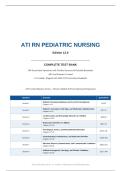
ATI RN PEDIATRIC NURSING
Edition 13.0
COMPLETE TEST BANK
300 Exam-Style Questions with Verified Answers & Detailed Rationales
All Core Domains Covered
A+ Graded | Aligned with 2026 ATI Curriculum Standards
ATI Content Mastery Series | Review Module & Proctored Exam Preparation
Section Domain Questions
Pediatric Nursing Foundations and Growth & Development
Section 1 Q1-30
Chapters 1-8
Pediatric Assessment, Vital Signs, and Medication Administration
Section 2 Q31-55
Chapters 9-14
Cardiovascular and Hematologic Disorders in Children
Section 3 Q56-85
Chapters 15-20
Respiratory Disorders in Children
Section 4 Q86-115
Chapters 21-26
Neurological, Sensory, and Musculoskeletal Disorders
Section 5 Q116-145
Chapters 27-32
Gastrointestinal, Genitourinary, and Endocrine Disorders
Section 6 Q146-180
Chapters 33-39
Infectious Diseases, Immunizations, and Communicable Conditions
Section 7 Q181-210
Chapters 40-44
Pediatric Emergencies, Oncology, and Chronic Conditions
Section 8 Q211-240
Chapters 45-50
ATI Content Mastery Series - A+ Graded | Verified Answers & Detailed Rationales
,ATI RN Pediatric Nursing Edition 13.0 | Complete Test Bank - 300 Questions Page 2
Psychosocial, Mental Health, and Family-Centered Care
Section 9 Q241-265
Chapters 51-55
Comprehensive Pediatric Nursing Integration, Prioritization, and
Section 10 Clinical Judgment Q266-300
All Chapters
ATI Content Mastery Series - A+ Graded | Verified Answers & Detailed Rationales
,ATI RN Pediatric Nursing Edition 13.0 | Complete Test Bank - 300 Questions Page 3
ATI RN Pediatric Nursing Edition 13.0
Complete Test Bank - 300 Exam-Style Questions with Verified Answers & Detailed Rationales
Cognitive Level Distribution: 30% Recall | 50% Application | 20% Analysis
Format: 80% Scenario-Based | 20% Direct Recall/Calculation
Aligned with 2026 ATI Content Mastery Series and NCLEX Test Plan
SECTION 1: Pediatric Nursing Foundations and Growth &
Development
Coverage: Chapters 1-8 | Questions: Q1-30
Q1: A nurse is preparing to admit a 4-year-old child to the pediatric unit. Which action by the nurse best
demonstrates the principle of atraumatic care?
A. Allowing the child to choose which arm to use for the IV insertion [CORRECT]
B. Restraining the child during vital signs to ensure accuracy
C. Informing the child that procedures will not hurt if they hold still
D. Limiting parental visitation to encourage independence
Correct Answer: A
Rationale: Atraumatic care minimizes physical and psychological stress for children and families. Allowing the child to
choose which arm to use provides a sense of control and reduces anxiety without compromising care. Restraining the
child increases fear and loss of trust. Lying about pain destroys the nurse-child trust relationship, which is foundational to
therapeutic communication. Limiting parental visitation contradicts family-centered care principles, as parents should be
encouraged to stay and participate in care to promote the child's sense of security.
Q2: A parent asks the nurse when their 6-month-old infant will likely begin to sit without support. Based on
Erikson's stages and developmental milestones, which response by the nurse is most appropriate?
A. Most infants sit without support by 6 months of age
B. Infants typically sit without support by 8 to 9 months of age [CORRECT]
C. Your infant should be sitting without support by 5 months of age
D. Sitting without support usually occurs around 10 to 12 months of age
Correct Answer: B
Rationale: According to growth and development milestones, infants typically achieve independent sitting between 8
and 9 months of age. At 6 months, infants can sit with support and may begin to sit momentarily without support, but true
independent sitting develops later. This milestone occurs during Erikson's stage of trust versus mistrust transitioning into
autonomy, and reflects maturation of trunk control and postural stability. Expecting a 6-month-old to sit unsupported is
developmentally inappropriate, while 10-12 months is too late and may indicate a developmental delay requiring
evaluation.
ATI Content Mastery Series - A+ Graded | Verified Answers & Detailed Rationales
, ATI RN Pediatric Nursing Edition 13.0 | Complete Test Bank - 300 Questions Page 4
Q3: A nurse is caring for a toddler who is hospitalized. According to Piaget's preoperational stage of cognitive
development, which characteristic should the nurse anticipate?
A. The child can think logically about concrete events
B. The child uses magical thinking and egocentrism [CORRECT]
C. The child demonstrates abstract reasoning capabilities
D. The child understands conservation of volume
Correct Answer: B
Rationale: Piaget's preoperational stage, occurring from approximately 2 to 7 years of age, is characterized by magical
thinking, egocentrism, and the use of symbols. Toddlers in this stage believe their thoughts cause events and cannot view
situations from others' perspectives. Logical thinking about concrete events (option A) characterizes the concrete
operational stage (7-11 years), abstract reasoning (option C) is the formal operational stage (11+ years), and conservation
(option D) is achieved during the concrete operational stage. Nurses must understand these characteristics to
communicate effectively and provide age-appropriate explanations during procedures.
Q4: A nurse is planning care for a hospitalized school-age child. According to Erikson's psychosocial
development theory, which developmental conflict is this child working to resolve?
A. Trust versus mistrust
B. Autonomy versus shame and doubt
C. Initiative versus guilt
D. Industry versus inferiority [CORRECT]
Correct Answer: D
Rationale: School-age children (6-12 years) are in Erikson's stage of industry versus inferiority, where they develop a
sense of competence through achievement and accomplishments. Nurses can support this by allowing children to
participate in care, complete schoolwork, and master new skills during hospitalization. Trust versus mistrust applies to
infants (0-1 year), autonomy versus shame and doubt to toddlers (1-3 years), and initiative versus guilt to preschoolers
(3-6 years). Recognizing the child's developmental stage allows the nurse to provide opportunities for mastery and
prevent feelings of inferiority during the hospital experience.
Q5: A nurse is teaching the parents of a 2-month-old infant about injury prevention. Which statement by the
parent indicates that teaching has been effective?
A. I will place my baby in a forward-facing car seat in the back seat
B. I will set the water heater temperature to 130 degrees Fahrenheit
C. I will place my baby on the back to sleep and remove all soft bedding [CORRECT]
D. I will give small toys with detachable parts to encourage play
Correct Answer: C
Rationale: Placing infants on their back to sleep and removing soft bedding, pillows, and stuffed animals from the crib
reduces the risk of sudden infant death syndrome (SIDS), which is the leading cause of death in infants 1-12 months.
Infants under 2 years must be in rear-facing car seats, not forward-facing. Water heater temperature should be set at 120
degrees Fahrenheit or below to prevent scald burns. Toys with detachable parts pose a choking hazard for infants who
explore the environment orally. Anticipatory guidance is a key nursing role in well-child visits.
ATI Content Mastery Series - A+ Graded | Verified Answers & Detailed Rationales
Edition 13.0
COMPLETE TEST BANK
300 Exam-Style Questions with Verified Answers & Detailed Rationales
All Core Domains Covered
A+ Graded | Aligned with 2026 ATI Curriculum Standards
ATI Content Mastery Series | Review Module & Proctored Exam Preparation
Section Domain Questions
Pediatric Nursing Foundations and Growth & Development
Section 1 Q1-30
Chapters 1-8
Pediatric Assessment, Vital Signs, and Medication Administration
Section 2 Q31-55
Chapters 9-14
Cardiovascular and Hematologic Disorders in Children
Section 3 Q56-85
Chapters 15-20
Respiratory Disorders in Children
Section 4 Q86-115
Chapters 21-26
Neurological, Sensory, and Musculoskeletal Disorders
Section 5 Q116-145
Chapters 27-32
Gastrointestinal, Genitourinary, and Endocrine Disorders
Section 6 Q146-180
Chapters 33-39
Infectious Diseases, Immunizations, and Communicable Conditions
Section 7 Q181-210
Chapters 40-44
Pediatric Emergencies, Oncology, and Chronic Conditions
Section 8 Q211-240
Chapters 45-50
ATI Content Mastery Series - A+ Graded | Verified Answers & Detailed Rationales
,ATI RN Pediatric Nursing Edition 13.0 | Complete Test Bank - 300 Questions Page 2
Psychosocial, Mental Health, and Family-Centered Care
Section 9 Q241-265
Chapters 51-55
Comprehensive Pediatric Nursing Integration, Prioritization, and
Section 10 Clinical Judgment Q266-300
All Chapters
ATI Content Mastery Series - A+ Graded | Verified Answers & Detailed Rationales
,ATI RN Pediatric Nursing Edition 13.0 | Complete Test Bank - 300 Questions Page 3
ATI RN Pediatric Nursing Edition 13.0
Complete Test Bank - 300 Exam-Style Questions with Verified Answers & Detailed Rationales
Cognitive Level Distribution: 30% Recall | 50% Application | 20% Analysis
Format: 80% Scenario-Based | 20% Direct Recall/Calculation
Aligned with 2026 ATI Content Mastery Series and NCLEX Test Plan
SECTION 1: Pediatric Nursing Foundations and Growth &
Development
Coverage: Chapters 1-8 | Questions: Q1-30
Q1: A nurse is preparing to admit a 4-year-old child to the pediatric unit. Which action by the nurse best
demonstrates the principle of atraumatic care?
A. Allowing the child to choose which arm to use for the IV insertion [CORRECT]
B. Restraining the child during vital signs to ensure accuracy
C. Informing the child that procedures will not hurt if they hold still
D. Limiting parental visitation to encourage independence
Correct Answer: A
Rationale: Atraumatic care minimizes physical and psychological stress for children and families. Allowing the child to
choose which arm to use provides a sense of control and reduces anxiety without compromising care. Restraining the
child increases fear and loss of trust. Lying about pain destroys the nurse-child trust relationship, which is foundational to
therapeutic communication. Limiting parental visitation contradicts family-centered care principles, as parents should be
encouraged to stay and participate in care to promote the child's sense of security.
Q2: A parent asks the nurse when their 6-month-old infant will likely begin to sit without support. Based on
Erikson's stages and developmental milestones, which response by the nurse is most appropriate?
A. Most infants sit without support by 6 months of age
B. Infants typically sit without support by 8 to 9 months of age [CORRECT]
C. Your infant should be sitting without support by 5 months of age
D. Sitting without support usually occurs around 10 to 12 months of age
Correct Answer: B
Rationale: According to growth and development milestones, infants typically achieve independent sitting between 8
and 9 months of age. At 6 months, infants can sit with support and may begin to sit momentarily without support, but true
independent sitting develops later. This milestone occurs during Erikson's stage of trust versus mistrust transitioning into
autonomy, and reflects maturation of trunk control and postural stability. Expecting a 6-month-old to sit unsupported is
developmentally inappropriate, while 10-12 months is too late and may indicate a developmental delay requiring
evaluation.
ATI Content Mastery Series - A+ Graded | Verified Answers & Detailed Rationales
, ATI RN Pediatric Nursing Edition 13.0 | Complete Test Bank - 300 Questions Page 4
Q3: A nurse is caring for a toddler who is hospitalized. According to Piaget's preoperational stage of cognitive
development, which characteristic should the nurse anticipate?
A. The child can think logically about concrete events
B. The child uses magical thinking and egocentrism [CORRECT]
C. The child demonstrates abstract reasoning capabilities
D. The child understands conservation of volume
Correct Answer: B
Rationale: Piaget's preoperational stage, occurring from approximately 2 to 7 years of age, is characterized by magical
thinking, egocentrism, and the use of symbols. Toddlers in this stage believe their thoughts cause events and cannot view
situations from others' perspectives. Logical thinking about concrete events (option A) characterizes the concrete
operational stage (7-11 years), abstract reasoning (option C) is the formal operational stage (11+ years), and conservation
(option D) is achieved during the concrete operational stage. Nurses must understand these characteristics to
communicate effectively and provide age-appropriate explanations during procedures.
Q4: A nurse is planning care for a hospitalized school-age child. According to Erikson's psychosocial
development theory, which developmental conflict is this child working to resolve?
A. Trust versus mistrust
B. Autonomy versus shame and doubt
C. Initiative versus guilt
D. Industry versus inferiority [CORRECT]
Correct Answer: D
Rationale: School-age children (6-12 years) are in Erikson's stage of industry versus inferiority, where they develop a
sense of competence through achievement and accomplishments. Nurses can support this by allowing children to
participate in care, complete schoolwork, and master new skills during hospitalization. Trust versus mistrust applies to
infants (0-1 year), autonomy versus shame and doubt to toddlers (1-3 years), and initiative versus guilt to preschoolers
(3-6 years). Recognizing the child's developmental stage allows the nurse to provide opportunities for mastery and
prevent feelings of inferiority during the hospital experience.
Q5: A nurse is teaching the parents of a 2-month-old infant about injury prevention. Which statement by the
parent indicates that teaching has been effective?
A. I will place my baby in a forward-facing car seat in the back seat
B. I will set the water heater temperature to 130 degrees Fahrenheit
C. I will place my baby on the back to sleep and remove all soft bedding [CORRECT]
D. I will give small toys with detachable parts to encourage play
Correct Answer: C
Rationale: Placing infants on their back to sleep and removing soft bedding, pillows, and stuffed animals from the crib
reduces the risk of sudden infant death syndrome (SIDS), which is the leading cause of death in infants 1-12 months.
Infants under 2 years must be in rear-facing car seats, not forward-facing. Water heater temperature should be set at 120
degrees Fahrenheit or below to prevent scald burns. Toys with detachable parts pose a choking hazard for infants who
explore the environment orally. Anticipatory guidance is a key nursing role in well-child visits.
ATI Content Mastery Series - A+ Graded | Verified Answers & Detailed Rationales

