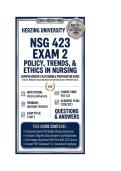
,NSG 423 Exam 2 Policy, Trends, & Ethics in Nursing Questions And
Answers 2026/2027 Herzing University
Q1. Which epidemiologic measure identifies the number of new
cases of a health condition occurring in a population during a
specified period?
A) Incidence
B) Prevalence
C) Mortality
D) Case fatality
Correct Answer: A) Incidence
Rationale: Incidence measures newly occurring cases and is useful for
identifying the risk or rate of developing a condition.
Q2. Which measure describes all existing cases of a disease within a
population at a particular time or over a specified period?
A) Incidence
B) Prevalence
C) Relative risk
D) Mortality
Correct Answer: B) Prevalence
Rationale: Prevalence reflects the total burden of an existing condition
within a population.
Q3. A nurse is comparing deaths from opioid overdose across
several years. Which epidemiologic measure is most directly being
examined?
A) Incidence
B) Prevalence
C) Mortality
D) Sensitivity
Correct Answer: C) Mortality
Rationale: Mortality measures deaths occurring within a population and can
reveal important health trends.
Q4. Which data would best demonstrate the burden of a chronic
disease in a population?
A) The number of healthcare workers in the region
B) The number of hospitals
C) One patient's disease severity
D) Prevalence, morbidity, mortality, and disability associated with the
disease
, Correct Answer: D) Prevalence, morbidity, mortality, and disability associated
with the disease
Rationale: Disease burden is reflected by how common a condition is and
the illness, disability, and death associated with it.
Q5. Which factor is most important when comparing disease rates
between two populations of very different sizes?
A) Use rates or proportions rather than raw case counts alone
B) Compare only the total number of cases
C) Ignore population size
D) Use only one year's data
Correct Answer: A) Use rates or proportions rather than raw case counts
alone
Rationale: Rates account for population size and provide more meaningful
comparisons than absolute counts.
Q6. Which finding most strongly suggests that a health issue is
becoming a greater national priority?
A) Increasing incidence, mortality, or population impact over time
B) One isolated case
C) One hospital's staffing problem
D) A decrease in affected populations
Correct Answer: A) Increasing incidence, mortality, or population impact over
time
Rationale: Worsening trends and growing population burden support
prioritization of a health issue.
Q7. Which term refers to illness, complications, or disability caused
by a disease?
A) Mortality
B) Morbidity
C) Incidence
D) Surveillance
Correct Answer: B) Morbidity
Rationale: Morbidity refers to illness, disability, and other adverse health
consequences short of death.
Q8. Why is epidemiologic trend analysis important in policy
development?
A) It guarantees political agreement
B) It helps identify changes in disease burden and populations at greatest
risk
Answers 2026/2027 Herzing University
Q1. Which epidemiologic measure identifies the number of new
cases of a health condition occurring in a population during a
specified period?
A) Incidence
B) Prevalence
C) Mortality
D) Case fatality
Correct Answer: A) Incidence
Rationale: Incidence measures newly occurring cases and is useful for
identifying the risk or rate of developing a condition.
Q2. Which measure describes all existing cases of a disease within a
population at a particular time or over a specified period?
A) Incidence
B) Prevalence
C) Relative risk
D) Mortality
Correct Answer: B) Prevalence
Rationale: Prevalence reflects the total burden of an existing condition
within a population.
Q3. A nurse is comparing deaths from opioid overdose across
several years. Which epidemiologic measure is most directly being
examined?
A) Incidence
B) Prevalence
C) Mortality
D) Sensitivity
Correct Answer: C) Mortality
Rationale: Mortality measures deaths occurring within a population and can
reveal important health trends.
Q4. Which data would best demonstrate the burden of a chronic
disease in a population?
A) The number of healthcare workers in the region
B) The number of hospitals
C) One patient's disease severity
D) Prevalence, morbidity, mortality, and disability associated with the
disease
, Correct Answer: D) Prevalence, morbidity, mortality, and disability associated
with the disease
Rationale: Disease burden is reflected by how common a condition is and
the illness, disability, and death associated with it.
Q5. Which factor is most important when comparing disease rates
between two populations of very different sizes?
A) Use rates or proportions rather than raw case counts alone
B) Compare only the total number of cases
C) Ignore population size
D) Use only one year's data
Correct Answer: A) Use rates or proportions rather than raw case counts
alone
Rationale: Rates account for population size and provide more meaningful
comparisons than absolute counts.
Q6. Which finding most strongly suggests that a health issue is
becoming a greater national priority?
A) Increasing incidence, mortality, or population impact over time
B) One isolated case
C) One hospital's staffing problem
D) A decrease in affected populations
Correct Answer: A) Increasing incidence, mortality, or population impact over
time
Rationale: Worsening trends and growing population burden support
prioritization of a health issue.
Q7. Which term refers to illness, complications, or disability caused
by a disease?
A) Mortality
B) Morbidity
C) Incidence
D) Surveillance
Correct Answer: B) Morbidity
Rationale: Morbidity refers to illness, disability, and other adverse health
consequences short of death.
Q8. Why is epidemiologic trend analysis important in policy
development?
A) It guarantees political agreement
B) It helps identify changes in disease burden and populations at greatest
risk