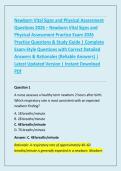
Newborn Vital Signs and Physical Assessment
Questions 2026 – Newborn Vital Signs and
Physical Assessment Practice Exam 2026
Practice Questions & Study Guide | Complete
Exam-Style Questions with Correct Detailed
Answers & Rationales (Reliable Answers) |
Latest Updated Version | Instant Download
PDf
Question 1
A nurse assesses a healthy term newborn 2 hours after birth.
Which respiratory rate is most consistent with an expected
newborn finding?
A. 18 breaths/minute
B. 28 breaths/minute
C. 48 breaths/minute
D. 76 breaths/minute
Answer: C. 48 breaths/minute
Rationale: A respiratory rate of approximately 40–60
breaths/minute is generally expected in a newborn. Newborn
,respirations can be irregular, so the respiratory rate should be
counted for a complete minute rather than for a shorter interval
and multiplied. A rate of 18 or 28 breaths/minute is unusually
low for a newborn, while 76 breaths/minute represents
tachypnea and warrants further assessment, particularly for
associated signs such as grunting, nasal flaring, or retractions.
Question 2
During the initial physical assessment, which finding requires
the nurse's most immediate attention?
A. Acrocyanosis of the hands and feet shortly after birth
B. Vernix covering portions of the skin
C. Mild molding of the skull after vaginal delivery
D. Central cyanosis involving the tongue and trunk
Answer: D. Central cyanosis involving the tongue and trunk
Rationale: Central cyanosis is abnormal and can indicate
inadequate oxygenation associated with cardiac disease,
pulmonary disease, or other serious conditions. Acrocyanosis,
particularly during the early transitional period, can be a normal
newborn finding when the central body remains pink. Vernix
and molding are also common findings associated with normal
newborn adaptation and the birth process. Central cyanosis
,therefore requires prompt evaluation rather than routine
observation.
Question 3
A newborn has a heart rate of 132 beats/minute while resting
quietly. How should the nurse interpret this finding?
A. Severe bradycardia
B. Within an expected newborn range
C. Significant neonatal tachycardia
D. Evidence of cardiovascular compromise
Answer: B. Within an expected newborn range
Rationale: A resting newborn heart rate around 100–160
beats/minute is commonly considered an expected range during
routine physical assessment. Heart rate should always be
interpreted in context, including the infant's activity level,
respiratory status, perfusion, and overall clinical condition. A
heart rate of 132 beats/minute in a clinically stable newborn is
therefore reassuring rather than indicative of bradycardia or
tachycardia.
Question 4
, Which technique provides the most appropriate measurement
of a newborn's respiratory rate?
A. Count respirations for 15 seconds and multiply by four
B. Count respirations for 30 seconds and multiply by two
C. Count respirations continuously for a full 60 seconds
D. Count only the respirations occurring during crying
Answer: C. Count respirations continuously for a full 60
seconds
Rationale: Newborn breathing can be irregular, with variations
in rate and brief pauses. Counting for a complete minute
reduces the chance that an irregular respiratory pattern will
produce a misleading result. The assessment should ideally
occur while the infant is quiet or resting because crying can
substantially increase the respiratory rate and make
interpretation more difficult.
Question 5
A nurse obtains an axillary temperature of 36.2°C in a newborn.
Which interpretation is most appropriate?
A. Normal temperature variation
B. Hypothermia requiring intervention and reassessment
C. Expected temperature immediately after feeding
D. Hyperthermia caused by excessive environmental warmth
Questions 2026 – Newborn Vital Signs and
Physical Assessment Practice Exam 2026
Practice Questions & Study Guide | Complete
Exam-Style Questions with Correct Detailed
Answers & Rationales (Reliable Answers) |
Latest Updated Version | Instant Download
Question 1
A nurse assesses a healthy term newborn 2 hours after birth.
Which respiratory rate is most consistent with an expected
newborn finding?
A. 18 breaths/minute
B. 28 breaths/minute
C. 48 breaths/minute
D. 76 breaths/minute
Answer: C. 48 breaths/minute
Rationale: A respiratory rate of approximately 40–60
breaths/minute is generally expected in a newborn. Newborn
,respirations can be irregular, so the respiratory rate should be
counted for a complete minute rather than for a shorter interval
and multiplied. A rate of 18 or 28 breaths/minute is unusually
low for a newborn, while 76 breaths/minute represents
tachypnea and warrants further assessment, particularly for
associated signs such as grunting, nasal flaring, or retractions.
Question 2
During the initial physical assessment, which finding requires
the nurse's most immediate attention?
A. Acrocyanosis of the hands and feet shortly after birth
B. Vernix covering portions of the skin
C. Mild molding of the skull after vaginal delivery
D. Central cyanosis involving the tongue and trunk
Answer: D. Central cyanosis involving the tongue and trunk
Rationale: Central cyanosis is abnormal and can indicate
inadequate oxygenation associated with cardiac disease,
pulmonary disease, or other serious conditions. Acrocyanosis,
particularly during the early transitional period, can be a normal
newborn finding when the central body remains pink. Vernix
and molding are also common findings associated with normal
newborn adaptation and the birth process. Central cyanosis
,therefore requires prompt evaluation rather than routine
observation.
Question 3
A newborn has a heart rate of 132 beats/minute while resting
quietly. How should the nurse interpret this finding?
A. Severe bradycardia
B. Within an expected newborn range
C. Significant neonatal tachycardia
D. Evidence of cardiovascular compromise
Answer: B. Within an expected newborn range
Rationale: A resting newborn heart rate around 100–160
beats/minute is commonly considered an expected range during
routine physical assessment. Heart rate should always be
interpreted in context, including the infant's activity level,
respiratory status, perfusion, and overall clinical condition. A
heart rate of 132 beats/minute in a clinically stable newborn is
therefore reassuring rather than indicative of bradycardia or
tachycardia.
Question 4
, Which technique provides the most appropriate measurement
of a newborn's respiratory rate?
A. Count respirations for 15 seconds and multiply by four
B. Count respirations for 30 seconds and multiply by two
C. Count respirations continuously for a full 60 seconds
D. Count only the respirations occurring during crying
Answer: C. Count respirations continuously for a full 60
seconds
Rationale: Newborn breathing can be irregular, with variations
in rate and brief pauses. Counting for a complete minute
reduces the chance that an irregular respiratory pattern will
produce a misleading result. The assessment should ideally
occur while the infant is quiet or resting because crying can
substantially increase the respiratory rate and make
interpretation more difficult.
Question 5
A nurse obtains an axillary temperature of 36.2°C in a newborn.
Which interpretation is most appropriate?
A. Normal temperature variation
B. Hypothermia requiring intervention and reassessment
C. Expected temperature immediately after feeding
D. Hyperthermia caused by excessive environmental warmth