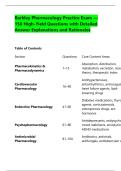
Barkley Pharmacology Practice Exam —
150 High-Yield Questions with Detailed
Answer Explanations and Rationales
Table of Contents
Section Questions Core Content Areas
Absorption, distribution,
Pharmacokinetics &
1–15 metabolism, excretion, recep
Pharmacodynamics
theory, therapeutic index
Antihypertensives,
Cardiovascular antiarrhythmics, anticoagula
16–40
Pharmacology heart failure agents, lipid-
lowering drugs
Diabetes medications, thyro
agents, corticosteroids,
Endocrine Pharmacology 41–60
osteoporosis drugs, sex
hormones
Antidepressants, antipsycho
Psychopharmacology 61–80 mood stabilizers, anxiolytics
ADHD medications
Antimicrobial Antibiotics, antivirals,
81–100
Pharmacology antifungals, antitubercular d
,Section Questions Core Content Areas
Pain Management & Anti- Opioids, NSAIDs,
Inflammatory 101–115 acetaminophen, muscle
Pharmacology relaxants, migraine medicat
Gastrointestinal & Proton pump inhibitors,
Genitourinary 116–130 antiemetics, laxatives, BPH
Pharmacology medications, urinary agents
Bronchodilators, corticoster
Respiratory Pharmacology 131–140 leukotriene modifiers,
antihistamines
Geriatrics, pediatrics, pregna
Special Populations &
141–150 hepatic/renal impairment, d
Prescribing Considerations
interactions
Section 1: Pharmacokinetics & Pharmacodynamics
(Questions 1–15)
1. A 72-year-old patient is prescribed a medication that
undergoes extensive first-pass metabolism. Which route of
administration would bypass this effect?
A) Oral
B) Sublingual
C) Rectal
D) Enteral
Correct Answer: B
Rationale: Sublingual administration bypasses the hepatic
first-pass effect because the medication is absorbed directly
into the systemic circulation through the venous drainage
,of the oral mucosa. Oral and enteral routes undergo first-
pass metabolism. Rectal administration partially bypasses
first-pass metabolism but is not as complete as sublingual.
2. Which pharmacokinetic parameter describes the fraction
of an administered drug dose that reaches systemic
circulation unchanged?
A) Volume of distribution
B) Clearance
C) Bioavailability
D) Half-life
Correct Answer: C
Rationale: Bioavailability (F) is the fraction of an
administered dose that reaches systemic circulation in an
unchanged form. Intravenous administration has 100%
bioavailability. Volume of distribution describes the
apparent space in which a drug distributes. Clearance
describes the rate of drug removal from plasma. Half-life is
the time required for plasma concentration to decrease by
50%.
3. A patient with chronic kidney disease is prescribed a
medication that is primarily renally excreted. Which
adjustment is most appropriate?
A) Increase the dose
B) Decrease the dose or extend the dosing interval
C) Administer the medication intravenously
D) Add a second medication to enhance elimination
Correct Answer: B
Rationale: For renally excreted drugs in patients with
chronic kidney disease, dose reduction or interval extension
, is required to prevent accumulation and toxicity. Increasing
the dose or adding another medication would worsen the
problem.
4. A 65-year-old patient is taking warfarin. Which
cytochrome P450 enzyme is primarily responsible for
warfarin metabolism?
A) CYP2D6
B) CYP3A4
C) CYP2C9
D) CYP1A2
Correct Answer: C
Rationale: Warfarin is primarily metabolized by CYP2C9.
Genetic polymorphisms in CYP2C9 can affect warfarin
dosing and bleeding risk. CYP3A4 metabolizes many
medications but is not the primary enzyme for warfarin.
5. Which of the following best describes the therapeutic
index of a drug?
A) The ratio of the toxic dose to the therapeutic dose
B) The time required for a drug to reach steady state
C) The percentage of drug bound to plasma proteins
D) The rate of drug absorption from the gastrointestinal tract
Correct Answer: A
Rationale: The therapeutic index (TI) is the ratio of the toxic
dose (TD50) to the therapeutic dose (ED50). A narrow
therapeutic index (e.g., warfarin, digoxin, lithium) indicates
a small margin between therapeutic and toxic effects,
requiring close monitoring.
150 High-Yield Questions with Detailed
Answer Explanations and Rationales
Table of Contents
Section Questions Core Content Areas
Absorption, distribution,
Pharmacokinetics &
1–15 metabolism, excretion, recep
Pharmacodynamics
theory, therapeutic index
Antihypertensives,
Cardiovascular antiarrhythmics, anticoagula
16–40
Pharmacology heart failure agents, lipid-
lowering drugs
Diabetes medications, thyro
agents, corticosteroids,
Endocrine Pharmacology 41–60
osteoporosis drugs, sex
hormones
Antidepressants, antipsycho
Psychopharmacology 61–80 mood stabilizers, anxiolytics
ADHD medications
Antimicrobial Antibiotics, antivirals,
81–100
Pharmacology antifungals, antitubercular d
,Section Questions Core Content Areas
Pain Management & Anti- Opioids, NSAIDs,
Inflammatory 101–115 acetaminophen, muscle
Pharmacology relaxants, migraine medicat
Gastrointestinal & Proton pump inhibitors,
Genitourinary 116–130 antiemetics, laxatives, BPH
Pharmacology medications, urinary agents
Bronchodilators, corticoster
Respiratory Pharmacology 131–140 leukotriene modifiers,
antihistamines
Geriatrics, pediatrics, pregna
Special Populations &
141–150 hepatic/renal impairment, d
Prescribing Considerations
interactions
Section 1: Pharmacokinetics & Pharmacodynamics
(Questions 1–15)
1. A 72-year-old patient is prescribed a medication that
undergoes extensive first-pass metabolism. Which route of
administration would bypass this effect?
A) Oral
B) Sublingual
C) Rectal
D) Enteral
Correct Answer: B
Rationale: Sublingual administration bypasses the hepatic
first-pass effect because the medication is absorbed directly
into the systemic circulation through the venous drainage
,of the oral mucosa. Oral and enteral routes undergo first-
pass metabolism. Rectal administration partially bypasses
first-pass metabolism but is not as complete as sublingual.
2. Which pharmacokinetic parameter describes the fraction
of an administered drug dose that reaches systemic
circulation unchanged?
A) Volume of distribution
B) Clearance
C) Bioavailability
D) Half-life
Correct Answer: C
Rationale: Bioavailability (F) is the fraction of an
administered dose that reaches systemic circulation in an
unchanged form. Intravenous administration has 100%
bioavailability. Volume of distribution describes the
apparent space in which a drug distributes. Clearance
describes the rate of drug removal from plasma. Half-life is
the time required for plasma concentration to decrease by
50%.
3. A patient with chronic kidney disease is prescribed a
medication that is primarily renally excreted. Which
adjustment is most appropriate?
A) Increase the dose
B) Decrease the dose or extend the dosing interval
C) Administer the medication intravenously
D) Add a second medication to enhance elimination
Correct Answer: B
Rationale: For renally excreted drugs in patients with
chronic kidney disease, dose reduction or interval extension
, is required to prevent accumulation and toxicity. Increasing
the dose or adding another medication would worsen the
problem.
4. A 65-year-old patient is taking warfarin. Which
cytochrome P450 enzyme is primarily responsible for
warfarin metabolism?
A) CYP2D6
B) CYP3A4
C) CYP2C9
D) CYP1A2
Correct Answer: C
Rationale: Warfarin is primarily metabolized by CYP2C9.
Genetic polymorphisms in CYP2C9 can affect warfarin
dosing and bleeding risk. CYP3A4 metabolizes many
medications but is not the primary enzyme for warfarin.
5. Which of the following best describes the therapeutic
index of a drug?
A) The ratio of the toxic dose to the therapeutic dose
B) The time required for a drug to reach steady state
C) The percentage of drug bound to plasma proteins
D) The rate of drug absorption from the gastrointestinal tract
Correct Answer: A
Rationale: The therapeutic index (TI) is the ratio of the toxic
dose (TD50) to the therapeutic dose (ED50). A narrow
therapeutic index (e.g., warfarin, digoxin, lithium) indicates
a small margin between therapeutic and toxic effects,
requiring close monitoring.