
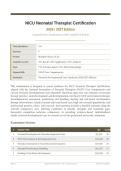
NICU Neonatal Therapist Certification
Edition
Comprehensive Examination with Complete Solutions
Total Questions 150
Sections 9
Format Multiple Choice (A-D)
Cognitive Levels 25% Recall / 50% Application / 25% Analysis
Style 75% Scenario-based / 25% Direct Knowledge
Aligned With NANT Core Competencies
Standards Neonatal Developmental Care Standards (2026/2027 Edition)
This examination is designed to assess readiness for NICU Neonatal Therapist Certification,
aligned with the National Association of Neonatal Therapists (NANT) Core Competencies and
current Neonatal Developmental Care Standards. Questions span nine core domains of neonatal
therapy practice: neurodevelopment and developmental care theory; NICU environmental design;
neurobehavioral assessment; positioning and handling; feeding and oral-motor development;
therapy interventions; family-centered and team-based care; high-risk neonatal populations; and
professional practice, ethics, and research. Each question includes a detailed rationale citing the
relevant competency area, allowing candidates to identify strengths and remediate gaps.
Successful completion indicates competency in providing evidence-based, individualized,
family-centered developmental care to neonates across the gestational and acuity continuum.
Examination Sections
# Section Title Q# Count
1 Neonatal Development & Neurodevelopmental Care Q1-Q20 20
2 NICU Environment & Developmental Care Q21-Q40 20
3 Neonatal Assessment & Neurobehavioral Evaluation Q41-Q60 20
4 Neonatal Positioning & Handling Q61-Q75 15
5 Feeding & Oral-Motor Development Q76-Q95 20
Page 1 Aligned with NANT Core Competencies 2026/2027 Edition
, 6 Neonatal Therapy Interventions Q96-Q115 20
7 Family-Centered Care & NICU Team Collaboration Q116-Q130 15
8 High-Risk Neonatal Populations & Special Considerations Q131-Q140 10
9 Professional Practice, Ethics, & Research Q141-Q150 10
This examination is intended for professional development and certification preparation. Each question includes a
rationale identifying the correct answer and the NANT-aligned competency it addresses.
Page 1 Aligned with NANT Core Competencies 2026/2027 Edition
, SECTION 1
20 Questions
Neonatal Development & Neurodevelopmental Care
Q1. A neonatal therapist is educating NICU staff about fetal brain development. During which
gestational age range does the most rapid phase of synaptogenesis occur in the human
cerebral cortex, producing the foundational overproduction of synaptic connections that
is later pruned by experience?
A. 8-15 weeks gestation, during primary neurulation
B. 16-22 weeks gestation, during neuronal migration
C. 24-32 weeks gestation and continuing through the third trimester *[CORRECT]*
D. Postnatally only, between 6 and 12 months corrected age
Correct Answer: C. 24-32 weeks gestation and continuing through the third trimester
Rationale: Synaptogenesis peaks between 24 and 32 weeks gestation and continues rapidly
through the third trimester, the very window during which very preterm infants are exposed to
the NICU environment. This exuberant synapse production, followed by experience-dependent
pruning, is central to NANT Core Competency 1 (Neonatal Neurodevelopment). Options A and B
occur too early; Option D ignores the critical prenatal onset of this process.
Q2. A 28-week preterm infant is cared for in a brightly lit, noisy open-bay NICU. The parents
ask the therapist why their infant's long-term development may be affected. Using Als'
Synactive Theory, which subsystem is MOST directly disrupted first when the autonomic
system is overwhelmed by environmental stress?
A. The motor subsystem, evidenced by flaccid extremities
B. The attention/interaction subsystem, evidenced by poor eye contact
C. The autonomic subsystem itself, evidenced by color changes, bradycardia, and
desaturations *[CORRECT]*
D. The state regulation subsystem, evidenced by prolonged crying
Correct Answer: C. The autonomic subsystem itself, evidenced by color changes, bradycardia,
and ...
Rationale: In Als' Synactive Theory, the autonomic system is the foundational subsystem; when
overwhelmed, it manifests color changes, bradycardia, desaturations, and respiratory instability
before higher-order subsystems (motor, state, attention) can be expected to organize. The other
subsystems depend on autonomic stability, so Options A, B, and D represent later breakdowns
that follow autonomic compromise rather than precede it.
Q3. Which statement BEST reflects current evidence regarding myelination in the developing
preterm brain?
A. Myelination is essentially complete by 28 weeks gestation.
B. Myelination proceeds in a caudal-to-rostral and dorsal-to-ventral pattern, with sensory
pathways myelinating before motor pathways. *[CORRECT]*
C. Myelination occurs in a proximodistal pattern with limb myelination preceding brainstem
myelination.
D. Preterm birth accelerates myelination so that it is complete by term-equivalent age.
Page 1 Aligned with NANT Core Competencies 2026/2027 Edition
, NICU Neonatal Therapist Certification 2026/2027 Complete Solutions | 150 Questions
Correct Answer: B. Myelination proceeds in a caudal-to-rostral and dorsal-to-ventral pattern,
wi...
Rationale: Myelination follows a caudal-to-rostral, dorsal-to-ventral, and proximal-to-distal
sequence, with sensory pathways generally myelinating before motor pathways. Preterm birth
does NOT accelerate myelination; in fact, NICU stressors and altered experience can delay or
disrupt normal myelination patterns. Options A and D are incorrect on timing; Option C reverses
the proximal-to-distal order for the brain.
Q4. A 30-week gestational age infant is 1 week old. The therapist notes that the infant's cortical
gray matter volume is reduced compared to term-born peers. Which factor contributes
MOST significantly to this preterm brain volume difference, according to current
neuroimaging evidence?
A. Genetic predisposition to microcephaly in preterm populations
B. Loss of the in-utero environment that normally supports third-trimester cortical
growth, combined with NICU stressors *[CORRECT]*
C. Excessive maternal folate supplementation during pregnancy
D. Hyperoxia-induced acceleration of neuronal apoptosis that is unavoidable
Correct Answer: B. Loss of the in-utero environment that normally supports third-trimester
corti...
Rationale: The third trimester is a critical period for cortical gyration, synaptogenesis, and
dendritic arborization, all of which depend on the buffered uterine environment. Preterm infants
lose this protective milieu and are exposed to noxious NICU stimuli, pain, and altered sensory
input, which contribute to reduced cortical volume and white matter abnormalities. NANT
competency emphasizes neuroprotective strategies to mitigate these effects. Options A, C, and D
are unsupported or inaccurate.
Q5. Which time window is widely considered the MOST critical for sensory development and
the formation of synaptic architecture in the preterm brain, such that adverse experience
during this window produces lasting changes?
A. 23-32 weeks postmenstrual age, the late second and early third trimester *[CORRECT]*
B. 0-3 months post-term, the early infancy window
C. 12-24 months corrected age, during early language acquisition
D. 36-40 weeks postmenstrual age, the immediate preterm-to-term transition
Correct Answer: A. 23-32 weeks postmenstrual age, the late second and early third trimester
Rationale: The 23-32 week postmenstrual age window corresponds to peak synaptogenesis, rapid
axonal and dendritic growth, and the onset of cortical organization. Preterm infants in the NICU
during this window are uniquely vulnerable to sensory disruption. NANT-aligned
neuroprotective care targets this period. Options B and C are postnatal windows of plasticity but
are not the critical period for foundational cortical architecture. Option D is too narrow and too
late.
Q6. A 26-week infant shows exaggerated startles, hiccups, and frequent desaturations during
routine care. The therapist wants to leverage the preterm brain's neuroplasticity to
support recovery. Which intervention BEST applies principles of experience-dependent
neuroplasticity?
Page 4 Aligned with NANT Core Competencies 2026/2027 Edition
Edition
Comprehensive Examination with Complete Solutions
Total Questions 150
Sections 9
Format Multiple Choice (A-D)
Cognitive Levels 25% Recall / 50% Application / 25% Analysis
Style 75% Scenario-based / 25% Direct Knowledge
Aligned With NANT Core Competencies
Standards Neonatal Developmental Care Standards (2026/2027 Edition)
This examination is designed to assess readiness for NICU Neonatal Therapist Certification,
aligned with the National Association of Neonatal Therapists (NANT) Core Competencies and
current Neonatal Developmental Care Standards. Questions span nine core domains of neonatal
therapy practice: neurodevelopment and developmental care theory; NICU environmental design;
neurobehavioral assessment; positioning and handling; feeding and oral-motor development;
therapy interventions; family-centered and team-based care; high-risk neonatal populations; and
professional practice, ethics, and research. Each question includes a detailed rationale citing the
relevant competency area, allowing candidates to identify strengths and remediate gaps.
Successful completion indicates competency in providing evidence-based, individualized,
family-centered developmental care to neonates across the gestational and acuity continuum.
Examination Sections
# Section Title Q# Count
1 Neonatal Development & Neurodevelopmental Care Q1-Q20 20
2 NICU Environment & Developmental Care Q21-Q40 20
3 Neonatal Assessment & Neurobehavioral Evaluation Q41-Q60 20
4 Neonatal Positioning & Handling Q61-Q75 15
5 Feeding & Oral-Motor Development Q76-Q95 20
Page 1 Aligned with NANT Core Competencies 2026/2027 Edition
, 6 Neonatal Therapy Interventions Q96-Q115 20
7 Family-Centered Care & NICU Team Collaboration Q116-Q130 15
8 High-Risk Neonatal Populations & Special Considerations Q131-Q140 10
9 Professional Practice, Ethics, & Research Q141-Q150 10
This examination is intended for professional development and certification preparation. Each question includes a
rationale identifying the correct answer and the NANT-aligned competency it addresses.
Page 1 Aligned with NANT Core Competencies 2026/2027 Edition
, SECTION 1
20 Questions
Neonatal Development & Neurodevelopmental Care
Q1. A neonatal therapist is educating NICU staff about fetal brain development. During which
gestational age range does the most rapid phase of synaptogenesis occur in the human
cerebral cortex, producing the foundational overproduction of synaptic connections that
is later pruned by experience?
A. 8-15 weeks gestation, during primary neurulation
B. 16-22 weeks gestation, during neuronal migration
C. 24-32 weeks gestation and continuing through the third trimester *[CORRECT]*
D. Postnatally only, between 6 and 12 months corrected age
Correct Answer: C. 24-32 weeks gestation and continuing through the third trimester
Rationale: Synaptogenesis peaks between 24 and 32 weeks gestation and continues rapidly
through the third trimester, the very window during which very preterm infants are exposed to
the NICU environment. This exuberant synapse production, followed by experience-dependent
pruning, is central to NANT Core Competency 1 (Neonatal Neurodevelopment). Options A and B
occur too early; Option D ignores the critical prenatal onset of this process.
Q2. A 28-week preterm infant is cared for in a brightly lit, noisy open-bay NICU. The parents
ask the therapist why their infant's long-term development may be affected. Using Als'
Synactive Theory, which subsystem is MOST directly disrupted first when the autonomic
system is overwhelmed by environmental stress?
A. The motor subsystem, evidenced by flaccid extremities
B. The attention/interaction subsystem, evidenced by poor eye contact
C. The autonomic subsystem itself, evidenced by color changes, bradycardia, and
desaturations *[CORRECT]*
D. The state regulation subsystem, evidenced by prolonged crying
Correct Answer: C. The autonomic subsystem itself, evidenced by color changes, bradycardia,
and ...
Rationale: In Als' Synactive Theory, the autonomic system is the foundational subsystem; when
overwhelmed, it manifests color changes, bradycardia, desaturations, and respiratory instability
before higher-order subsystems (motor, state, attention) can be expected to organize. The other
subsystems depend on autonomic stability, so Options A, B, and D represent later breakdowns
that follow autonomic compromise rather than precede it.
Q3. Which statement BEST reflects current evidence regarding myelination in the developing
preterm brain?
A. Myelination is essentially complete by 28 weeks gestation.
B. Myelination proceeds in a caudal-to-rostral and dorsal-to-ventral pattern, with sensory
pathways myelinating before motor pathways. *[CORRECT]*
C. Myelination occurs in a proximodistal pattern with limb myelination preceding brainstem
myelination.
D. Preterm birth accelerates myelination so that it is complete by term-equivalent age.
Page 1 Aligned with NANT Core Competencies 2026/2027 Edition
, NICU Neonatal Therapist Certification 2026/2027 Complete Solutions | 150 Questions
Correct Answer: B. Myelination proceeds in a caudal-to-rostral and dorsal-to-ventral pattern,
wi...
Rationale: Myelination follows a caudal-to-rostral, dorsal-to-ventral, and proximal-to-distal
sequence, with sensory pathways generally myelinating before motor pathways. Preterm birth
does NOT accelerate myelination; in fact, NICU stressors and altered experience can delay or
disrupt normal myelination patterns. Options A and D are incorrect on timing; Option C reverses
the proximal-to-distal order for the brain.
Q4. A 30-week gestational age infant is 1 week old. The therapist notes that the infant's cortical
gray matter volume is reduced compared to term-born peers. Which factor contributes
MOST significantly to this preterm brain volume difference, according to current
neuroimaging evidence?
A. Genetic predisposition to microcephaly in preterm populations
B. Loss of the in-utero environment that normally supports third-trimester cortical
growth, combined with NICU stressors *[CORRECT]*
C. Excessive maternal folate supplementation during pregnancy
D. Hyperoxia-induced acceleration of neuronal apoptosis that is unavoidable
Correct Answer: B. Loss of the in-utero environment that normally supports third-trimester
corti...
Rationale: The third trimester is a critical period for cortical gyration, synaptogenesis, and
dendritic arborization, all of which depend on the buffered uterine environment. Preterm infants
lose this protective milieu and are exposed to noxious NICU stimuli, pain, and altered sensory
input, which contribute to reduced cortical volume and white matter abnormalities. NANT
competency emphasizes neuroprotective strategies to mitigate these effects. Options A, C, and D
are unsupported or inaccurate.
Q5. Which time window is widely considered the MOST critical for sensory development and
the formation of synaptic architecture in the preterm brain, such that adverse experience
during this window produces lasting changes?
A. 23-32 weeks postmenstrual age, the late second and early third trimester *[CORRECT]*
B. 0-3 months post-term, the early infancy window
C. 12-24 months corrected age, during early language acquisition
D. 36-40 weeks postmenstrual age, the immediate preterm-to-term transition
Correct Answer: A. 23-32 weeks postmenstrual age, the late second and early third trimester
Rationale: The 23-32 week postmenstrual age window corresponds to peak synaptogenesis, rapid
axonal and dendritic growth, and the onset of cortical organization. Preterm infants in the NICU
during this window are uniquely vulnerable to sensory disruption. NANT-aligned
neuroprotective care targets this period. Options B and C are postnatal windows of plasticity but
are not the critical period for foundational cortical architecture. Option D is too narrow and too
late.
Q6. A 26-week infant shows exaggerated startles, hiccups, and frequent desaturations during
routine care. The therapist wants to leverage the preterm brain's neuroplasticity to
support recovery. Which intervention BEST applies principles of experience-dependent
neuroplasticity?
Page 4 Aligned with NANT Core Competencies 2026/2027 Edition

