
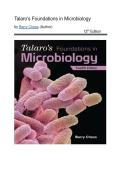
Talaro's Foundations in Microbiology
by Barry Chess (Author)
12th Edition
,TABLE OF CONTENTS
1. The Main Themes of Microbiology
2. The Chemistry of Biology
3. Tools of the Laboratory: Methods of Studying Microorganisms
4. A Survey of Prokaryotic Cells and Microorganisms
5. A Survey of Eukaryotic Cells and Microorganisms
6. An Introduction to Viruses, Viroids, and Prions
7. Microbial Nutrition, Ecology, and Growth
8. An Introduction to Microbial Metabolism: The Chemical Crossroads of Life
9. An Introduction to Microbial Genetics
10. Genetic Engineering: A Revolution in Molecular Biology
11. Physical and Chemical Agents for Microbial Control
12. Drugs, Microbes, Host--The Elements of Chemotherapy
13. Microbe-Human Interactions: Infection, Disease, and Epidemiology
14. An Introduction to Host Defenses and Innate Immunities
15. Adaptive, Specific Immunity and Immunization
16. Disorders in Immunity
17. Procedures for Identifying Pathogens and Diagnosing Infections
,TEST BANK
Talaro's Foundations in Microbiology, 12th Edition
By Barry Chess
CHAPTER 1: THE MAIN THEMES OF MICROBIOLOGY
Multiple Choice Questions
1. Which of the following is NOT a major group of microorganisms?
a) Bacteria
b) Fungi
c) Plants
d) Protozoa
e) Algae
Answer: c) Plants
Rationale: Plants are not microorganisms. The major groups of microorganisms include bacteria,
archaea, fungi, protozoa, algae, and helminths (studied in microbiology due to their parasitic nature).
Viruses are also studied in microbiology.
2. The term "microorganism" best describes:
a) Any organism that causes disease
b) An organism that is too small to be seen without magnification
c) Only bacteria and viruses
d) Any single-celled organism
e) Only prokaryotic organisms
Answer: b) An organism that is too small to be seen without magnification
Rationale: Microorganisms are defined by their small size, requiring magnification to be observed. Not all
microorganisms cause disease, and the group includes both prokaryotic and eukaryotic organisms as
well as viruses.
3. Who is considered the "Father of Microbiology" based on his observations of "animalcules" using a
simple microscope?
a) Robert Koch
b) Louis Pasteur
c) Antonie van Leeuwenhoek
, d) Joseph Lister
e) Edward Jenner
Answer: c) Antonie van Leeuwenhoek
Rationale: Antonie van Leeuwenhoek (1632–1723) was the first person to observe and describe
microorganisms, which he called "animalcules," using simple single-lens microscopes he crafted himself.
4. The theory of spontaneous generation stated that:
a) Microorganisms arise from preexisting microorganisms
b) Living organisms can arise from nonliving matter
c) Disease is caused by microorganisms
d) All cells come from preexisting cells
e) Fermentation is caused by living yeast
Answer: b) Living organisms can arise from nonliving matter
Rationale: Spontaneous generation was the belief that living organisms could arise spontaneously from
nonliving or decomposing matter. This was disproved through the work of Francesco Redi, Louis Pasteur,
and John Tyndall, among others.
5. Louis Pasteur's swan-neck flask experiment was designed to:
a) Demonstrate the existence of viruses
b) Prove that fermentation requires oxygen
c) Disprove spontaneous generation
d) Isolate pure cultures of bacteria
e) Develop vaccines for anthrax
Answer: c) Disprove spontaneous generation
Rationale: Pasteur's elegant swan-neck flask experiment allowed air to enter the flask while trapping
microorganisms in the curved neck, demonstrating that microbial growth only occurred when microbes
had access to the nutrient broth, thus disproving spontaneous generation.
6. Robert Koch's postulates are used to:
a) Classify microorganisms into taxonomic groups
b) Establish a causal link between a specific microorganism and a specific disease
c) Determine the best antibiotic for treating an infection
d) Identify the mode of transmission of an infectious disease
e) Develop vaccines for viral diseases
Answer: b) Establish a causal link between a specific microorganism and a specific disease
Rationale: Koch's postulates provide a systematic method for proving that a specific microorganism
causes a specific disease. They require the microbe to be found in all cases of the disease, isolated in pure
culture, reproduce the disease when introduced into a healthy host, and be reisolated from the
experimental host.

