
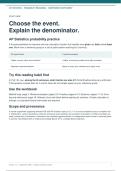
AP STATISTICS / PROBABILITY REASONING / INDEPENDENT SUPPLEMENT
START HERE
Choose the event.
Explain the denominator.
AP Statistics probability practice
A focused workbook for learners who can calculate a fraction but hesitate over given, or, both and at least
one. Work from a reference group or a set of paths before reaching for a formula.
20 original tasks 3 worked examples
Tables, events, paths and simulation A table, a branching model and a digit simulation
Separate reasoned solutions Space to show your method and a repair route
Try this reading habit first
In P(A | B), say: among the B outcomes, what fraction are also A? Circle B before doing any arithmetic.
If the question instead asks for A and B, keep the full sample space as your reference group.
Use the workbook
Method map: page 2. Worked examples: pages 3-5. Practice: pages 6-10. Solutions: pages 11-15. Error
log and references: page 16. Attempt a four-task block before opening its solutions. A basic calculator is
enough; no calculator-brand commands are required.
Scope and provenance
A narrow supplement supporting selected Fall 2026 AP Statistics topics 2.2-2.7. It is not the complete course or complete Unit
2. Distributions, normal calculations, inference and actual exam questions are excluded. All situations, numbers and tasks are
newly created with AI assistance. Calculations are checked programmatically; no independent expert review or achieved grade
is claimed. Not affiliated with or endorsed by College Board. AP is a College Board trademark.
Version 1.0 | September 2026 | Original synthetic practice 1
,AP STATISTICS / PROBABILITY REASONING / INDEPENDENT SUPPLEMENT
METHOD MAP
Read the words before
choosing the operation.
Question wording Reference group / method
A given B: P(A | B) Restrict to B. Divide the joint count by the B count. Requires P(B) > 0.
A and B: both Use the overlap. In a path model multiply P(A) by P(B | A).
A or B: at least one Add the two margins, then subtract their overlap once.
Neither A nor B Subtract the union from 1.
At least one success Consider 1 - P(no successes).
Independent? Check joint = product of margins; do not assume it from separate names.
Mutually exclusive? Check no shared outcomes: the joint probability is zero.
Compact reference
P(A | B) = P(A and B) / P(B)
P(A and B) = P(A) x P(B | A)
P(A or B) = P(A) + P(B) - P(A and B)
P(not A) = 1 - P(A)
Before accepting an answer
Check that a probability lies between 0 and 1. The overlap cannot exceed either margin. Two disjoint
events with positive probabilities cannot be independent: their joint probability is zero, but the product of
their margins is positive. Keep fractions or full precision during the calculation; round only the reported final
value.
Show your reasoning
Write: event in words -> reference group or paths -> expression with values -> answer in context. A correct
decimal alone does not show that you chose the right model.
Version 1.0 | September 2026 | Original synthetic practice 2
, AP STATISTICS / PROBABILITY REASONING / INDEPENDENT SUPPLEMENT
WORKED EXAMPLE 1
One table.
Three different questions.
A synthetic register contains 120 makers. Each selects a session time and whether to reserve a tool kit.
Choose one maker uniformly at random. Let M = morning and K = kit reserved.
Kit K No kit Total
Morning M 30 18 48
Afternoon 42 30 72
Total 72 48 120
A. Morning and kit
The reference group is all 120 makers. The overlap contains 30.
P(M and K) = 30/120 = 0.25.
B. Kit, given morning
Only 48 morning makers remain in the reference group. Of them, 30 reserved a kit.
P(K | M) = 30/48 = 0.625. This is a share of morning makers.
C. Morning, given kit
Now restrict to the 72 kit reservations.
P(M | K) = 30/72 = 5/12, approximately 0.4167. Reversing the condition keeps the overlap but changes
the denominator.
An independence check
P(K) = 72/120 = 0.60, which differs from P(K | M) = 0.625. These events are not independent for a uniformly
chosen register entry. This comparison describes the synthetic table, not a causal effect of attending in the
morning.
Version 1.0 | September 2026 | Original synthetic practice 3

