

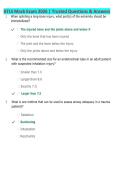
ATLS Mock Exam 2026 | Trusted Questions & Answers
1. When splinting a long-bone injury, what part(s) of the extremity should be
immobilized?
The injured bone and the joints above and below it
Only the bone that has been injured
The joint and the bone below the injury
Only the joints above and below the injury
2. What is the recommended size for an endotracheal tube in an adult patient
with suspected inhalation injury?
Smaller than 7.0
Larger than 8.0
Exactly 7.5
Larger than 7.5
3. What is one method that can be used to assess airway adequacy in a trauma
patient?
Sedation
Suctioning
Intubation
Restraints
,4. In a scenario where a trauma patient presents with pale, cool skin and
delayed capillary refill, what does this suggest about their hemodynamic
status?
The patient may be experiencing inadequate blood flow or shock.
The patient is likely well-hydrated and stable.
The patient has a normal hemodynamic status and requires no
immediate intervention.
The patient is experiencing a respiratory issue unrelated to
hemodynamics.
5. In a trauma scenario where a patient presents with severe facial trauma and
signs of airway obstruction, what would be the most appropriate intervention
if edema of the glottis is suspected?
Establish a surgical airway
Administer oxygen via a non-rebreather mask
Attempt to place a nasopharyngeal airway
Perform a tracheostomy immediately without assessment
6. What is the primary cause of burn shock in trauma patients?
Hemorrhagic loss
Hypothermia
Interstitial loss due to inflammation
Evaporative loss through the disrupted skin
7. Describe why the vertical incision technique is preferred for surgical
cricothyroidotomy in pediatric patients.
, The vertical incision technique minimizes the risk of injury to
surrounding structures and allows for better access to the airway.
The vertical incision technique is faster and requires less training.
The vertical incision technique is easier to perform in adults than in
children.
The vertical incision technique is used primarily for cosmetic reasons.
8. Methods for maintaining normothermia of the trauma patient include:
Warm blankets
Minimal exposure to open air
Pre-warming the operating room
All of the above
9. When a patient has an open fracture, it is best practice to automatically start
IV antibiotics and give what immunization?
Pneumonia
Tetanus
Rabies
Influenza
10. In a trauma scenario, if a patient presents with symptoms of central cord
syndrome after a fall, what immediate management steps should be taken to
address potential airway and hemodynamic issues?
Administer pain medication and wait for further evaluation.
Focus solely on treating the lower extremities without addressing
airway concerns.
, Assess and secure the airway, monitor vital signs, and provide
intravenous fluids as needed.
Immediately perform surgery to decompress the spinal cord.
11. What is the formula used to estimate mean normal pediatric blood pressure?
60 + (2 x age in years)
80 + (3 x age in years)
90 + (2 x age in years)
70 + (2 x age in years)
12. In a scenario where a patient has sustained severe burns and is exhibiting
signs of airway obstruction, what should be the immediate priority in trauma
management?
Conduct a primary survey to assess airway and circulation.
Focus solely on treating the burns.
Administer pain relief before assessing the patient.
Wait for the patient to stabilize before conducting any assessments.
13. Which of the following is considered a musculoskeletal adjunct to primary
surgery in trauma management?
Applying a splint(s)
Performing a physical examination
Administering pain medication
Conducting a neurological assessment
14. A client is admitted to the emergency department with a suspected cervical
spine fracture at the C3 level. The nurse is most concerned about the client's
1. When splinting a long-bone injury, what part(s) of the extremity should be
immobilized?
The injured bone and the joints above and below it
Only the bone that has been injured
The joint and the bone below the injury
Only the joints above and below the injury
2. What is the recommended size for an endotracheal tube in an adult patient
with suspected inhalation injury?
Smaller than 7.0
Larger than 8.0
Exactly 7.5
Larger than 7.5
3. What is one method that can be used to assess airway adequacy in a trauma
patient?
Sedation
Suctioning
Intubation
Restraints
,4. In a scenario where a trauma patient presents with pale, cool skin and
delayed capillary refill, what does this suggest about their hemodynamic
status?
The patient may be experiencing inadequate blood flow or shock.
The patient is likely well-hydrated and stable.
The patient has a normal hemodynamic status and requires no
immediate intervention.
The patient is experiencing a respiratory issue unrelated to
hemodynamics.
5. In a trauma scenario where a patient presents with severe facial trauma and
signs of airway obstruction, what would be the most appropriate intervention
if edema of the glottis is suspected?
Establish a surgical airway
Administer oxygen via a non-rebreather mask
Attempt to place a nasopharyngeal airway
Perform a tracheostomy immediately without assessment
6. What is the primary cause of burn shock in trauma patients?
Hemorrhagic loss
Hypothermia
Interstitial loss due to inflammation
Evaporative loss through the disrupted skin
7. Describe why the vertical incision technique is preferred for surgical
cricothyroidotomy in pediatric patients.
, The vertical incision technique minimizes the risk of injury to
surrounding structures and allows for better access to the airway.
The vertical incision technique is faster and requires less training.
The vertical incision technique is easier to perform in adults than in
children.
The vertical incision technique is used primarily for cosmetic reasons.
8. Methods for maintaining normothermia of the trauma patient include:
Warm blankets
Minimal exposure to open air
Pre-warming the operating room
All of the above
9. When a patient has an open fracture, it is best practice to automatically start
IV antibiotics and give what immunization?
Pneumonia
Tetanus
Rabies
Influenza
10. In a trauma scenario, if a patient presents with symptoms of central cord
syndrome after a fall, what immediate management steps should be taken to
address potential airway and hemodynamic issues?
Administer pain medication and wait for further evaluation.
Focus solely on treating the lower extremities without addressing
airway concerns.
, Assess and secure the airway, monitor vital signs, and provide
intravenous fluids as needed.
Immediately perform surgery to decompress the spinal cord.
11. What is the formula used to estimate mean normal pediatric blood pressure?
60 + (2 x age in years)
80 + (3 x age in years)
90 + (2 x age in years)
70 + (2 x age in years)
12. In a scenario where a patient has sustained severe burns and is exhibiting
signs of airway obstruction, what should be the immediate priority in trauma
management?
Conduct a primary survey to assess airway and circulation.
Focus solely on treating the burns.
Administer pain relief before assessing the patient.
Wait for the patient to stabilize before conducting any assessments.
13. Which of the following is considered a musculoskeletal adjunct to primary
surgery in trauma management?
Applying a splint(s)
Performing a physical examination
Administering pain medication
Conducting a neurological assessment
14. A client is admitted to the emergency department with a suspected cervical
spine fracture at the C3 level. The nurse is most concerned about the client's

