

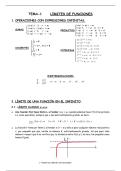
TEMA-1 LÍMITES DE FUNCIONES
1. OPERACIONES CON EXPRESIONES INFINITAS.
(+ ) + 𝐋 = + (+) · (+ ) = +
(+ ) + (+) = + (+) · 𝐋 = + 𝐬𝐢 𝐋 > 𝟎
SUMAS { PRODUCTOS (−) · 𝐋 = − 𝐬𝐢 𝐋 > 𝟎
(−) + 𝐋 = −
(−) + (−) = − (+) · 𝐋 = − 𝐬𝐢 𝐋 < 𝟎
{(−) · 𝐋 = + 𝐬𝐢 𝐋 < 𝟎
𝑳 (+)(+) = +∞
=𝟎
±∞ (+)(−) = 0
𝑳
= ±∞, 𝒔𝒊 𝑳≠𝟎 (+)𝑙 = +∞, 𝑠𝑖 𝑙 > 0
COCIENTES 𝟎
𝟎 (+)𝑙 = 0 , 𝑠𝑖 𝑙 < 0
±∞
=𝟎 POTENCIAS
±∞
𝑙(+) = 0, 𝑠𝑖 0 < 𝑙 < 1
{ 𝟎 = ±∞ 𝑙(−) = +∞, 𝑠𝑖 0 < 𝑙 < 1
𝑙(+) = +∞, 𝑠𝑖 𝑙 > 1
{ 𝑙(−) = 0, 𝑠𝑖 𝑙 > 1
INDETERMINACIONES
0 ±∞
, , ∞−∞ , 0⋅∞ , 1∞ , 00 , ∞0
0 ±∞
2. LÍMITE DE UNA FUNCIÓN EN EL INFINITO.
2.1. LÍMITE CUANDO x→+.
❑ Una función f(x) tiene límite L al tender x a + , cuando podemos hacer f(x) tan próximo
a L como queramos, siempre que x sea suficientemente grande, es decir,
lim f (x ) = L 0 K 0 / x K f (x ) − L
x →+
❑ La función f tiene por límite L al tender x a + si y sólo si para cualquier número real positivo
,por pequeño que sea, existe un número K, suficientemente grande, tal que para todo
número x mayor que K se verifica que, la distancia entre f(x) y L se hace tan pequeña como
hemos fijado.
Ly
x
- 1 –TEORÍA DE LÍMITES DE FUNCIONES
, ❑ Una función tiene como límite + en + cuando podemos hacer f(x) tan grande como
queramos, siempre que x sea suficientemente grande. y
lim f (x ) = + K 0 H 0/ xH f (x ) K
x →+
x
❑ Una función tiene como límite - en + cuando podemos hacer f(x) tan pequeño como
queramos, siempre que x sea suficientemente grande. y x
lim f (x ) = − K 0 H 0/ xH f (x ) K
x →+
2.2. LÍMITE CUANDO x→- .
❑ Una función f(x) tiene límite L al tender x a - , cuando podemos hacer f(x) tan próximo
a L como queramos, siempre que x sea suficientemente pequeño, es decir, y
lim f (x ) = L 0 H 0/ x H f (x ) − L
x →−
x
❑ Una función tiene como límite + en - cuando podemos hacer f(x) tan grande como
queramos, siempre que x sea suficientemente pequeño. y
lim f (x ) = + K 0 H 0/ xH f (x ) K
x →−
x
❑ Una función tiene como límite - en - cuando podemos hacer f(x) tan pequeño como
queramos, siempre que x sea suficientemente pequeño.
y
lim f (x ) = − K 0 H 0/ xH f (x ) K x
x →−
- 2 –TEORÍA DE LÍMITES DE FUNCIONES
1. OPERACIONES CON EXPRESIONES INFINITAS.
(+ ) + 𝐋 = + (+) · (+ ) = +
(+ ) + (+) = + (+) · 𝐋 = + 𝐬𝐢 𝐋 > 𝟎
SUMAS { PRODUCTOS (−) · 𝐋 = − 𝐬𝐢 𝐋 > 𝟎
(−) + 𝐋 = −
(−) + (−) = − (+) · 𝐋 = − 𝐬𝐢 𝐋 < 𝟎
{(−) · 𝐋 = + 𝐬𝐢 𝐋 < 𝟎
𝑳 (+)(+) = +∞
=𝟎
±∞ (+)(−) = 0
𝑳
= ±∞, 𝒔𝒊 𝑳≠𝟎 (+)𝑙 = +∞, 𝑠𝑖 𝑙 > 0
COCIENTES 𝟎
𝟎 (+)𝑙 = 0 , 𝑠𝑖 𝑙 < 0
±∞
=𝟎 POTENCIAS
±∞
𝑙(+) = 0, 𝑠𝑖 0 < 𝑙 < 1
{ 𝟎 = ±∞ 𝑙(−) = +∞, 𝑠𝑖 0 < 𝑙 < 1
𝑙(+) = +∞, 𝑠𝑖 𝑙 > 1
{ 𝑙(−) = 0, 𝑠𝑖 𝑙 > 1
INDETERMINACIONES
0 ±∞
, , ∞−∞ , 0⋅∞ , 1∞ , 00 , ∞0
0 ±∞
2. LÍMITE DE UNA FUNCIÓN EN EL INFINITO.
2.1. LÍMITE CUANDO x→+.
❑ Una función f(x) tiene límite L al tender x a + , cuando podemos hacer f(x) tan próximo
a L como queramos, siempre que x sea suficientemente grande, es decir,
lim f (x ) = L 0 K 0 / x K f (x ) − L
x →+
❑ La función f tiene por límite L al tender x a + si y sólo si para cualquier número real positivo
,por pequeño que sea, existe un número K, suficientemente grande, tal que para todo
número x mayor que K se verifica que, la distancia entre f(x) y L se hace tan pequeña como
hemos fijado.
Ly
x
- 1 –TEORÍA DE LÍMITES DE FUNCIONES
, ❑ Una función tiene como límite + en + cuando podemos hacer f(x) tan grande como
queramos, siempre que x sea suficientemente grande. y
lim f (x ) = + K 0 H 0/ xH f (x ) K
x →+
x
❑ Una función tiene como límite - en + cuando podemos hacer f(x) tan pequeño como
queramos, siempre que x sea suficientemente grande. y x
lim f (x ) = − K 0 H 0/ xH f (x ) K
x →+
2.2. LÍMITE CUANDO x→- .
❑ Una función f(x) tiene límite L al tender x a - , cuando podemos hacer f(x) tan próximo
a L como queramos, siempre que x sea suficientemente pequeño, es decir, y
lim f (x ) = L 0 H 0/ x H f (x ) − L
x →−
x
❑ Una función tiene como límite + en - cuando podemos hacer f(x) tan grande como
queramos, siempre que x sea suficientemente pequeño. y
lim f (x ) = + K 0 H 0/ xH f (x ) K
x →−
x
❑ Una función tiene como límite - en - cuando podemos hacer f(x) tan pequeño como
queramos, siempre que x sea suficientemente pequeño.
y
lim f (x ) = − K 0 H 0/ xH f (x ) K x
x →−
- 2 –TEORÍA DE LÍMITES DE FUNCIONES

