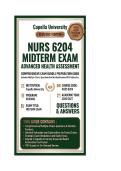
,NURS 6204 Midterm Exam Advanced Health Assessment Questions
And Answers | 2026/2027 Capella University
Q1. Which component of the health history identifies the main
reason the patient is seeking care?
A) Review of systems
B) Chief complaint
C) Family history
D) Social history
Correct Answer: B) Chief complaint
Rationale: The chief complaint is the brief statement describing the primary
reason the patient presents for healthcare.
Q2. Which component of the history describes the patient's current
symptoms in greater detail?
A) History of present illness
B) Family history
C) Past surgical history
D) Social history
Correct Answer: A) History of present illness
Rationale: The history of present illness expands on the chief complaint and
describes the onset, characteristics, timing, associated symptoms, and other
relevant details.
Q3. Which question is most appropriate for obtaining the history of
present illness?
A) “What is your favorite food?”
B) “Can you tell me when the pain started?”
C) “What illnesses did your parents have?”
D) “Where were you born?”
Correct Answer: B) “Can you tell me when the pain started?”
Rationale: Questions about onset, location, duration, quality, severity, and
associated factors help characterize the present illness.
Q4. Which question is open-ended?
A) “Is the pain sharp?”
B) “Does the pain occur at night?”
, C) “Tell me what brought you in today.”
D) “Is your pain a 7 out of 10?”
Correct Answer: C) “Tell me what brought you in today.”
Rationale: Open-ended questions encourage the patient to describe concerns
in their own words and provide more complete information.
Q5. Which communication behavior is most therapeutic during a
patient interview?
A) Interrupting frequently
B) Maintaining attentive body language
C) Changing the topic quickly
D) Asking several questions at once
Correct Answer: B) Maintaining attentive body language
Rationale: Appropriate eye contact, posture, facial expression, and focused
attention communicate interest and encourage disclosure.
**Q6. Which interviewing technique helps the patient continue discussing a
concern?
A) Facilitation
B) Confrontation
C) False reassurance
D) Changing the subject
Correct Answer: A) Facilitation
Rationale: Facilitation uses verbal or nonverbal cues such as “Go on” or a nod
to encourage the patient to continue.
**Q7. Which response is an example of therapeutic communication?
A) “Everything will be fine.”
B) “Why are you so worried?”
C) “Tell me more about what concerns you.”
D) “You should not think that way.”
Correct Answer: C) “Tell me more about what concerns you.”
Rationale: This response invites the patient to explore concerns without
minimizing or judging the patient's feelings.
**Q8. Which response is false reassurance?
And Answers | 2026/2027 Capella University
Q1. Which component of the health history identifies the main
reason the patient is seeking care?
A) Review of systems
B) Chief complaint
C) Family history
D) Social history
Correct Answer: B) Chief complaint
Rationale: The chief complaint is the brief statement describing the primary
reason the patient presents for healthcare.
Q2. Which component of the history describes the patient's current
symptoms in greater detail?
A) History of present illness
B) Family history
C) Past surgical history
D) Social history
Correct Answer: A) History of present illness
Rationale: The history of present illness expands on the chief complaint and
describes the onset, characteristics, timing, associated symptoms, and other
relevant details.
Q3. Which question is most appropriate for obtaining the history of
present illness?
A) “What is your favorite food?”
B) “Can you tell me when the pain started?”
C) “What illnesses did your parents have?”
D) “Where were you born?”
Correct Answer: B) “Can you tell me when the pain started?”
Rationale: Questions about onset, location, duration, quality, severity, and
associated factors help characterize the present illness.
Q4. Which question is open-ended?
A) “Is the pain sharp?”
B) “Does the pain occur at night?”
, C) “Tell me what brought you in today.”
D) “Is your pain a 7 out of 10?”
Correct Answer: C) “Tell me what brought you in today.”
Rationale: Open-ended questions encourage the patient to describe concerns
in their own words and provide more complete information.
Q5. Which communication behavior is most therapeutic during a
patient interview?
A) Interrupting frequently
B) Maintaining attentive body language
C) Changing the topic quickly
D) Asking several questions at once
Correct Answer: B) Maintaining attentive body language
Rationale: Appropriate eye contact, posture, facial expression, and focused
attention communicate interest and encourage disclosure.
**Q6. Which interviewing technique helps the patient continue discussing a
concern?
A) Facilitation
B) Confrontation
C) False reassurance
D) Changing the subject
Correct Answer: A) Facilitation
Rationale: Facilitation uses verbal or nonverbal cues such as “Go on” or a nod
to encourage the patient to continue.
**Q7. Which response is an example of therapeutic communication?
A) “Everything will be fine.”
B) “Why are you so worried?”
C) “Tell me more about what concerns you.”
D) “You should not think that way.”
Correct Answer: C) “Tell me more about what concerns you.”
Rationale: This response invites the patient to explore concerns without
minimizing or judging the patient's feelings.
**Q8. Which response is false reassurance?