
Page 1 of 59
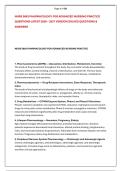
NURS 5663 PHARMACOLOGY FOR ADVANCED NURSING PRACTICE
QUESTIONS LATEST 2026 – 2027 VERSION SOLVED QUESTIONS &
ANSWERS
NURS 5663 PHARMACOLOGY FOR ADVANCED NURSING PRACTICE
1. Pharmacokinetics (ADME) — Absorption, Distribution, Metabolism, Excretion
The study of drug movement throughout the body. Key concepts include bioavailability,
first-pass effect, protein binding, volume of distribution, and half-life. The four basic
concepts are absorption into blood, distribution from blood to tissues, metabolism
(biotransformation), and excretion.
2. Pharmacodynamics — Drug-Receptor Interactions, Dose-Response, Therapeutic
Index
The study of biochemical and physiologic effects of drugs on the body and molecular
mechanisms of action. Covers agonists vs. antagonists, affinity vs. intrinsic activity,
dose-response curves, therapeutic index, and receptor theory.
3. Drug Metabolism — CYP450 Enzyme System, Phase I and Phase II Reactions
Phase I reactions (oxidation via cytochrome P450, reduction, hydrolysis) convert parent
drugs to more polar active metabolites. Phase II involves conjugation reactions. CYP450
inducers and inhibitors significantly alter drug metabolism and cause clinically
important drug interactions.
4. Lifespan Pharmacology — Neonates, Pregnancy, Elderly
Age-related changes affect pharmacokinetics and pharmacodynamics. Geriatric
patients experience decreased renal clearance, altered protein binding, polypharmacy
risks, and increased adverse drug reactions. Neonates have immature hepatic and renal
function. Pregnancy alters drug distribution and metabolism.
5. Peripheral Nervous System Pharmacology — Cholinergic and Adrenergic Agents
Covers cholinergic agonists, anticholinergics, adrenergic agonists, and adrenergic
antagonists. Includes drugs such as dobutamine, prazosin, and muscarinic agonists
and their clinical applications.
, Page 2 of 59
6. Central Nervous System Pharmacology — Anxiolytics, Antidepressants,
Antipsychotics, Anticonvulsants
Covers benzodiazepines (antidote: flumazenil), antidepressants, antipsychotics, and
mood stabilizers. Includes mechanisms of action, adverse effects, and clinical
considerations.
7. Cardiovascular and Renal Pharmacology — Antihypertensives, Diuretics,
Antianginals
Includes ACE inhibitors, ARBs, calcium channel blockers, beta-blockers, diuretics, and
nitrates. Covers mechanisms of vasodilation, reduction of calcium influx via L-type
channels, and clinical monitoring parameters.
8. Endocrine Pharmacology — Thyroid Hormones, Insulin, Glucocorticoids,
Reproductive Hormones
Covers thyroid hormone synthesis and regulation, insulin types and indications, insulin
vs. glucagon characteristics, adverse effects of glucocorticoids, and the menstrual
cycle with pharmacological implications.
9. Anti-Infective Pharmacology — Antibiotics, Antifungals, Antivirals
Covers tetracyclines (30S ribosomal subunit binding, bacteriostatic), penicillins,
cephalosporins, aminoglycosides, and combination chemotherapy principles. Includes
mechanisms of action, resistance patterns, and cross-resistance concerns.
10. Gastrointestinal and Respiratory Pharmacology — PPIs, H2 Blockers,
Antiemetics, Bronchodilators
Covers proton pump inhibitors, H2 receptor antagonists, antiemetics, inhaled
corticosteroids, beta-2 agonists, and leukotriene modifiers. Includes peptic ulcer
treatment approaches and asthma management principles.
QUESTIONS WITH RATIONALES
SECTION 1: PHARMACOKINETICS & PHARMACODYNAMICS (Questions 1–30)
1. A nurse practitioner is teaching a patient about a medication that is highly
protein-bound. Which statement best explains the clinical significance of this
property?
A) The drug will have a rapid onset of action
B) The drug will have a prolonged duration of action
C) Only the unbound fraction of the drug is pharmacologically active
D) The drug will be excreted more rapidly
Answer: C
Rationale: Only unbound drug molecules can cross membranes and interact with
, Page 3 of 59
receptors. High protein binding limits the active free fraction and can lead to drug
interactions when displaced by other protein-bound drugs.
2. A patient with hepatic cirrhosis is prescribed a medication that undergoes
extensive first-pass metabolism. Which dosage adjustment is most appropriate?
A) Increase the oral dose to ensure therapeutic effect
B) Decrease the oral dose due to reduced metabolism
C) No adjustment is necessary
D) Switch to a more hepatotoxic alternative
Answer: B
Rationale: Hepatic cirrhosis reduces first-pass metabolism, increasing oral
bioavailability. Lowering the dose prevents toxicity from excessive drug accumulation.
3. Which pharmacokinetic parameter describes the volume of plasma from which a
drug is completely removed per unit of time?
A) Half-life
B) Volume of distribution
C) Clearance
D) Bioavailability
Answer: C
Rationale: Clearance quantifies the rate at which a drug is eliminated from the body
and is expressed as volume per unit time (e.g., mL/min).
4. A nurse practitioner calculates that a drug has a half-life of 6 hours.
Approximately how long will it take to reach steady-state plasma concentration
with continuous dosing?
A) 6 hours
B) 12 hours
C) 24–30 hours
D) 48 hours
Answer: C
Rationale: Steady state is typically reached after approximately 4–5 half-lives. With a 6-
hour half-life, steady state occurs in approximately 24–30 hours.
5. Which of the following best describes the difference between
pharmacodynamics and pharmacokinetics?
A) Pharmacodynamics is what the body does to the drug; pharmacokinetics is what the
drug does to the body
B) Pharmacodynamics is what the drug does to the body; pharmacokinetics is what the
body does to the drug
C) Both terms describe drug metabolism
D) Pharmacokinetics only applies to intravenous drugs
Answer: B
, Page 4 of 59
Rationale: Pharmacodynamics evaluates the biochemical and physiologic effects of
drugs and their molecular mechanisms of action, while pharmacokinetics describes
drug movement through absorption, distribution, metabolism, and excretion.
6. A patient is taking warfarin, which is highly protein-bound. If the patient is also
prescribed a drug that displaces warfarin from albumin, what is the expected
clinical effect?
A) Decreased warfarin effect
B) Increased risk of bleeding
C) No change in warfarin effect
D) Increased warfarin metabolism
Answer: B
Rationale: Displacement from albumin increases the free (active) fraction of warfarin,
enhancing its anticoagulant effect and increasing bleeding risk.
7. Which route of administration provides 100% bioavailability?
A) Oral
B) Rectal
C) Intravenous
D) Subcutaneous
Answer: C
Rationale: Intravenous administration bypasses absorption barriers entirely, delivering
the full dose directly into systemic circulation.
8. A drug that is a CYP450 enzyme inducer will have what effect on the metabolism
of a concurrently administered substrate drug?
A) Decreased metabolism of the substrate
B) Increased metabolism of the substrate
C) No effect on substrate metabolism
D) Competitive inhibition of substrate metabolism
Answer: B
Rationale: Enzyme inducers increase CYP450 enzyme activity, accelerating the
metabolism of substrate drugs and potentially reducing their therapeutic efficacy.
9. Which statement correctly describes the role of CYP450 enzyme inhibitors in
drug metabolism?
A) They increase the metabolic activity of CYP450 enzymes
B) They block the metabolic activity of CYP450 enzymes
C) They have no effect on drug metabolism
D) They only affect Phase II reactions
Answer: B
Rationale: CYP450 inhibitors block or reduce enzyme activity, decreasing the
metabolism of substrate drugs and increasing their plasma concentrations.
NURS 5663 PHARMACOLOGY FOR ADVANCED NURSING PRACTICE
QUESTIONS LATEST 2026 – 2027 VERSION SOLVED QUESTIONS &
ANSWERS
NURS 5663 PHARMACOLOGY FOR ADVANCED NURSING PRACTICE
1. Pharmacokinetics (ADME) — Absorption, Distribution, Metabolism, Excretion
The study of drug movement throughout the body. Key concepts include bioavailability,
first-pass effect, protein binding, volume of distribution, and half-life. The four basic
concepts are absorption into blood, distribution from blood to tissues, metabolism
(biotransformation), and excretion.
2. Pharmacodynamics — Drug-Receptor Interactions, Dose-Response, Therapeutic
Index
The study of biochemical and physiologic effects of drugs on the body and molecular
mechanisms of action. Covers agonists vs. antagonists, affinity vs. intrinsic activity,
dose-response curves, therapeutic index, and receptor theory.
3. Drug Metabolism — CYP450 Enzyme System, Phase I and Phase II Reactions
Phase I reactions (oxidation via cytochrome P450, reduction, hydrolysis) convert parent
drugs to more polar active metabolites. Phase II involves conjugation reactions. CYP450
inducers and inhibitors significantly alter drug metabolism and cause clinically
important drug interactions.
4. Lifespan Pharmacology — Neonates, Pregnancy, Elderly
Age-related changes affect pharmacokinetics and pharmacodynamics. Geriatric
patients experience decreased renal clearance, altered protein binding, polypharmacy
risks, and increased adverse drug reactions. Neonates have immature hepatic and renal
function. Pregnancy alters drug distribution and metabolism.
5. Peripheral Nervous System Pharmacology — Cholinergic and Adrenergic Agents
Covers cholinergic agonists, anticholinergics, adrenergic agonists, and adrenergic
antagonists. Includes drugs such as dobutamine, prazosin, and muscarinic agonists
and their clinical applications.
, Page 2 of 59
6. Central Nervous System Pharmacology — Anxiolytics, Antidepressants,
Antipsychotics, Anticonvulsants
Covers benzodiazepines (antidote: flumazenil), antidepressants, antipsychotics, and
mood stabilizers. Includes mechanisms of action, adverse effects, and clinical
considerations.
7. Cardiovascular and Renal Pharmacology — Antihypertensives, Diuretics,
Antianginals
Includes ACE inhibitors, ARBs, calcium channel blockers, beta-blockers, diuretics, and
nitrates. Covers mechanisms of vasodilation, reduction of calcium influx via L-type
channels, and clinical monitoring parameters.
8. Endocrine Pharmacology — Thyroid Hormones, Insulin, Glucocorticoids,
Reproductive Hormones
Covers thyroid hormone synthesis and regulation, insulin types and indications, insulin
vs. glucagon characteristics, adverse effects of glucocorticoids, and the menstrual
cycle with pharmacological implications.
9. Anti-Infective Pharmacology — Antibiotics, Antifungals, Antivirals
Covers tetracyclines (30S ribosomal subunit binding, bacteriostatic), penicillins,
cephalosporins, aminoglycosides, and combination chemotherapy principles. Includes
mechanisms of action, resistance patterns, and cross-resistance concerns.
10. Gastrointestinal and Respiratory Pharmacology — PPIs, H2 Blockers,
Antiemetics, Bronchodilators
Covers proton pump inhibitors, H2 receptor antagonists, antiemetics, inhaled
corticosteroids, beta-2 agonists, and leukotriene modifiers. Includes peptic ulcer
treatment approaches and asthma management principles.
QUESTIONS WITH RATIONALES
SECTION 1: PHARMACOKINETICS & PHARMACODYNAMICS (Questions 1–30)
1. A nurse practitioner is teaching a patient about a medication that is highly
protein-bound. Which statement best explains the clinical significance of this
property?
A) The drug will have a rapid onset of action
B) The drug will have a prolonged duration of action
C) Only the unbound fraction of the drug is pharmacologically active
D) The drug will be excreted more rapidly
Answer: C
Rationale: Only unbound drug molecules can cross membranes and interact with
, Page 3 of 59
receptors. High protein binding limits the active free fraction and can lead to drug
interactions when displaced by other protein-bound drugs.
2. A patient with hepatic cirrhosis is prescribed a medication that undergoes
extensive first-pass metabolism. Which dosage adjustment is most appropriate?
A) Increase the oral dose to ensure therapeutic effect
B) Decrease the oral dose due to reduced metabolism
C) No adjustment is necessary
D) Switch to a more hepatotoxic alternative
Answer: B
Rationale: Hepatic cirrhosis reduces first-pass metabolism, increasing oral
bioavailability. Lowering the dose prevents toxicity from excessive drug accumulation.
3. Which pharmacokinetic parameter describes the volume of plasma from which a
drug is completely removed per unit of time?
A) Half-life
B) Volume of distribution
C) Clearance
D) Bioavailability
Answer: C
Rationale: Clearance quantifies the rate at which a drug is eliminated from the body
and is expressed as volume per unit time (e.g., mL/min).
4. A nurse practitioner calculates that a drug has a half-life of 6 hours.
Approximately how long will it take to reach steady-state plasma concentration
with continuous dosing?
A) 6 hours
B) 12 hours
C) 24–30 hours
D) 48 hours
Answer: C
Rationale: Steady state is typically reached after approximately 4–5 half-lives. With a 6-
hour half-life, steady state occurs in approximately 24–30 hours.
5. Which of the following best describes the difference between
pharmacodynamics and pharmacokinetics?
A) Pharmacodynamics is what the body does to the drug; pharmacokinetics is what the
drug does to the body
B) Pharmacodynamics is what the drug does to the body; pharmacokinetics is what the
body does to the drug
C) Both terms describe drug metabolism
D) Pharmacokinetics only applies to intravenous drugs
Answer: B
, Page 4 of 59
Rationale: Pharmacodynamics evaluates the biochemical and physiologic effects of
drugs and their molecular mechanisms of action, while pharmacokinetics describes
drug movement through absorption, distribution, metabolism, and excretion.
6. A patient is taking warfarin, which is highly protein-bound. If the patient is also
prescribed a drug that displaces warfarin from albumin, what is the expected
clinical effect?
A) Decreased warfarin effect
B) Increased risk of bleeding
C) No change in warfarin effect
D) Increased warfarin metabolism
Answer: B
Rationale: Displacement from albumin increases the free (active) fraction of warfarin,
enhancing its anticoagulant effect and increasing bleeding risk.
7. Which route of administration provides 100% bioavailability?
A) Oral
B) Rectal
C) Intravenous
D) Subcutaneous
Answer: C
Rationale: Intravenous administration bypasses absorption barriers entirely, delivering
the full dose directly into systemic circulation.
8. A drug that is a CYP450 enzyme inducer will have what effect on the metabolism
of a concurrently administered substrate drug?
A) Decreased metabolism of the substrate
B) Increased metabolism of the substrate
C) No effect on substrate metabolism
D) Competitive inhibition of substrate metabolism
Answer: B
Rationale: Enzyme inducers increase CYP450 enzyme activity, accelerating the
metabolism of substrate drugs and potentially reducing their therapeutic efficacy.
9. Which statement correctly describes the role of CYP450 enzyme inhibitors in
drug metabolism?
A) They increase the metabolic activity of CYP450 enzymes
B) They block the metabolic activity of CYP450 enzymes
C) They have no effect on drug metabolism
D) They only affect Phase II reactions
Answer: B
Rationale: CYP450 inhibitors block or reduce enzyme activity, decreasing the
metabolism of substrate drugs and increasing their plasma concentrations.

