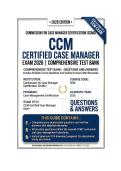
,CCM Certified Case Manager Exam 2026 | Comprehensive Test Bank |
Questions And Answers
TABLE OF CONTENTS
1. Care Management — Q1–Q60
2. Reimbursement Methods — Q61–Q84
3. Psychosocial Concepts and Support Systems — Q85–Q124
4. Quality and Outcomes Evaluation and Measurements — Q125–Q144
5. Rehabilitation Concepts and Strategies — Q145–Q164
6. Ethical, Legal, and Practice Standards — Q165–Q200
1. CARE MANAGEMENT
Q1. Which activity is the foundation of effective case management?
A) Billing the client
B) Comprehensive assessment of the client's needs
C) Selecting the least expensive service
D) Discharging the client immediately
Correct Answer: B) Comprehensive assessment of the client's needs
Rationale: Comprehensive assessment identifies the client's medical,
functional, behavioral, social, and environmental needs and provides the
foundation for an individualized plan.
Q2. Which statement best describes the case management process?
A) Assessment, planning, implementation, coordination, monitoring, and
evaluation
B) Diagnosis and treatment only
C) Billing and claims processing only
D) Discharge planning without reassessment
Correct Answer: A) Assessment, planning, implementation, coordination,
monitoring, and evaluation
Rationale: Case management is a continuous process that connects
assessment and planning with coordinated implementation, monitoring, and
evaluation.
,Q3. Which characteristic is most important when developing a
client-centered plan of care?
A) The client's goals and preferences
B) The payer's preferences alone
C) The case manager's personal priorities
D) The shortest possible length of stay
Correct Answer: A) The client's goals and preferences
Rationale: A client-centered plan reflects the individual's values, priorities,
needs, abilities, and desired outcomes.
Q4. Which assessment finding should be prioritized first in a
medically complex client?
A) Immediate safety or life-threatening needs
B) Long-term recreational goals
C) Preferred transportation method
D) Future employment preferences
Correct Answer: A) Immediate safety or life-threatening needs
Rationale: Case managers prioritize urgent threats to safety and health
before addressing lower-priority needs.
Q5. Which intervention best demonstrates care coordination?
A) Ensuring the primary care provider, specialists, and community providers
share relevant information
B) Sending the client home without communication
C) Allowing each provider to develop an unrelated plan
D) Limiting communication to the payer
Correct Answer: A) Ensuring the primary care provider, specialists, and
community providers share relevant information
Rationale: Care coordination connects providers and services so that care is
continuous, consistent, and appropriately integrated.
Q6. Which factor should be considered when determining an
appropriate caseload?
A) Client complexity and required intensity of case management
B) Client's preferred case-manager name
, C) Number of available parking spaces
D) Provider vacation schedule
Correct Answer: A) Client complexity and required intensity of case
management
Rationale: Caseload assignment should consider acuity, complexity, service
needs, and the amount of case-management intervention required.
**Q7. Which client would generally require greater case-management
intensity?
A) Client with multiple chronic conditions, functional limitations, and
fragmented services
B) Client with a resolved minor illness
C) Client requiring routine preventive care only
D) Client with no identified barriers
Correct Answer: A) Client with multiple chronic conditions, functional
limitations, and fragmented services
Rationale: Multiple interacting conditions and fragmented care increase
coordination needs and case-management complexity.
Q8. Which approach is most appropriate when a client's needs
change substantially?
A) Reassess the client and revise the plan of care
B) Keep the original plan unchanged
C) Close the case immediately
D) Wait until annual review
Correct Answer: A) Reassess the client and revise the plan of care
Rationale: Case management requires ongoing reassessment so the plan
reflects current needs and goals.
**Q9. Which outcome best demonstrates effective case management?
A) Improved client outcomes and appropriate use of services
B) Maximum utilization of all available services
C) Increased cost regardless of outcomes
D) Shortest possible contact time
Correct Answer: A) Improved client outcomes and appropriate use of services
Questions And Answers
TABLE OF CONTENTS
1. Care Management — Q1–Q60
2. Reimbursement Methods — Q61–Q84
3. Psychosocial Concepts and Support Systems — Q85–Q124
4. Quality and Outcomes Evaluation and Measurements — Q125–Q144
5. Rehabilitation Concepts and Strategies — Q145–Q164
6. Ethical, Legal, and Practice Standards — Q165–Q200
1. CARE MANAGEMENT
Q1. Which activity is the foundation of effective case management?
A) Billing the client
B) Comprehensive assessment of the client's needs
C) Selecting the least expensive service
D) Discharging the client immediately
Correct Answer: B) Comprehensive assessment of the client's needs
Rationale: Comprehensive assessment identifies the client's medical,
functional, behavioral, social, and environmental needs and provides the
foundation for an individualized plan.
Q2. Which statement best describes the case management process?
A) Assessment, planning, implementation, coordination, monitoring, and
evaluation
B) Diagnosis and treatment only
C) Billing and claims processing only
D) Discharge planning without reassessment
Correct Answer: A) Assessment, planning, implementation, coordination,
monitoring, and evaluation
Rationale: Case management is a continuous process that connects
assessment and planning with coordinated implementation, monitoring, and
evaluation.
,Q3. Which characteristic is most important when developing a
client-centered plan of care?
A) The client's goals and preferences
B) The payer's preferences alone
C) The case manager's personal priorities
D) The shortest possible length of stay
Correct Answer: A) The client's goals and preferences
Rationale: A client-centered plan reflects the individual's values, priorities,
needs, abilities, and desired outcomes.
Q4. Which assessment finding should be prioritized first in a
medically complex client?
A) Immediate safety or life-threatening needs
B) Long-term recreational goals
C) Preferred transportation method
D) Future employment preferences
Correct Answer: A) Immediate safety or life-threatening needs
Rationale: Case managers prioritize urgent threats to safety and health
before addressing lower-priority needs.
Q5. Which intervention best demonstrates care coordination?
A) Ensuring the primary care provider, specialists, and community providers
share relevant information
B) Sending the client home without communication
C) Allowing each provider to develop an unrelated plan
D) Limiting communication to the payer
Correct Answer: A) Ensuring the primary care provider, specialists, and
community providers share relevant information
Rationale: Care coordination connects providers and services so that care is
continuous, consistent, and appropriately integrated.
Q6. Which factor should be considered when determining an
appropriate caseload?
A) Client complexity and required intensity of case management
B) Client's preferred case-manager name
, C) Number of available parking spaces
D) Provider vacation schedule
Correct Answer: A) Client complexity and required intensity of case
management
Rationale: Caseload assignment should consider acuity, complexity, service
needs, and the amount of case-management intervention required.
**Q7. Which client would generally require greater case-management
intensity?
A) Client with multiple chronic conditions, functional limitations, and
fragmented services
B) Client with a resolved minor illness
C) Client requiring routine preventive care only
D) Client with no identified barriers
Correct Answer: A) Client with multiple chronic conditions, functional
limitations, and fragmented services
Rationale: Multiple interacting conditions and fragmented care increase
coordination needs and case-management complexity.
Q8. Which approach is most appropriate when a client's needs
change substantially?
A) Reassess the client and revise the plan of care
B) Keep the original plan unchanged
C) Close the case immediately
D) Wait until annual review
Correct Answer: A) Reassess the client and revise the plan of care
Rationale: Case management requires ongoing reassessment so the plan
reflects current needs and goals.
**Q9. Which outcome best demonstrates effective case management?
A) Improved client outcomes and appropriate use of services
B) Maximum utilization of all available services
C) Increased cost regardless of outcomes
D) Shortest possible contact time
Correct Answer: A) Improved client outcomes and appropriate use of services