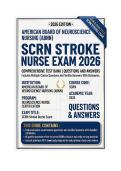
,SCRN Stroke Nurse Exam 2026 | Comprehensive Test Bank | Questions And Answers
TABLE OF CONTENTS
1. Anatomy, Physiology, and Pathophysiology of Stroke — Q1–Q34
2. Hyperacute Care — Q35–Q84
3. Acute Care — Q85–Q134
4. Post-acute Care — Q135–Q164
5. Primary and Secondary Preventative Care — Q165–Q200
1. ANATOMY, PHYSIOLOGY, AND PATHOPHYSIOLOGY OF STROKE
Q1. Which artery is the most common location of an ischemic stroke involving a major
cerebral artery?
A) Middle cerebral artery
B) Anterior spinal artery
C) Basilar artery only
D) Posterior communicating artery only
Correct Answer: A) Middle cerebral artery
Rationale: The middle cerebral artery supplies a large portion of the cerebral hemisphere
and is a common site of ischemic stroke.
Q2. Which cerebral artery primarily supplies the medial frontal and parietal lobes?
A) Middle cerebral artery
B) Anterior cerebral artery
C) Posterior cerebral artery
D) Basilar artery
Correct Answer: B) Anterior cerebral artery
Rationale: The anterior cerebral artery supplies medial frontal and parietal regions,
including areas involved in lower-extremity motor and sensory function.
Q3. Which cerebral artery primarily supplies the occipital cortex?
A) Anterior cerebral artery
B) Middle cerebral artery
,C) Posterior cerebral artery
D) External carotid artery
Correct Answer: C) Posterior cerebral artery
Rationale: The posterior cerebral artery supplies the occipital lobe and portions of the
medial temporal and thalamic regions.
Q4. A patient develops sudden aphasia and right-sided weakness. Which vascular territory
is most likely affected?
A) Left middle cerebral artery
B) Right posterior cerebral artery
C) Right anterior cerebral artery
D) Left vertebral artery only
Correct Answer: A) Left middle cerebral artery
Rationale: The dominant hemisphere's middle cerebral artery supplies language areas and
motor regions controlling the contralateral face and upper extremity.
Q5. A patient has sudden left-sided weakness primarily affecting the leg. Which vascular
territory is most consistent with this deficit?
A) Right anterior cerebral artery
B) Left middle cerebral artery
C) Left posterior cerebral artery
D) Right posterior communicating artery
Correct Answer: A) Right anterior cerebral artery
Rationale: The anterior cerebral artery supplies the medial motor cortex, where the lower-
extremity region is represented.
Q6. Which structure connects the two cerebral hemispheres?
A) Corpus callosum
B) Medulla
C) Pons
D) Cerebellar peduncle
Correct Answer: A) Corpus callosum
Rationale: The corpus callosum allows communication between the left and right cerebral
hemispheres.
, Q7. Which brain structure is primarily responsible for coordination and balance?
A) Cerebellum
B) Medulla
C) Thalamus
D) Hypothalamus
Correct Answer: A) Cerebellum
Rationale: The cerebellum coordinates movement, balance, posture, and motor learning.
Q8. Which brain structure regulates many vital autonomic functions, including respiration
and cardiovascular control?
A) Medulla oblongata
B) Occipital lobe
C) Corpus callosum
D) Basal ganglia
Correct Answer: A) Medulla oblongata
Rationale: The medulla contains critical autonomic centers involved in breathing, heart
rate, and blood-pressure regulation.
Q9. Which structure plays a major role in relaying sensory information to the cerebral
cortex?
A) Thalamus
B) Cerebellum
C) Medulla
D) Frontal sinus
Correct Answer: A) Thalamus
Rationale: The thalamus relays most sensory information to appropriate areas of the
cerebral cortex.
Q10. Which lobe is primarily associated with voluntary motor function and executive
processes?
A) Frontal
B) Occipital
C) Temporal
D) Insular only
Correct Answer: A) Frontal
TABLE OF CONTENTS
1. Anatomy, Physiology, and Pathophysiology of Stroke — Q1–Q34
2. Hyperacute Care — Q35–Q84
3. Acute Care — Q85–Q134
4. Post-acute Care — Q135–Q164
5. Primary and Secondary Preventative Care — Q165–Q200
1. ANATOMY, PHYSIOLOGY, AND PATHOPHYSIOLOGY OF STROKE
Q1. Which artery is the most common location of an ischemic stroke involving a major
cerebral artery?
A) Middle cerebral artery
B) Anterior spinal artery
C) Basilar artery only
D) Posterior communicating artery only
Correct Answer: A) Middle cerebral artery
Rationale: The middle cerebral artery supplies a large portion of the cerebral hemisphere
and is a common site of ischemic stroke.
Q2. Which cerebral artery primarily supplies the medial frontal and parietal lobes?
A) Middle cerebral artery
B) Anterior cerebral artery
C) Posterior cerebral artery
D) Basilar artery
Correct Answer: B) Anterior cerebral artery
Rationale: The anterior cerebral artery supplies medial frontal and parietal regions,
including areas involved in lower-extremity motor and sensory function.
Q3. Which cerebral artery primarily supplies the occipital cortex?
A) Anterior cerebral artery
B) Middle cerebral artery
,C) Posterior cerebral artery
D) External carotid artery
Correct Answer: C) Posterior cerebral artery
Rationale: The posterior cerebral artery supplies the occipital lobe and portions of the
medial temporal and thalamic regions.
Q4. A patient develops sudden aphasia and right-sided weakness. Which vascular territory
is most likely affected?
A) Left middle cerebral artery
B) Right posterior cerebral artery
C) Right anterior cerebral artery
D) Left vertebral artery only
Correct Answer: A) Left middle cerebral artery
Rationale: The dominant hemisphere's middle cerebral artery supplies language areas and
motor regions controlling the contralateral face and upper extremity.
Q5. A patient has sudden left-sided weakness primarily affecting the leg. Which vascular
territory is most consistent with this deficit?
A) Right anterior cerebral artery
B) Left middle cerebral artery
C) Left posterior cerebral artery
D) Right posterior communicating artery
Correct Answer: A) Right anterior cerebral artery
Rationale: The anterior cerebral artery supplies the medial motor cortex, where the lower-
extremity region is represented.
Q6. Which structure connects the two cerebral hemispheres?
A) Corpus callosum
B) Medulla
C) Pons
D) Cerebellar peduncle
Correct Answer: A) Corpus callosum
Rationale: The corpus callosum allows communication between the left and right cerebral
hemispheres.
, Q7. Which brain structure is primarily responsible for coordination and balance?
A) Cerebellum
B) Medulla
C) Thalamus
D) Hypothalamus
Correct Answer: A) Cerebellum
Rationale: The cerebellum coordinates movement, balance, posture, and motor learning.
Q8. Which brain structure regulates many vital autonomic functions, including respiration
and cardiovascular control?
A) Medulla oblongata
B) Occipital lobe
C) Corpus callosum
D) Basal ganglia
Correct Answer: A) Medulla oblongata
Rationale: The medulla contains critical autonomic centers involved in breathing, heart
rate, and blood-pressure regulation.
Q9. Which structure plays a major role in relaying sensory information to the cerebral
cortex?
A) Thalamus
B) Cerebellum
C) Medulla
D) Frontal sinus
Correct Answer: A) Thalamus
Rationale: The thalamus relays most sensory information to appropriate areas of the
cerebral cortex.
Q10. Which lobe is primarily associated with voluntary motor function and executive
processes?
A) Frontal
B) Occipital
C) Temporal
D) Insular only
Correct Answer: A) Frontal