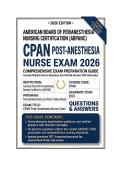
,CPAN Post-Anesthesia Nurse Exam 2026 | Comprehensive Test Bank |
Questions And Answers
TABLE OF CONTENTS
1. Anesthesia — Q1–Q48
2. Physiology — Q49–Q84
3. Perianesthesia Monitoring and Intervention — Q85–Q154
4. Perianesthesia Care Considerations — Q155–Q182
5. Professional Nursing Practice and Guidelines — Q183–Q200
1. ANESTHESIA
Q1. A patient arrives in the PACU immediately after general
anesthesia and is difficult to arouse. Which assessment is the
priority?
A) Airway patency and respiratory status
B) Last bowel movement
C) Appetite
D) Skin moisture
Correct Answer: A) Airway patency and respiratory status
Rationale: Airway obstruction and respiratory depression can rapidly
become life-threatening during emergence from anesthesia.
Q2. Which phase of general anesthesia is associated with
excitement and potentially irregular breathing and movement?
A) Stage I
B) Stage II
C) Stage III
D) Stage IV
Correct Answer: B) Stage II
Rationale: Stage II is characterized by excitement, irregular respirations,
and heightened reflex activity as consciousness is lost.
Q3. Which stage of anesthesia is associated with surgical anesthesia
and depressed reflexes?
,A) Stage I
B) Stage II
C) Stage III
D) Stage IV
Correct Answer: C) Stage III
Rationale: Stage III is the stage of surgical anesthesia, with progressive
depression of consciousness and reflexes.
Q4. Which finding suggests excessive depth of general anesthesia?
A) Severe respiratory depression and hypotension
B) Increased alertness
C) Hypertension with agitation
D) Strong protective reflexes
Correct Answer: A) Severe respiratory depression and hypotension
Rationale: Excessive anesthetic depth can depress respiratory and
cardiovascular function.
Q5. Which anesthetic technique involves temporary interruption of
nerve conduction in a specific region of the body?
A) Regional anesthesia
B) General anesthesia
C) Topical sedation only
D) Minimal sedation
Correct Answer: A) Regional anesthesia
Rationale: Regional anesthesia blocks nerve conduction in a targeted body
region while avoiding complete unconsciousness.
Q6. A patient receives spinal anesthesia for lower-extremity
surgery. Which assessment is particularly important in the PACU?
A) Return of motor and sensory function
B) Bowel sounds only
C) Hearing acuity
D) Appetite
Correct Answer: A) Return of motor and sensory function
Rationale: Neurologic recovery after neuraxial anesthesia should be
assessed to identify delayed or abnormal block resolution.
, Q7. A patient develops hypotension and bradycardia following
spinal anesthesia. What mechanism is most likely?
A) Sympathetic blockade
B) Increased catecholamine release
C) Hypervolemia
D) Increased systemic vascular resistance
Correct Answer: A) Sympathetic blockade
Rationale: Neuraxial blockade can reduce sympathetic vascular tone and
venous return, producing hypotension and bradycardia.
Q8. Which regional anesthesia complication requires immediate
assessment when a patient develops severe respiratory difficulty?
A) High spinal block
B) Mild pruritus
C) Urinary frequency
D) Local bruising
Correct Answer: A) High spinal block
Rationale: A high neuraxial block can impair respiratory muscles and
cardiovascular function.
Q9. Which local anesthetic is particularly associated with
cardiotoxicity when systemic toxicity develops?
A) Bupivacaine
B) Lidocaine-free saline
C) Acetaminophen
D) Ketorolac
Correct Answer: A) Bupivacaine
Rationale: Bupivacaine can produce severe cardiac conduction
abnormalities and ventricular dysrhythmias in systemic toxicity.
Q10. A patient develops seizures and ventricular dysrhythmia after
an accidental intravascular local anesthetic injection. What
complication should the nurse suspect?
A) Local anesthetic systemic toxicity
B) Malignant hyperthermia
Questions And Answers
TABLE OF CONTENTS
1. Anesthesia — Q1–Q48
2. Physiology — Q49–Q84
3. Perianesthesia Monitoring and Intervention — Q85–Q154
4. Perianesthesia Care Considerations — Q155–Q182
5. Professional Nursing Practice and Guidelines — Q183–Q200
1. ANESTHESIA
Q1. A patient arrives in the PACU immediately after general
anesthesia and is difficult to arouse. Which assessment is the
priority?
A) Airway patency and respiratory status
B) Last bowel movement
C) Appetite
D) Skin moisture
Correct Answer: A) Airway patency and respiratory status
Rationale: Airway obstruction and respiratory depression can rapidly
become life-threatening during emergence from anesthesia.
Q2. Which phase of general anesthesia is associated with
excitement and potentially irregular breathing and movement?
A) Stage I
B) Stage II
C) Stage III
D) Stage IV
Correct Answer: B) Stage II
Rationale: Stage II is characterized by excitement, irregular respirations,
and heightened reflex activity as consciousness is lost.
Q3. Which stage of anesthesia is associated with surgical anesthesia
and depressed reflexes?
,A) Stage I
B) Stage II
C) Stage III
D) Stage IV
Correct Answer: C) Stage III
Rationale: Stage III is the stage of surgical anesthesia, with progressive
depression of consciousness and reflexes.
Q4. Which finding suggests excessive depth of general anesthesia?
A) Severe respiratory depression and hypotension
B) Increased alertness
C) Hypertension with agitation
D) Strong protective reflexes
Correct Answer: A) Severe respiratory depression and hypotension
Rationale: Excessive anesthetic depth can depress respiratory and
cardiovascular function.
Q5. Which anesthetic technique involves temporary interruption of
nerve conduction in a specific region of the body?
A) Regional anesthesia
B) General anesthesia
C) Topical sedation only
D) Minimal sedation
Correct Answer: A) Regional anesthesia
Rationale: Regional anesthesia blocks nerve conduction in a targeted body
region while avoiding complete unconsciousness.
Q6. A patient receives spinal anesthesia for lower-extremity
surgery. Which assessment is particularly important in the PACU?
A) Return of motor and sensory function
B) Bowel sounds only
C) Hearing acuity
D) Appetite
Correct Answer: A) Return of motor and sensory function
Rationale: Neurologic recovery after neuraxial anesthesia should be
assessed to identify delayed or abnormal block resolution.
, Q7. A patient develops hypotension and bradycardia following
spinal anesthesia. What mechanism is most likely?
A) Sympathetic blockade
B) Increased catecholamine release
C) Hypervolemia
D) Increased systemic vascular resistance
Correct Answer: A) Sympathetic blockade
Rationale: Neuraxial blockade can reduce sympathetic vascular tone and
venous return, producing hypotension and bradycardia.
Q8. Which regional anesthesia complication requires immediate
assessment when a patient develops severe respiratory difficulty?
A) High spinal block
B) Mild pruritus
C) Urinary frequency
D) Local bruising
Correct Answer: A) High spinal block
Rationale: A high neuraxial block can impair respiratory muscles and
cardiovascular function.
Q9. Which local anesthetic is particularly associated with
cardiotoxicity when systemic toxicity develops?
A) Bupivacaine
B) Lidocaine-free saline
C) Acetaminophen
D) Ketorolac
Correct Answer: A) Bupivacaine
Rationale: Bupivacaine can produce severe cardiac conduction
abnormalities and ventricular dysrhythmias in systemic toxicity.
Q10. A patient develops seizures and ventricular dysrhythmia after
an accidental intravascular local anesthetic injection. What
complication should the nurse suspect?
A) Local anesthetic systemic toxicity
B) Malignant hyperthermia