
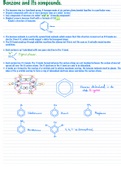
Benzene and its compounds.
• The benzene ring is a functional group. A hexagon made of six carbon atoms bonded together in a particular way.
• Organic compounds with one or more benzene rings are called “arenes”
• Any compounds of benzene are called “aryl” or “aromatic compounds”.
• Simplest arene is benzene itself with a formula of C H
Kekule’s structure of benzene: bb
shorter
Longer
• The benzene molecule is a perfectly symmetrical molecule which means that this structure is incorrect as C=C bonds are
shorter than C-C, which would suggest a distorted hexagonal shape.
• The C=C bond would go through addition reactions like alkenes but this is not the case as it actually needs harsher
conditions.
• Each carbon is sp² hybridised with one spare electron in the π bond.
Sp Trigonalplanar
• Each carbon has 3 σ-bonds. The π bonds formed between the carbon atoms are not localised between the carbon atoms but
spread all over the 6 carbon atoms. The 6 electrons in the π bond are said to be delocalised.
• π bonds are formed by the overlap of p-orbitals and to achieve maximum overlap, the benzene molecule must be planar. The
lobes of the p-orbital overlap to form a ring of delocalised electrons above and below the carbon atoms.
O
E d
CDC Electrons delocalised in ite
wholeTL system
U OH NHz
Chlorobenzene Phenol Phenylamine
NO
OH
Br Br
Nitrobenzene 2,4 b tribromophenol
Br
,Reactions of arenes
• Maintains the highly stable delocalised ring of π-bonding with electrons intact.
• Usually attacked by an electrophile which is attracted to the high electron density around the benzene ring.
Electrophilic substitution with bromine or chlorine.
Conditions: Halogen gas bubbled through
For bromine: anhydrous FeBr catalyst
the benzene and catalyst at
For chlorine: anhydrous AlCl₃ / FeCl₃ catalyst
room temperature.
(These catalysts are called
halogen carriers)
General reaction:
Br
catalyst
Br2 anhydrous y t HBR
FeBr
The creation of the electrophile:
has an empty 3d orbital
xx xx f Electron deficientcompound
Br
xx
Br t FeBr
xx
Dativebond
fFeBr
St g
xx xx
Br
xx
l Bris
xx
Brt CteBra
Reaction: high electron density
H
r t EBI FeBr
H
Br
H J
Brt SLOW v Br OR Br FAST
electrophile t HBrtFeBr
H H H
Stable Endothermic as Unstable Exothermic ashigh Stable
wtohighenergy tolowenergy
• The benzene would have a high tendency to get rid of the hydrogen as in that way it will be able to return to its stable
position (π-system). π-system confers a lot of stability to the benzene - aromatic ring.
Ortho / meta / para directors (2, 3, 4)
CH CH CH CH
Nor
HNOs
Hrsa
NO
NO
63 ORTHO 3 META 34 PARA
, Positiveinductiveeffect
CHz CH CH CH
Electrophile
E E
y E
ORTHO 2
A
CH CH CH
META 3
J
E E E
CH CH CH
C J PARACH
E E E
The circled carbocations are most likely to form as they are the most stable due to the electron donating group and this
explains why ortho (2) and para (4) are more likely to form. This lowers the activation energy therefore facilitates the
reaction. The electron-donating group directs the activation groups (2, 4 and 6). The same goes to phenol and phenylamine
(others shown in data booklet).
When Cl₂ is added: CH CH CH
a
ALU
Cle 2 t ZHU
U
2 Chloromethyl benzene 4 chloromethyl benzene
When excess Cl₂ is added, we can form:
CHz Ctb CH
U U U u u
012 OR
a
The C-Cl bond in the halogenoarene is stronger than in halogenoalkane as one of the lone pairs of electrons of the halogen
overlaps the π bonds of the rings, giving it partial double bond characteristics.
CHz CHEL
boil
z t HCL Free radicalsubstitution
UV light
Chloromethyl
Nitration of benzene. benzene
Also electrophilic substitution with NO₂⁺ ion as electrophile. (Nitronium ion)
Conditions: Conc. HNO₃, conc, H₂SO₄ and refluxed at about 55°C. 0
HNO₃ + 2H₂SO₄ NO₂⁺ + 2HSO₄⁻ + H₃O⁺ O
General reaction: Nt
Noe
At 100°C, 3NO₂ groups go on
2, 4, 6 activating groups
HN z
t H2O
with a CH₃ directing group.
• The benzene ring is a functional group. A hexagon made of six carbon atoms bonded together in a particular way.
• Organic compounds with one or more benzene rings are called “arenes”
• Any compounds of benzene are called “aryl” or “aromatic compounds”.
• Simplest arene is benzene itself with a formula of C H
Kekule’s structure of benzene: bb
shorter
Longer
• The benzene molecule is a perfectly symmetrical molecule which means that this structure is incorrect as C=C bonds are
shorter than C-C, which would suggest a distorted hexagonal shape.
• The C=C bond would go through addition reactions like alkenes but this is not the case as it actually needs harsher
conditions.
• Each carbon is sp² hybridised with one spare electron in the π bond.
Sp Trigonalplanar
• Each carbon has 3 σ-bonds. The π bonds formed between the carbon atoms are not localised between the carbon atoms but
spread all over the 6 carbon atoms. The 6 electrons in the π bond are said to be delocalised.
• π bonds are formed by the overlap of p-orbitals and to achieve maximum overlap, the benzene molecule must be planar. The
lobes of the p-orbital overlap to form a ring of delocalised electrons above and below the carbon atoms.
O
E d
CDC Electrons delocalised in ite
wholeTL system
U OH NHz
Chlorobenzene Phenol Phenylamine
NO
OH
Br Br
Nitrobenzene 2,4 b tribromophenol
Br
,Reactions of arenes
• Maintains the highly stable delocalised ring of π-bonding with electrons intact.
• Usually attacked by an electrophile which is attracted to the high electron density around the benzene ring.
Electrophilic substitution with bromine or chlorine.
Conditions: Halogen gas bubbled through
For bromine: anhydrous FeBr catalyst
the benzene and catalyst at
For chlorine: anhydrous AlCl₃ / FeCl₃ catalyst
room temperature.
(These catalysts are called
halogen carriers)
General reaction:
Br
catalyst
Br2 anhydrous y t HBR
FeBr
The creation of the electrophile:
has an empty 3d orbital
xx xx f Electron deficientcompound
Br
xx
Br t FeBr
xx
Dativebond
fFeBr
St g
xx xx
Br
xx
l Bris
xx
Brt CteBra
Reaction: high electron density
H
r t EBI FeBr
H
Br
H J
Brt SLOW v Br OR Br FAST
electrophile t HBrtFeBr
H H H
Stable Endothermic as Unstable Exothermic ashigh Stable
wtohighenergy tolowenergy
• The benzene would have a high tendency to get rid of the hydrogen as in that way it will be able to return to its stable
position (π-system). π-system confers a lot of stability to the benzene - aromatic ring.
Ortho / meta / para directors (2, 3, 4)
CH CH CH CH
Nor
HNOs
Hrsa
NO
NO
63 ORTHO 3 META 34 PARA
, Positiveinductiveeffect
CHz CH CH CH
Electrophile
E E
y E
ORTHO 2
A
CH CH CH
META 3
J
E E E
CH CH CH
C J PARACH
E E E
The circled carbocations are most likely to form as they are the most stable due to the electron donating group and this
explains why ortho (2) and para (4) are more likely to form. This lowers the activation energy therefore facilitates the
reaction. The electron-donating group directs the activation groups (2, 4 and 6). The same goes to phenol and phenylamine
(others shown in data booklet).
When Cl₂ is added: CH CH CH
a
ALU
Cle 2 t ZHU
U
2 Chloromethyl benzene 4 chloromethyl benzene
When excess Cl₂ is added, we can form:
CHz Ctb CH
U U U u u
012 OR
a
The C-Cl bond in the halogenoarene is stronger than in halogenoalkane as one of the lone pairs of electrons of the halogen
overlaps the π bonds of the rings, giving it partial double bond characteristics.
CHz CHEL
boil
z t HCL Free radicalsubstitution
UV light
Chloromethyl
Nitration of benzene. benzene
Also electrophilic substitution with NO₂⁺ ion as electrophile. (Nitronium ion)
Conditions: Conc. HNO₃, conc, H₂SO₄ and refluxed at about 55°C. 0
HNO₃ + 2H₂SO₄ NO₂⁺ + 2HSO₄⁻ + H₃O⁺ O
General reaction: Nt
Noe
At 100°C, 3NO₂ groups go on
2, 4, 6 activating groups
HN z
t H2O
with a CH₃ directing group.

