
CIEMT - EMT Final Exam Questions With Complete Solutions 2026/2027 150 Questions | 13 Sections
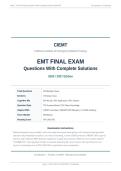
CIEMT
California Institute of Emergency Medical Training
EMT FINAL EXAM
Questions With Complete Solutions
Edition
Total Questions 150 Multiple Choice
Sections 13 Domain Areas
Cognitive Mix 20% Recall | 50% Application | 30% Analysis
Question Style 75% Scenario-Based | 25% Direct Knowledge
Aligned With CIEMT Curriculum | NREMT EMT Blueprint | CA EMS Authority
Time Allotted 180 Minutes
Passing Score 70% (105/150)
Examination Instructions
Read each question stem carefully. Select the single best answer from options A-D. Scenario-based questions
describe real prehospital encounters; use clinical reasoning, current CIEMT protocols, NREMT EMT scope of
practice, and California EMS Authority regulations to guide your selection. Mark the correct option marked
*[CORRECT]*. Each question includes a rationale explaining the correct answer and why distractors are
incorrect. A passing score of 70% (105/150) is required for course completion.
Confidential — Property of CIEMT. Reproduction prohibited.
Page 1 | CIEMT EMT Final 2026/2027 | Confidential
,CIEMT - EMT Final Exam Questions With Complete Solutions 2026/2027 150 Questions | 13 Sections
Examination Blueprint
# Section Title Q Range Items
1 Section 1: EMS Systems & Roles Q1 - Q10 10
2 Section 2: Workforce Safety & Wellness Q11 - Q20 10
3 Section 3: Medical, Legal, & Ethical Issues Q21 - Q31 11
4 Section 4: Communications & Documentation Q32 - Q39 8
5 Section 5: The Human Body & Pathophysiology Q40 - Q53 14
6 Section 6: Life Span Development Q54 - Q61 8
7 Section 7: Principles of Pharmacology Q62 - Q71 10
8 Section 8: Airway Management & Ventilation Q72 - Q85 14
9 Section 9: Patient Assessment Q86 - Q99 14
10 Section 10: Medical Emergencies Q100 - Q118 19
11 Section 11: Trauma Emergencies Q119 - Q132 14
12 Section 12: Special Patient Populations Q133 - Q142 10
13 Section 13: EMS Operations Q143 - Q150 8
- TOTAL Q1 - Q150 150
Cognitive Level Distribution
Recall (knowledge / facts) 30 questions 20%
Application (use knowledge in a scenario) 75 questions 50%
Analysis (clinical decision-making, prioritization) 45 questions 30%
Page 2 | CIEMT EMT Final 2026/2027 | Confidential
,CIEMT - EMT Final Exam Questions With Complete Solutions 2026/2027 150 Questions | 13 Sections
Section 1: EMS Systems & Roles | Q1 - Q10
Q1: You are dispatched to a 64-year-old male with chest pain. After arriving, you realize the on-line medical
direction physician is unavailable. According to the CIEMT curriculum and standard EMS protocols, which of
the following best describes the standing orders you should follow?
A. Verbal orders given by the medical director at the time of the call
B. Written protocols that authorize the EMT to perform specific skills without contacting medical direction
first *[CORRECT]*
C. Orders that must be confirmed by a paramedic before implementation
D. A list of optional skills the EMT may perform at their discretion
Correct Answer: B
Rationale: Standing orders are written protocols authorized by the medical director that allow EMTs to perform specific
interventions prior to or without direct on-line contact. The CIEMT curriculum distinguishes these from on-line (direct)
medical direction, which involves real-time radio/phone orders. Option A describes on-line direction, while C and D
incorrectly require additional personnel or treat protocols as optional.
Q2: Which federal legislative landmark is widely credited with establishing modern EMS as a structured
system by providing funding for ambulance services, training programs, and regional EMS systems?
A. Highway Safety Act of 1966
B. Emergency Medical Act of 1973 (PL 93-154) *[CORRECT]*
C. Omnibus Budget Reconciliation Act of 1981
D. EMTALA of 1986
Correct Answer: B
Rationale: The Emergency Medical Act of 1973 (Public Law 93-154) funded the development of regional EMS systems and
authorized support for ambulance services, training, and communications. The Highway Safety Act of 1966 (Option A)
preceded it and established the foundation by recognizing prehospital care as a public safety need, but the 1973 Act
operationalized EMS systems nationwide.
Q3: You respond to a multi-vehicle collision with three critically injured patients and no paramedic
immediately available. Per CIEMT scope-of-practice standards, which level of EMS provider is trained to
perform advanced airway management, IV access, and select medication administration?
A. Emergency Medical Responder (EMR)
B. Emergency Medical Technician (EMT)
C. Advanced Emergency Medical Technician (AEMT)
D. Paramedic *[CORRECT]*
Correct Answer: D
Rationale: Paramedics represent the highest level of prehospital provider in the U.S. EMS system, trained in advanced
airway management (including intubation), intravenous access, fluid resuscitation, and a broad pharmacologic formulary.
AEMTs (Option C) perform limited advanced skills (IV, some meds, supraglottic airways), while EMTs focus on BLS, oxygen
therapy, and assisting with prescribed medications. EMRs provide immediate life-saving care pending arrival of higher-level
providers.
Page 3 | CIEMT EMT Final 2026/2027 | Confidential
, CIEMT - EMT Final Exam Questions With Complete Solutions 2026/2027 150 Questions | 13 Sections
Q4: A 1966 White Paper formally titled "Accidental Death and Disability: The Neglected Disease of Modern
Society" is recognized in CIEMT EMS history modules because it:
A. Established the National Registry of EMTs (NREMT) as the credentialing body
B. Brought public and governmental attention to preventable trauma deaths and catalyzed federal EMS
investment *[CORRECT]*
C. Mandated state-level EMS medical director requirements
D. Defined the four-tier EMS provider system (EMR/EMT/AEMT/Paramedic)
Correct Answer: B
Rationale: The 1966 White Paper, produced by the National Academy of Sciences-National Research Council, highlighted
that accident victims were dying from survivivable injuries due to inadequate prehospital and trauma system care. This
publication is credited with mobilizing federal action (including the Highway Safety Act of 1966 and later the EMS Act of
1973) that established the modern U.S. EMS system. Options A, C, and D describe developments that followed, not the paper
itself.
Q5: During a routine shift, your agency's Quality Improvement (CQI) coordinator pulls patient care reports
(PCRs) to audit documentation completeness, airway management technique, and response times. Which
component of the EMS system does this activity fall under?
A. Equipment and facilities management
B. Continuous Quality Improvement (CQI) *[CORRECT]*
C. Public information and education
D. Disaster and MCI planning
Correct Answer: B
Rationale: Continuous Quality Improvement (CQI) is a mandated EMS system component that involves ongoing review of
care, documentation, and processes to identify educational gaps and improve patient outcomes. CQI uses tools like PCR
audits, run reviews, and case debriefings. The CIEMT curriculum emphasizes that every EMT participates in CQI as a
professional responsibility. The other options describe separate, equally important EMS system components.
Q6: You arrive at a nursing facility to transport a stable patient. The nurse hands you a printed transfer sheet
but says the receiving physician's verbal order regarding oxygen therapy is awaiting your confirmation. Which
form of medical direction is being utilized?
A. Offline (indirect) medical direction only
B. Online (direct) medical direction *[CORRECT]*
C. Standing orders
D. Protocols only
Correct Answer: B
Rationale: On-line (or direct) medical direction occurs when a physician provides real-time verbal orders via radio, phone,
or face-to-face. Because the order is being awaited from the physician at the moment of patient contact, this is on-line
direction. Offline direction (Option A) involves pre-approved written protocols and standing orders developed in advance.
Options C and D are subsets of offline direction.
Page 4 | CIEMT EMT Final 2026/2027 | Confidential
CIEMT
California Institute of Emergency Medical Training
EMT FINAL EXAM
Questions With Complete Solutions
Edition
Total Questions 150 Multiple Choice
Sections 13 Domain Areas
Cognitive Mix 20% Recall | 50% Application | 30% Analysis
Question Style 75% Scenario-Based | 25% Direct Knowledge
Aligned With CIEMT Curriculum | NREMT EMT Blueprint | CA EMS Authority
Time Allotted 180 Minutes
Passing Score 70% (105/150)
Examination Instructions
Read each question stem carefully. Select the single best answer from options A-D. Scenario-based questions
describe real prehospital encounters; use clinical reasoning, current CIEMT protocols, NREMT EMT scope of
practice, and California EMS Authority regulations to guide your selection. Mark the correct option marked
*[CORRECT]*. Each question includes a rationale explaining the correct answer and why distractors are
incorrect. A passing score of 70% (105/150) is required for course completion.
Confidential — Property of CIEMT. Reproduction prohibited.
Page 1 | CIEMT EMT Final 2026/2027 | Confidential
,CIEMT - EMT Final Exam Questions With Complete Solutions 2026/2027 150 Questions | 13 Sections
Examination Blueprint
# Section Title Q Range Items
1 Section 1: EMS Systems & Roles Q1 - Q10 10
2 Section 2: Workforce Safety & Wellness Q11 - Q20 10
3 Section 3: Medical, Legal, & Ethical Issues Q21 - Q31 11
4 Section 4: Communications & Documentation Q32 - Q39 8
5 Section 5: The Human Body & Pathophysiology Q40 - Q53 14
6 Section 6: Life Span Development Q54 - Q61 8
7 Section 7: Principles of Pharmacology Q62 - Q71 10
8 Section 8: Airway Management & Ventilation Q72 - Q85 14
9 Section 9: Patient Assessment Q86 - Q99 14
10 Section 10: Medical Emergencies Q100 - Q118 19
11 Section 11: Trauma Emergencies Q119 - Q132 14
12 Section 12: Special Patient Populations Q133 - Q142 10
13 Section 13: EMS Operations Q143 - Q150 8
- TOTAL Q1 - Q150 150
Cognitive Level Distribution
Recall (knowledge / facts) 30 questions 20%
Application (use knowledge in a scenario) 75 questions 50%
Analysis (clinical decision-making, prioritization) 45 questions 30%
Page 2 | CIEMT EMT Final 2026/2027 | Confidential
,CIEMT - EMT Final Exam Questions With Complete Solutions 2026/2027 150 Questions | 13 Sections
Section 1: EMS Systems & Roles | Q1 - Q10
Q1: You are dispatched to a 64-year-old male with chest pain. After arriving, you realize the on-line medical
direction physician is unavailable. According to the CIEMT curriculum and standard EMS protocols, which of
the following best describes the standing orders you should follow?
A. Verbal orders given by the medical director at the time of the call
B. Written protocols that authorize the EMT to perform specific skills without contacting medical direction
first *[CORRECT]*
C. Orders that must be confirmed by a paramedic before implementation
D. A list of optional skills the EMT may perform at their discretion
Correct Answer: B
Rationale: Standing orders are written protocols authorized by the medical director that allow EMTs to perform specific
interventions prior to or without direct on-line contact. The CIEMT curriculum distinguishes these from on-line (direct)
medical direction, which involves real-time radio/phone orders. Option A describes on-line direction, while C and D
incorrectly require additional personnel or treat protocols as optional.
Q2: Which federal legislative landmark is widely credited with establishing modern EMS as a structured
system by providing funding for ambulance services, training programs, and regional EMS systems?
A. Highway Safety Act of 1966
B. Emergency Medical Act of 1973 (PL 93-154) *[CORRECT]*
C. Omnibus Budget Reconciliation Act of 1981
D. EMTALA of 1986
Correct Answer: B
Rationale: The Emergency Medical Act of 1973 (Public Law 93-154) funded the development of regional EMS systems and
authorized support for ambulance services, training, and communications. The Highway Safety Act of 1966 (Option A)
preceded it and established the foundation by recognizing prehospital care as a public safety need, but the 1973 Act
operationalized EMS systems nationwide.
Q3: You respond to a multi-vehicle collision with three critically injured patients and no paramedic
immediately available. Per CIEMT scope-of-practice standards, which level of EMS provider is trained to
perform advanced airway management, IV access, and select medication administration?
A. Emergency Medical Responder (EMR)
B. Emergency Medical Technician (EMT)
C. Advanced Emergency Medical Technician (AEMT)
D. Paramedic *[CORRECT]*
Correct Answer: D
Rationale: Paramedics represent the highest level of prehospital provider in the U.S. EMS system, trained in advanced
airway management (including intubation), intravenous access, fluid resuscitation, and a broad pharmacologic formulary.
AEMTs (Option C) perform limited advanced skills (IV, some meds, supraglottic airways), while EMTs focus on BLS, oxygen
therapy, and assisting with prescribed medications. EMRs provide immediate life-saving care pending arrival of higher-level
providers.
Page 3 | CIEMT EMT Final 2026/2027 | Confidential
, CIEMT - EMT Final Exam Questions With Complete Solutions 2026/2027 150 Questions | 13 Sections
Q4: A 1966 White Paper formally titled "Accidental Death and Disability: The Neglected Disease of Modern
Society" is recognized in CIEMT EMS history modules because it:
A. Established the National Registry of EMTs (NREMT) as the credentialing body
B. Brought public and governmental attention to preventable trauma deaths and catalyzed federal EMS
investment *[CORRECT]*
C. Mandated state-level EMS medical director requirements
D. Defined the four-tier EMS provider system (EMR/EMT/AEMT/Paramedic)
Correct Answer: B
Rationale: The 1966 White Paper, produced by the National Academy of Sciences-National Research Council, highlighted
that accident victims were dying from survivivable injuries due to inadequate prehospital and trauma system care. This
publication is credited with mobilizing federal action (including the Highway Safety Act of 1966 and later the EMS Act of
1973) that established the modern U.S. EMS system. Options A, C, and D describe developments that followed, not the paper
itself.
Q5: During a routine shift, your agency's Quality Improvement (CQI) coordinator pulls patient care reports
(PCRs) to audit documentation completeness, airway management technique, and response times. Which
component of the EMS system does this activity fall under?
A. Equipment and facilities management
B. Continuous Quality Improvement (CQI) *[CORRECT]*
C. Public information and education
D. Disaster and MCI planning
Correct Answer: B
Rationale: Continuous Quality Improvement (CQI) is a mandated EMS system component that involves ongoing review of
care, documentation, and processes to identify educational gaps and improve patient outcomes. CQI uses tools like PCR
audits, run reviews, and case debriefings. The CIEMT curriculum emphasizes that every EMT participates in CQI as a
professional responsibility. The other options describe separate, equally important EMS system components.
Q6: You arrive at a nursing facility to transport a stable patient. The nurse hands you a printed transfer sheet
but says the receiving physician's verbal order regarding oxygen therapy is awaiting your confirmation. Which
form of medical direction is being utilized?
A. Offline (indirect) medical direction only
B. Online (direct) medical direction *[CORRECT]*
C. Standing orders
D. Protocols only
Correct Answer: B
Rationale: On-line (or direct) medical direction occurs when a physician provides real-time verbal orders via radio, phone,
or face-to-face. Because the order is being awaited from the physician at the moment of patient contact, this is on-line
direction. Offline direction (Option A) involves pre-approved written protocols and standing orders developed in advance.
Options C and D are subsets of offline direction.
Page 4 | CIEMT EMT Final 2026/2027 | Confidential

