
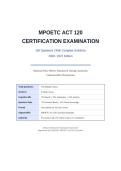
MPOETC ACT 120
CERTIFICATION EXAMINATION
150 Questions | With Complete Solutions
Edition
Municipal Police Officers' Education & Training Commission
Commonwealth of Pennsylvania
Total Questions 150 Multiple-Choice
Sections 8 Subject Areas
Cognitive Mix 25% Recall | 50% Application | 25% Analysis
Question Style 75% Scenario-Based | 25% Direct Knowledge
Format Four Options (A–D), One Correct
Aligned With MPOETC Act 120 Curriculum Standards
Authority PA Crimes Code, PA Vehicle Code, U.S. Constitution
Official Certification Preparation Examination
Aligned with the 2026/2027 MPOETC Act 120 Curriculum
,MPOETC ACT 120 Certification Exam | 150 Questions | Complete Solutions
Pennsylvania
| 2026/2027
Municipal Police Officers' Education & Training Commission
Examination Overview
This certification examination is designed to assess the competency of candidates seeking MPOETC Act 120
certification as municipal police officers in the Commonwealth of Pennsylvania. The examination is structured into
eight (8) sections aligned with the MPOETC Act 120 Curriculum Standards, the Pennsylvania Crimes Code (Title 18),
the Pennsylvania Vehicle Code (Title 75), and applicable federal constitutional law governing law enforcement
conduct.
Each question presents four options (A, B, C, D) with exactly one correct answer. Following each question, the correct
answer is identified and a rationale is provided that explains why the correct option is right and why the distractors are
wrong, with reference to MPOETC curriculum standards, Pennsylvania law, and constitutional requirements.
The examination is calibrated to assess three cognitive levels: approximately 25% of questions test recall of legal
standards, doctrines, and procedures; 50% test application of those standards to real-world policing situations; and 25%
require analysis of complex scenarios involving constitutional decision-making, procedural application, and integration
of multiple doctrinal areas.
Section Subject Area Questions Cognitive Focus
Section 1 Constitutional Law & Amendments Q1–Q20 Recall + Application
Section 2 Criminal Law & Pennsylvania Crimes Code Q21–Q45 Recall + Application
Section 3 Vehicle Code & Traffic Enforcement Q46–Q65 Application + Analysis
Section 4 Patrol Procedures & Investigative Detention Q66–Q85 Application + Analysis
Section 5 Use of Force & Defensive Tactics Q86–Q100 Application + Analysis
Section 6 Evidence, Search & Seizure, & Court Procedures Q101–Q120 Recall + Application
Section 7 Crisis Intervention & Special Populations Q121–Q135 Application + Analysis
Section 8 Law Enforcement Ethics & Professionalism Q136–Q150 Recall + Application
Instructions to Candidate
1. Read each question stem carefully and consider all four options before selecting an answer.
2. Select the single best answer — only one option per question is correct.
3. After answering, review the provided rationale to reinforce learning of the underlying constitutional, statutory, and
procedural standards.
4. Pennsylvania-specific statutes are cited by title and section (e.g., 18 Pa.C.S. § 2502). Federal case law is cited by
standard reporter format.
5. MPOETC curriculum standards reflect current best practices as of the 2026/2027 edition.
Page 2
,MPOETC ACT 120 Certification Exam | 150 Questions | Complete Solutions
Pennsylvania
| 2026/2027
Municipal Police Officers' Education & Training Commission
Section 1: Constitutional Law & Amendments
Q1: Officer Reyes is investigating a theft. She believes evidence of the crime is currently inside a suspect's private
residence. Under the 4th Amendment, which of the following is the MOST constitutionally sound method to
obtain that evidence?
A. Enter the residence immediately based on probable cause alone
B. Wait for the suspect to leave, then conduct a warrantless search under the open fields doctrine
C. Obtain a search warrant issued by a neutral magistrate upon a showing of probable cause *[CORRECT]*
D. Conduct a protective sweep of the residence and seize any evidence in plain view
Correct Answer: C
Rationale: The 4th Amendment requires that searches be conducted pursuant to a warrant issued by a neutral and detached
magistrate upon a showing of probable cause. Warrantless searches are per se unreasonable subject only to a few specifically
established and well-delineated exceptions. Plainview and protective sweeps are limited exceptions and do not authorize a
residential search based only on probable cause.
Q2: In Terry v. Ohio (1968), the United States Supreme Court established that an officer may conduct a brief
investigatory stop and pat-down search when the officer has:
A. Probable cause to believe the person has committed a crime
B. A hunch that the person is about to engage in criminal activity
C. Reasonable suspicion that criminal activity is afoot and the person is armed and dangerous *[CORRECT]*
D. Consent from the person to be searched
Correct Answer: C
Rationale: Terry permits a stop and frisk based on reasonable, articulable suspicion that criminal activity is afoot and the suspect is
armed and dangerous. A mere hunch is insufficient, probable cause is the higher standard required for arrest, and consent is a
separate exception that does not require reasonable suspicion.
Q3: Which Supreme Court case applied the exclusionary rule to the states, requiring that evidence obtained in
violation of the 4th Amendment be inadmissible in state criminal prosecutions?
A. Mapp v. Ohio (1961) *[CORRECT]*
B. Miranda v. Arizona (1966)
C. Terry v. Ohio (1968)
D. Gideon v. Wainwright (1963)
Correct Answer: A
Rationale: Mapp v. Ohio (1961) held that the exclusionary rule, previously applicable only to federal prosecutions, was
incorporated against the states through the 14th Amendment. Miranda addresses custodial interrogation warnings, Terry addresses
stop-and-frisk, and Gideon addresses the right to counsel in felony cases.
Page 3
, MPOETC ACT 120 Certification Exam | 150 Questions | Complete Solutions
Pennsylvania
| 2026/2027
Municipal Police Officers' Education & Training Commission
Q4: Under Tennessee v. Garner (1985), an officer may use deadly force to prevent the escape of a fleeing felon
only when:
A. The suspect has committed any felony offense
B. The officer has probable cause to believe the suspect poses a significant threat of death or serious physical
injury to the officer or others *[CORRECT]*
C. The suspect refuses verbal commands to stop
D. The suspect is carrying any weapon, including a pocket knife
Correct Answer: B
Rationale: Garner established that deadly force may be used only when necessary to prevent escape AND when the officer has
probable cause to believe the suspect poses a significant threat of death or serious physical injury. A blanket fleeing-felon rule is
unconstitutional. Refusing commands or possessing a pocket knife alone is insufficient to meet this standard.
Q5: In Graham v. Connor (1989), the Supreme Court held that all claims that law enforcement officers have
used excessive force in the course of an arrest, investigatory stop, or other seizure must be evaluated under the
standard of:
A. Subjective intent of the officer
B. Strict liability for any injury caused
C. Objective reasonableness under the 4th Amendment *[CORRECT]*
D. The 14th Amendment substantive due process standard
Correct Answer: C
Rationale: Graham established that excessive force claims are analyzed under the 4th Amendment's objective reasonableness
standard, judged from the perspective of a reasonable officer on the scene, rather than with 20/20 hindsight. Subjective intent is
irrelevant, strict liability does not apply, and the 14th Amendment is not the proper standard for force claims involving seizures.
Q6: A suspect is interrogated in a police interrogation room for two hours without being advised of his Miranda
rights. He confesses. At trial, the confession is likely:
A. Admissible because the suspect was not physically coerced
B. Inadmissible because the statements were obtained in violation of Miranda v. Arizona *[CORRECT]*
C. Admissible only if the suspect had prior experience with the criminal justice system
D. Admissible if the suspect is over 18 years of age
Correct Answer: B
Rationale: Miranda v. Arizona requires that a suspect in custodial interrogation be advised of the right to remain silent, that
anything said can be used against them, the right to an attorney, and appointment of counsel if indigent. Failure to provide these
warnings renders statements inadmissible in the prosecution's case-in-chief, regardless of the suspect's age or experience, even
absent physical coercion.
Page 4
CERTIFICATION EXAMINATION
150 Questions | With Complete Solutions
Edition
Municipal Police Officers' Education & Training Commission
Commonwealth of Pennsylvania
Total Questions 150 Multiple-Choice
Sections 8 Subject Areas
Cognitive Mix 25% Recall | 50% Application | 25% Analysis
Question Style 75% Scenario-Based | 25% Direct Knowledge
Format Four Options (A–D), One Correct
Aligned With MPOETC Act 120 Curriculum Standards
Authority PA Crimes Code, PA Vehicle Code, U.S. Constitution
Official Certification Preparation Examination
Aligned with the 2026/2027 MPOETC Act 120 Curriculum
,MPOETC ACT 120 Certification Exam | 150 Questions | Complete Solutions
Pennsylvania
| 2026/2027
Municipal Police Officers' Education & Training Commission
Examination Overview
This certification examination is designed to assess the competency of candidates seeking MPOETC Act 120
certification as municipal police officers in the Commonwealth of Pennsylvania. The examination is structured into
eight (8) sections aligned with the MPOETC Act 120 Curriculum Standards, the Pennsylvania Crimes Code (Title 18),
the Pennsylvania Vehicle Code (Title 75), and applicable federal constitutional law governing law enforcement
conduct.
Each question presents four options (A, B, C, D) with exactly one correct answer. Following each question, the correct
answer is identified and a rationale is provided that explains why the correct option is right and why the distractors are
wrong, with reference to MPOETC curriculum standards, Pennsylvania law, and constitutional requirements.
The examination is calibrated to assess three cognitive levels: approximately 25% of questions test recall of legal
standards, doctrines, and procedures; 50% test application of those standards to real-world policing situations; and 25%
require analysis of complex scenarios involving constitutional decision-making, procedural application, and integration
of multiple doctrinal areas.
Section Subject Area Questions Cognitive Focus
Section 1 Constitutional Law & Amendments Q1–Q20 Recall + Application
Section 2 Criminal Law & Pennsylvania Crimes Code Q21–Q45 Recall + Application
Section 3 Vehicle Code & Traffic Enforcement Q46–Q65 Application + Analysis
Section 4 Patrol Procedures & Investigative Detention Q66–Q85 Application + Analysis
Section 5 Use of Force & Defensive Tactics Q86–Q100 Application + Analysis
Section 6 Evidence, Search & Seizure, & Court Procedures Q101–Q120 Recall + Application
Section 7 Crisis Intervention & Special Populations Q121–Q135 Application + Analysis
Section 8 Law Enforcement Ethics & Professionalism Q136–Q150 Recall + Application
Instructions to Candidate
1. Read each question stem carefully and consider all four options before selecting an answer.
2. Select the single best answer — only one option per question is correct.
3. After answering, review the provided rationale to reinforce learning of the underlying constitutional, statutory, and
procedural standards.
4. Pennsylvania-specific statutes are cited by title and section (e.g., 18 Pa.C.S. § 2502). Federal case law is cited by
standard reporter format.
5. MPOETC curriculum standards reflect current best practices as of the 2026/2027 edition.
Page 2
,MPOETC ACT 120 Certification Exam | 150 Questions | Complete Solutions
Pennsylvania
| 2026/2027
Municipal Police Officers' Education & Training Commission
Section 1: Constitutional Law & Amendments
Q1: Officer Reyes is investigating a theft. She believes evidence of the crime is currently inside a suspect's private
residence. Under the 4th Amendment, which of the following is the MOST constitutionally sound method to
obtain that evidence?
A. Enter the residence immediately based on probable cause alone
B. Wait for the suspect to leave, then conduct a warrantless search under the open fields doctrine
C. Obtain a search warrant issued by a neutral magistrate upon a showing of probable cause *[CORRECT]*
D. Conduct a protective sweep of the residence and seize any evidence in plain view
Correct Answer: C
Rationale: The 4th Amendment requires that searches be conducted pursuant to a warrant issued by a neutral and detached
magistrate upon a showing of probable cause. Warrantless searches are per se unreasonable subject only to a few specifically
established and well-delineated exceptions. Plainview and protective sweeps are limited exceptions and do not authorize a
residential search based only on probable cause.
Q2: In Terry v. Ohio (1968), the United States Supreme Court established that an officer may conduct a brief
investigatory stop and pat-down search when the officer has:
A. Probable cause to believe the person has committed a crime
B. A hunch that the person is about to engage in criminal activity
C. Reasonable suspicion that criminal activity is afoot and the person is armed and dangerous *[CORRECT]*
D. Consent from the person to be searched
Correct Answer: C
Rationale: Terry permits a stop and frisk based on reasonable, articulable suspicion that criminal activity is afoot and the suspect is
armed and dangerous. A mere hunch is insufficient, probable cause is the higher standard required for arrest, and consent is a
separate exception that does not require reasonable suspicion.
Q3: Which Supreme Court case applied the exclusionary rule to the states, requiring that evidence obtained in
violation of the 4th Amendment be inadmissible in state criminal prosecutions?
A. Mapp v. Ohio (1961) *[CORRECT]*
B. Miranda v. Arizona (1966)
C. Terry v. Ohio (1968)
D. Gideon v. Wainwright (1963)
Correct Answer: A
Rationale: Mapp v. Ohio (1961) held that the exclusionary rule, previously applicable only to federal prosecutions, was
incorporated against the states through the 14th Amendment. Miranda addresses custodial interrogation warnings, Terry addresses
stop-and-frisk, and Gideon addresses the right to counsel in felony cases.
Page 3
, MPOETC ACT 120 Certification Exam | 150 Questions | Complete Solutions
Pennsylvania
| 2026/2027
Municipal Police Officers' Education & Training Commission
Q4: Under Tennessee v. Garner (1985), an officer may use deadly force to prevent the escape of a fleeing felon
only when:
A. The suspect has committed any felony offense
B. The officer has probable cause to believe the suspect poses a significant threat of death or serious physical
injury to the officer or others *[CORRECT]*
C. The suspect refuses verbal commands to stop
D. The suspect is carrying any weapon, including a pocket knife
Correct Answer: B
Rationale: Garner established that deadly force may be used only when necessary to prevent escape AND when the officer has
probable cause to believe the suspect poses a significant threat of death or serious physical injury. A blanket fleeing-felon rule is
unconstitutional. Refusing commands or possessing a pocket knife alone is insufficient to meet this standard.
Q5: In Graham v. Connor (1989), the Supreme Court held that all claims that law enforcement officers have
used excessive force in the course of an arrest, investigatory stop, or other seizure must be evaluated under the
standard of:
A. Subjective intent of the officer
B. Strict liability for any injury caused
C. Objective reasonableness under the 4th Amendment *[CORRECT]*
D. The 14th Amendment substantive due process standard
Correct Answer: C
Rationale: Graham established that excessive force claims are analyzed under the 4th Amendment's objective reasonableness
standard, judged from the perspective of a reasonable officer on the scene, rather than with 20/20 hindsight. Subjective intent is
irrelevant, strict liability does not apply, and the 14th Amendment is not the proper standard for force claims involving seizures.
Q6: A suspect is interrogated in a police interrogation room for two hours without being advised of his Miranda
rights. He confesses. At trial, the confession is likely:
A. Admissible because the suspect was not physically coerced
B. Inadmissible because the statements were obtained in violation of Miranda v. Arizona *[CORRECT]*
C. Admissible only if the suspect had prior experience with the criminal justice system
D. Admissible if the suspect is over 18 years of age
Correct Answer: B
Rationale: Miranda v. Arizona requires that a suspect in custodial interrogation be advised of the right to remain silent, that
anything said can be used against them, the right to an attorney, and appointment of counsel if indigent. Failure to provide these
warnings renders statements inadmissible in the prosecution's case-in-chief, regardless of the suspect's age or experience, even
absent physical coercion.
Page 4

