
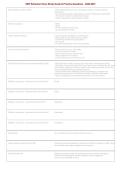
EMT Refresher Exam Study Guide & Practice Questions - 2026-2027
Body Substance Isolation (BSI) - Hand washing after each call; most effective means of reducing disease
transmission
- Use of protective gloves, safety glasses, gowns & masks when appropriate
- 10% bleach solution for blood borne cleanups
- Solution only good for approximately 3 weeks
EMT Immunizations - MMR
- Hep-B
- TB test at least once each year
- No immunization for AIDS
Proper Lifting Techniques - Know the physical limitations of self & partner
- Keep weight in close while carrying or lifting
- Lift with legs & back from squat position
- Don't reach
- #1 cause of EMT injury is from improper lifting
Haz-mat Scene Precautions - First concern is for your own safety
- If scene unsafe do not enter
- Set up safe zone if you are first unit in
- Always approach from upwind
- Do only that which you are trained to do.
EMT Stress & Critical Incident Stress Debriefing (CISD) - EMT response to death or serious injury may lead to critical incident stress.
- Defusing is an early intervention that occurs at the scene or shortly after the scene
of an incident, designed to stop the negative stress process that may occur in the
hours immediately following a disaster response.
- Critical incident stress debriefing (CISD)-A psychological, emotional and
educational group process to diminish the impact of critical incident stress.
- Best accomplished if commenced within 24-72 hours of the incident
DABDA is an acronym - what does the 1st D stand for? Denial
DABDA is an acronym - what does the 1st A stand for? Anger
DABDA is an acronym - what does the B stand for? Bargaining
DABDA is an acronym - what does the 2nd D stand for? Depression
DABDA is an acronym - what does the 2nd A stand for? Acceptance
Golden Rule Do unto others as you would have them do unto you
Public Health Law Article 30, Part 800 Contains the rules & regulations in reference to EMS & immunities. An EMT cannot
be held liable unless gross negligence can be proven.
Good Samaritan Act Designed to protect private non-certified persons who assist in emergency
treatment from legal action, with the exception of gross negligence.
(does not cover the EMT in NYS)
, EMT Refresher Exam Study Guide & Practice Questions - 2026-2027
Medical, Legal, and Ethical Issues Staying within the scope of practice & standard of care for his/her level of training,
combined with proper documentation will go a long way in preventing the EMT from
being involved in litigation.
Negligence Deviation from the standard of care as recognized by law
Criteria:
Duty to act
Breech of duty
Injury occurred
Proximate cause - Injury resulted from the improper action or failure to act.
assault and battery In certain circumstances the EMT can be charged with assault (unlawfully placing
someone in fear of immediate bodily harm) & battery (unlawful touching) for treating
an adult without consent.
consent Agreement by the patient to accept medical intervention
Informed (Actual) Consent A patient is told, in a manner they can understand, the nature and extent of the
procedure to be performed and the possible risks. The patient fully understands the
procedures, risks involved, and accepts.
Implied consent The unconscious, mentally impaired, or child patient under age 18 in a true
emergency, in which there is a significant risk of death, disability or deterioration of
the condition, the Law assumes that the patient or guardian would give their
consent.
Abandonment The termination of the provider-patient relationship without the consent from the
patient and not allowing that patient time to find another provider while care is still
needed. Transferring a patient to another health care professional who is not of
equal or higher training than you.
Delegated Practice The system Medical Director who is a physician delegates the rescuer to carry out
actions on their behalf. Example is on line medical direction (medical control) or off
line medical direction (standing orders and/or protocols).
Quality Improvement A system of internal & external audits, that monitors every aspect of pre hospital
care to achieve optimal excellence in-patient services rendered. When quality
issues are discovered, suggestions are made to prevent re occurrence.
DOCUMENTATION NYS PCR FORMS Important to fill all the shaded areas of form.
Dates and times of the ambulance call
Information from the patient, bystanders, and a physical examination
Observations at scene (subjective)
Physical findings (objective)
Treatment rendered and changes in patient condition
NO PERSONAL COMMENTS FROM THE EMT
Legal Document that reflects upon its author
Sloppy, incomplete record suggests sloppy and incomplete patient care
A large number of documentation errors occur from incomplete RMA documentation
forms. Fill out the PCR form completely with as much information as possible &
have police officer witness the signature of the person refusing medical aid.
If you didn't write it, you didn't do it.
ERROR?? Draw one line though it, initial it, date it and continue
PROUNCEMENT OF DEATH EMT may pronounce death only under criteria listed below:
- Rigor mortis
- Dependent lividity
- Decapitation
- De-composition
- Valid NYS pre hospital DNR form with patient
, EMT Refresher Exam Study Guide & Practice Questions - 2026-2027
Communications - 10 medical channels on Nassau Medical Control. Notifications required for all
hospital patient deliveries on Talk Group #1
- EMD = Emergency Medical Dispatch. Concept of delivering pre-prescribed
scripted instructions to emergency callers prior to the actual arrival of medical
technicians.
Emergency Medical Dispatcher (EMD) a vital link in the chain of survival & treatment
Triage tags: Black Dead, Lowest Priority
Triage tags: Green Minor Injuries, Low priority
Triage tags: Yellow Moderate Injuries, Delayed priority
Triage tags: Red Life Threatening Injuries, High priority
Brady slow
Tachy fast
Contra/Anti against
Des/dis/dys Disorder, difficult
cardio heart
Cerebro brain
Cephalo head
Hemi half
Hypo Deficient, under, below
, EMT Refresher Exam Study Guide & Practice Questions - 2026-2027
Hyper above, over, excess
Inter between
Intra inside
Anterior (ventral) Towards the front of the body or body part
Posterior (dorsal) Towards the back of the body or body part
Superior above, upper
Inferior below, lower
superficial near the surface
Deep Remote the the surface
Internal inside
External outside
Proximal Near to the point of attachment
Distal Farthest from the point of attachment
Medial Toward the midline of the body
Lateral Away from the midline of the body
Body Substance Isolation (BSI) - Hand washing after each call; most effective means of reducing disease
transmission
- Use of protective gloves, safety glasses, gowns & masks when appropriate
- 10% bleach solution for blood borne cleanups
- Solution only good for approximately 3 weeks
EMT Immunizations - MMR
- Hep-B
- TB test at least once each year
- No immunization for AIDS
Proper Lifting Techniques - Know the physical limitations of self & partner
- Keep weight in close while carrying or lifting
- Lift with legs & back from squat position
- Don't reach
- #1 cause of EMT injury is from improper lifting
Haz-mat Scene Precautions - First concern is for your own safety
- If scene unsafe do not enter
- Set up safe zone if you are first unit in
- Always approach from upwind
- Do only that which you are trained to do.
EMT Stress & Critical Incident Stress Debriefing (CISD) - EMT response to death or serious injury may lead to critical incident stress.
- Defusing is an early intervention that occurs at the scene or shortly after the scene
of an incident, designed to stop the negative stress process that may occur in the
hours immediately following a disaster response.
- Critical incident stress debriefing (CISD)-A psychological, emotional and
educational group process to diminish the impact of critical incident stress.
- Best accomplished if commenced within 24-72 hours of the incident
DABDA is an acronym - what does the 1st D stand for? Denial
DABDA is an acronym - what does the 1st A stand for? Anger
DABDA is an acronym - what does the B stand for? Bargaining
DABDA is an acronym - what does the 2nd D stand for? Depression
DABDA is an acronym - what does the 2nd A stand for? Acceptance
Golden Rule Do unto others as you would have them do unto you
Public Health Law Article 30, Part 800 Contains the rules & regulations in reference to EMS & immunities. An EMT cannot
be held liable unless gross negligence can be proven.
Good Samaritan Act Designed to protect private non-certified persons who assist in emergency
treatment from legal action, with the exception of gross negligence.
(does not cover the EMT in NYS)
, EMT Refresher Exam Study Guide & Practice Questions - 2026-2027
Medical, Legal, and Ethical Issues Staying within the scope of practice & standard of care for his/her level of training,
combined with proper documentation will go a long way in preventing the EMT from
being involved in litigation.
Negligence Deviation from the standard of care as recognized by law
Criteria:
Duty to act
Breech of duty
Injury occurred
Proximate cause - Injury resulted from the improper action or failure to act.
assault and battery In certain circumstances the EMT can be charged with assault (unlawfully placing
someone in fear of immediate bodily harm) & battery (unlawful touching) for treating
an adult without consent.
consent Agreement by the patient to accept medical intervention
Informed (Actual) Consent A patient is told, in a manner they can understand, the nature and extent of the
procedure to be performed and the possible risks. The patient fully understands the
procedures, risks involved, and accepts.
Implied consent The unconscious, mentally impaired, or child patient under age 18 in a true
emergency, in which there is a significant risk of death, disability or deterioration of
the condition, the Law assumes that the patient or guardian would give their
consent.
Abandonment The termination of the provider-patient relationship without the consent from the
patient and not allowing that patient time to find another provider while care is still
needed. Transferring a patient to another health care professional who is not of
equal or higher training than you.
Delegated Practice The system Medical Director who is a physician delegates the rescuer to carry out
actions on their behalf. Example is on line medical direction (medical control) or off
line medical direction (standing orders and/or protocols).
Quality Improvement A system of internal & external audits, that monitors every aspect of pre hospital
care to achieve optimal excellence in-patient services rendered. When quality
issues are discovered, suggestions are made to prevent re occurrence.
DOCUMENTATION NYS PCR FORMS Important to fill all the shaded areas of form.
Dates and times of the ambulance call
Information from the patient, bystanders, and a physical examination
Observations at scene (subjective)
Physical findings (objective)
Treatment rendered and changes in patient condition
NO PERSONAL COMMENTS FROM THE EMT
Legal Document that reflects upon its author
Sloppy, incomplete record suggests sloppy and incomplete patient care
A large number of documentation errors occur from incomplete RMA documentation
forms. Fill out the PCR form completely with as much information as possible &
have police officer witness the signature of the person refusing medical aid.
If you didn't write it, you didn't do it.
ERROR?? Draw one line though it, initial it, date it and continue
PROUNCEMENT OF DEATH EMT may pronounce death only under criteria listed below:
- Rigor mortis
- Dependent lividity
- Decapitation
- De-composition
- Valid NYS pre hospital DNR form with patient
, EMT Refresher Exam Study Guide & Practice Questions - 2026-2027
Communications - 10 medical channels on Nassau Medical Control. Notifications required for all
hospital patient deliveries on Talk Group #1
- EMD = Emergency Medical Dispatch. Concept of delivering pre-prescribed
scripted instructions to emergency callers prior to the actual arrival of medical
technicians.
Emergency Medical Dispatcher (EMD) a vital link in the chain of survival & treatment
Triage tags: Black Dead, Lowest Priority
Triage tags: Green Minor Injuries, Low priority
Triage tags: Yellow Moderate Injuries, Delayed priority
Triage tags: Red Life Threatening Injuries, High priority
Brady slow
Tachy fast
Contra/Anti against
Des/dis/dys Disorder, difficult
cardio heart
Cerebro brain
Cephalo head
Hemi half
Hypo Deficient, under, below
, EMT Refresher Exam Study Guide & Practice Questions - 2026-2027
Hyper above, over, excess
Inter between
Intra inside
Anterior (ventral) Towards the front of the body or body part
Posterior (dorsal) Towards the back of the body or body part
Superior above, upper
Inferior below, lower
superficial near the surface
Deep Remote the the surface
Internal inside
External outside
Proximal Near to the point of attachment
Distal Farthest from the point of attachment
Medial Toward the midline of the body
Lateral Away from the midline of the body

