
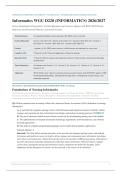
WESTERN GOVERNORS UNIVERSITY | COURSE D220 - INFORMATICS FOR NURSING PRACTICE
Informatics WGU D220 (INFORMATICS) 2026/2027
Course Examination Preparation | Verified Questions and Answers Aligned with WGU D220 Course
Objectives and Proctored Objective Assessment Format
Total Questions 60 sequential multiple-choice questions (Q1-Q60) across 6 sections
Section Blueprint Section 1 Q1-Q10 (10) - Section 2 Q11-Q22 (12) - Section 3 Q23-Q32 (10) - Section 4
Q33-Q40 (8) - Section 5 Q41-Q50 (10) - Section 6 Q51-Q60 (10)
Format 4 options (A-D), ONE correct answer; verified answer and rationale for every item
Cognitive Mix 25 percent recall, 55 percent application, 20 percent analysis
Question Style 75 percent clinical scenario and competency-based, 25 percent direct recall and terminology
identification
Time Simulation 95 minutes total: Section 1: 15 - Section 2: 20 - Section 3: 16 - Section 4: 12 - Section 5: 16 -
Section 6: 16
Alignment WGU D220 course objectives and proctored assessment format with 2026/2027 updates: CMS
Promoting Interoperability, information blocking rules, AI integration and governance, and
telehealth expansion
SECTION 1 | QUESTIONS Q1-Q10 | RECOMMENDED TIME: 15 minutes
Foundations of Nursing Informatics
ANA Definition of Nursing Informatics - Integration of Nursing, Computer, and Information Sciences - DIKW Framework (Data,
Information, Knowledge, Wisdom) - Historical Development - Foundation of Knowledge Model - Informatics Nurse Roles
Q1: Which statement most accurately reflects the American Nurses Association (ANA) definition of nursing
informatics?
A. A specialty that integrates nursing science with information and analytical sciences to identify, define,
manage, and communicate data, information, knowledge, and wisdom in nursing practice [CORRECT]
B. The use of electronic health record software exclusively for documenting nursing care at the bedside
C. The administration of hospital information technology departments, network hardware, and software
licensing agreements
D. The study of computer programming languages used to build clinical database applications
Correct Answer: A
Rationale: The ANA defines nursing informatics as the specialty that integrates nursing science with multiple
information and analytical sciences to identify, define, manage, and communicate data, information, knowledge,
and wisdom in nursing practice. Option B incorrectly narrows the specialty to EHR documentation, while option C
describes information technology administration rather than clinical informatics. Option D reflects computer
science alone, ignoring the nursing and information science components that define the discipline. D220
emphasizes that the integration of sciences, not the tool itself, is the essence of the definition.
Verified Questions and Answers | Informatics for Nursing Practice 1
,WGU D220 Informatics for Nursing Practice | 2026/2027
Q2: A nurse reviews a laboratory screen that displays a single value: "Potassium 3.2 mmol/L." In the DIKW
framework, this uninterpreted value represents which level?
A. Wisdom
B. Knowledge
C. Data [CORRECT]
D. Information
Correct Answer: C
Rationale: Data are discrete, uninterpreted values without context, and an isolated laboratory value is the classic
example of the data tier in the DIKW continuum. It becomes information only when interpreted against context,
such as the reference range of 3.5 to 5.0 mmol/L. Knowledge would involve understanding the patterns and
relationships associated with hypokalemia, and wisdom would involve applying that understanding to a specific
clinical intervention. Misclassifying raw values as information is a common D220 examination pitfall.
Q3: A nurse notices that a patient's potassium is 3.2 mmol/L, recognizes that this value falls below the reference
range, and compares it with earlier results showing a downward trend. In the DIKW framework, the act of
organizing and interpreting these values to reach the conclusion that "the patient's potassium is low and falling"
occurs at which level?
A. Data
B. Information [CORRECT]
C. Wisdom
D. Metacognition
Correct Answer: B
Rationale: Information is data that have been organized, structured, and interpreted to reveal relationships and
meaning, which is exactly what occurs when a nurse compares a value against a reference range and prior trends.
The raw laboratory numbers alone are data, whereas wisdom requires selecting and applying an appropriate
intervention. Metacognition is a learning concept, not a tier of the DIKW framework. D220 scenarios frequently
test the transition from data to information as the first interpretive step.
Q4: A nurse understands that a patient receiving digoxin who develops hypokalemia is at significantly increased
risk for digoxin toxicity and cardiac dysrhythmias. Within the DIKW framework, this understanding of the
relationship among potassium, digoxin, and cardiac conduction represents which level?
A. Data
B. Information
C. Wisdom
D. Knowledge [CORRECT]
Correct Answer: D
Rationale: Knowledge is the awareness and understanding of patterns, relationships, and principles that link pieces
of information together, such as the interaction between hypokalemia and digoxin sensitivity. The individual
laboratory values and trend lines are data and information respectively. Wisdom is reached only when the nurse
applies this knowledge to make an appropriate clinical decision for a specific patient. D220 expects students to
distinguish knowledge as the synthesis of relationships rather than the act of intervening.
Verified Questions and Answers | Informatics for Nursing Practice 2
, WGU D220 Informatics for Nursing Practice | 2026/2027
Q5: After synthesizing a patient's data, trend information, and knowledge of drug interactions, a nurse contacts
the provider, recommends holding the next digoxin dose, and initiates continuous cardiac monitoring. In the
DIKW framework, this appropriate application of knowledge to manage and solve a clinical problem is best
described as which level?
A. Information
B. Data management
C. Wisdom [CORRECT]
D. Knowledge acquisition
Correct Answer: C
Rationale: Wisdom is the appropriate application of knowledge to manage and solve human problems, and it is
demonstrated when the nurse selects the right intervention, at the right time, for the right patient. The nurse is not
merely collecting values or identifying relationships but is acting on synthesized understanding. Knowledge
acquisition refers to obtaining new knowledge rather than applying established knowledge at the bedside. This
data-to-wisdom progression is the most frequently tested DIKW application in D220 clinical scenarios.
Q6: Nursing informatics is formally described as the integration of which core sciences?
A. Nursing science, computer science, and information science, supported by cognitive and library sciences
[CORRECT]
B. Biology, chemistry, and physics applied to health information technology
C. Business administration, finance, and health economics
D. Epidemiology, biostatistics, and pharmacology
Correct Answer: A
Rationale: The classic formulation of nursing informatics describes it as the integration of nursing science,
computer science, and information science, with cognitive science and library science frequently cited as
supporting disciplines. Option B lists the natural sciences, which underpin general health knowledge but do not
define informatics. Options C and D describe business and research disciplines that inform healthcare
administration and population health rather than the core identity of nursing informatics. D220 consistently frames
the discipline around this interdisciplinary integration.
Q7: Which historical milestone correctly pairs an event in the evolution of nursing informatics with its
approximate time frame?
A. The ANA first recognized nursing informatics as a distinct nursing specialty in the 1960s
B. The first hospital information systems and early nursing applications emerged in the 1960s, with the ANA
officially recognizing nursing informatics as a specialty in 1992 [CORRECT]
C. Electronic health records were mandated for all United States hospitals in the 1970s
D. The first certification examination for nursing informatics was administered before any hospital
information systems existed
Correct Answer: B
Rationale: Early hospital information systems and the first nursing applications appeared in the 1960s, and the
ANA formally recognized nursing informatics as a nursing specialty in 1992, followed by the first informatics
certification examination in 1995. Option A reverses the timeline, since specialty recognition came decades after
the first systems. Option C is inaccurate because the HITECH Act drove widespread EHR adoption beginning in
2009, not the 1970s. Option D is chronologically impossible because certification necessarily followed system
development. D220 tests these timeline anchors to establish historical context for current systems.
Verified Questions and Answers | Informatics for Nursing Practice 3
Informatics WGU D220 (INFORMATICS) 2026/2027
Course Examination Preparation | Verified Questions and Answers Aligned with WGU D220 Course
Objectives and Proctored Objective Assessment Format
Total Questions 60 sequential multiple-choice questions (Q1-Q60) across 6 sections
Section Blueprint Section 1 Q1-Q10 (10) - Section 2 Q11-Q22 (12) - Section 3 Q23-Q32 (10) - Section 4
Q33-Q40 (8) - Section 5 Q41-Q50 (10) - Section 6 Q51-Q60 (10)
Format 4 options (A-D), ONE correct answer; verified answer and rationale for every item
Cognitive Mix 25 percent recall, 55 percent application, 20 percent analysis
Question Style 75 percent clinical scenario and competency-based, 25 percent direct recall and terminology
identification
Time Simulation 95 minutes total: Section 1: 15 - Section 2: 20 - Section 3: 16 - Section 4: 12 - Section 5: 16 -
Section 6: 16
Alignment WGU D220 course objectives and proctored assessment format with 2026/2027 updates: CMS
Promoting Interoperability, information blocking rules, AI integration and governance, and
telehealth expansion
SECTION 1 | QUESTIONS Q1-Q10 | RECOMMENDED TIME: 15 minutes
Foundations of Nursing Informatics
ANA Definition of Nursing Informatics - Integration of Nursing, Computer, and Information Sciences - DIKW Framework (Data,
Information, Knowledge, Wisdom) - Historical Development - Foundation of Knowledge Model - Informatics Nurse Roles
Q1: Which statement most accurately reflects the American Nurses Association (ANA) definition of nursing
informatics?
A. A specialty that integrates nursing science with information and analytical sciences to identify, define,
manage, and communicate data, information, knowledge, and wisdom in nursing practice [CORRECT]
B. The use of electronic health record software exclusively for documenting nursing care at the bedside
C. The administration of hospital information technology departments, network hardware, and software
licensing agreements
D. The study of computer programming languages used to build clinical database applications
Correct Answer: A
Rationale: The ANA defines nursing informatics as the specialty that integrates nursing science with multiple
information and analytical sciences to identify, define, manage, and communicate data, information, knowledge,
and wisdom in nursing practice. Option B incorrectly narrows the specialty to EHR documentation, while option C
describes information technology administration rather than clinical informatics. Option D reflects computer
science alone, ignoring the nursing and information science components that define the discipline. D220
emphasizes that the integration of sciences, not the tool itself, is the essence of the definition.
Verified Questions and Answers | Informatics for Nursing Practice 1
,WGU D220 Informatics for Nursing Practice | 2026/2027
Q2: A nurse reviews a laboratory screen that displays a single value: "Potassium 3.2 mmol/L." In the DIKW
framework, this uninterpreted value represents which level?
A. Wisdom
B. Knowledge
C. Data [CORRECT]
D. Information
Correct Answer: C
Rationale: Data are discrete, uninterpreted values without context, and an isolated laboratory value is the classic
example of the data tier in the DIKW continuum. It becomes information only when interpreted against context,
such as the reference range of 3.5 to 5.0 mmol/L. Knowledge would involve understanding the patterns and
relationships associated with hypokalemia, and wisdom would involve applying that understanding to a specific
clinical intervention. Misclassifying raw values as information is a common D220 examination pitfall.
Q3: A nurse notices that a patient's potassium is 3.2 mmol/L, recognizes that this value falls below the reference
range, and compares it with earlier results showing a downward trend. In the DIKW framework, the act of
organizing and interpreting these values to reach the conclusion that "the patient's potassium is low and falling"
occurs at which level?
A. Data
B. Information [CORRECT]
C. Wisdom
D. Metacognition
Correct Answer: B
Rationale: Information is data that have been organized, structured, and interpreted to reveal relationships and
meaning, which is exactly what occurs when a nurse compares a value against a reference range and prior trends.
The raw laboratory numbers alone are data, whereas wisdom requires selecting and applying an appropriate
intervention. Metacognition is a learning concept, not a tier of the DIKW framework. D220 scenarios frequently
test the transition from data to information as the first interpretive step.
Q4: A nurse understands that a patient receiving digoxin who develops hypokalemia is at significantly increased
risk for digoxin toxicity and cardiac dysrhythmias. Within the DIKW framework, this understanding of the
relationship among potassium, digoxin, and cardiac conduction represents which level?
A. Data
B. Information
C. Wisdom
D. Knowledge [CORRECT]
Correct Answer: D
Rationale: Knowledge is the awareness and understanding of patterns, relationships, and principles that link pieces
of information together, such as the interaction between hypokalemia and digoxin sensitivity. The individual
laboratory values and trend lines are data and information respectively. Wisdom is reached only when the nurse
applies this knowledge to make an appropriate clinical decision for a specific patient. D220 expects students to
distinguish knowledge as the synthesis of relationships rather than the act of intervening.
Verified Questions and Answers | Informatics for Nursing Practice 2
, WGU D220 Informatics for Nursing Practice | 2026/2027
Q5: After synthesizing a patient's data, trend information, and knowledge of drug interactions, a nurse contacts
the provider, recommends holding the next digoxin dose, and initiates continuous cardiac monitoring. In the
DIKW framework, this appropriate application of knowledge to manage and solve a clinical problem is best
described as which level?
A. Information
B. Data management
C. Wisdom [CORRECT]
D. Knowledge acquisition
Correct Answer: C
Rationale: Wisdom is the appropriate application of knowledge to manage and solve human problems, and it is
demonstrated when the nurse selects the right intervention, at the right time, for the right patient. The nurse is not
merely collecting values or identifying relationships but is acting on synthesized understanding. Knowledge
acquisition refers to obtaining new knowledge rather than applying established knowledge at the bedside. This
data-to-wisdom progression is the most frequently tested DIKW application in D220 clinical scenarios.
Q6: Nursing informatics is formally described as the integration of which core sciences?
A. Nursing science, computer science, and information science, supported by cognitive and library sciences
[CORRECT]
B. Biology, chemistry, and physics applied to health information technology
C. Business administration, finance, and health economics
D. Epidemiology, biostatistics, and pharmacology
Correct Answer: A
Rationale: The classic formulation of nursing informatics describes it as the integration of nursing science,
computer science, and information science, with cognitive science and library science frequently cited as
supporting disciplines. Option B lists the natural sciences, which underpin general health knowledge but do not
define informatics. Options C and D describe business and research disciplines that inform healthcare
administration and population health rather than the core identity of nursing informatics. D220 consistently frames
the discipline around this interdisciplinary integration.
Q7: Which historical milestone correctly pairs an event in the evolution of nursing informatics with its
approximate time frame?
A. The ANA first recognized nursing informatics as a distinct nursing specialty in the 1960s
B. The first hospital information systems and early nursing applications emerged in the 1960s, with the ANA
officially recognizing nursing informatics as a specialty in 1992 [CORRECT]
C. Electronic health records were mandated for all United States hospitals in the 1970s
D. The first certification examination for nursing informatics was administered before any hospital
information systems existed
Correct Answer: B
Rationale: Early hospital information systems and the first nursing applications appeared in the 1960s, and the
ANA formally recognized nursing informatics as a nursing specialty in 1992, followed by the first informatics
certification examination in 1995. Option A reverses the timeline, since specialty recognition came decades after
the first systems. Option C is inaccurate because the HITECH Act drove widespread EHR adoption beginning in
2009, not the 1970s. Option D is chronologically impossible because certification necessarily followed system
development. D220 tests these timeline anchors to establish historical context for current systems.
Verified Questions and Answers | Informatics for Nursing Practice 3

