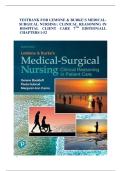
TESTBANK FOR LEMONE & BURKE’S MEDICAL-
01 01 01 01 01
SURGICAL NURSING: CLINICAL REASONING IN
01 01 01 01 01
HOSPITAL CLIENT CARE 7TH EDITION/ALL
01 01 01 01 01
CHAPTERS 1-52
01 01
,Chapter 1 01
1. The caregiver is caring for four Hospital clients on a medical–surgical unit.
01 01 01 01 01 01 01 01 01 01 01
WhichHospital client should the caregiver see initially?
01 01 01 01 01 01 01 01
1. A Hospital client admitted with hepatitis A who has had severe
01 01 01 01 01 01 01 01 01 01
diarrhea for thelast 24 hours
01 01 01 01 01 01
2. A Hospital client admitted with pneumonia who is has small
01 01 01 01 01 01 01 01 01
amounts ofyellow productive sputum
01 01 01 01 01
3. A Hospital client admitted with fever of unknown origin (FUO)
01 01 01 01 01 01 01 01 01
who hasbeen without fever for the last 48 hours
01 01 01 01 01 01 01 01 01 01
4. A Hospital client admitted with a wound infection whose WBC is
01 01 01 01 01 01 01 01 01 01
01 8,500 mm3ACCURATE ANSWER:-1
01 01 01
Reasoning:->>>The caregiver must decide which Hospital client should be seen on 01 01 01 01 01 01 01 01 01 01
theinitial rounds of the day. The caregiver must remember that the first
01 01 01 01 01 01 01 01 01 01 01 01 01
Hospital client to be seen should be the Hospital client who needs the
01 01 01 01 01 01 01 01 01 01 01 01
attention of the caregiver initially. A Hospital client with hepatitis A does
01 01 01 01 01 01 01 01 01 01 01 01
experience diarrhea,but diarrhea for the last 24 hours could cause the
01 01 01 01 01 01 01 01 01 01 01 01
Hospital client to have a problem withdehydration and experience a state of
01 01 01 01 01 01 01 01 01 01 01 01 01
fluid volume deficit.
01 01 01
Cognitive Level: Application 01 01
Hospital client Needs: Safe, Effective Care
01 01 01 01 01
EnvironmentNursing Process: Planning
01 01 01 01
2. The caregiver is preparing to administer influenza vaccines to a mass drive-
01 01 01 01 01 01 01 01 01 01 01
through clinic. Which statement by a Hospital client would indicate further
01 01 01 01 01 01 01 01 01 01 01
questioning prior togiving the Hospital client the influenza vaccine?
01 01 01 01 01 01 01 01 01 01
1. ―I am allergic to horse hair.‖
01 01 01 01 01
2. ―I try to get my vaccine every year.‖
01 01 01 01 01 01 01
3. ―I am not allergic to anything except eggs.‖
01 01 01 01 01 01 01
4. ―My husband had a severe allergic reaction after he received his
01 01 01 01 01 01 01 01 01 01
influenzavaccine.‖
01 01
ACCURATE ANSWER:-3 01
Reasoning:->>>Influenza vaccines are recommended for person at high risk for serious 01 01 01 01 01 01 01 01 01 01
sequelae of influenza. The caregiver should be aware that Hospital client with
01 01 01 01 01 01 01 01 01 01 01 01
asensitivity to eggs should not receive the vaccine. Vaccines prepared from
01 01 01 01 01 01 01 01 01 01 01 01
chicken or duck embryos are contraindicated in Hospital clients who are
01 01 01 01 01 01 01 01 01 01 01
allergic to eggs.
01 01 01
,Cognitive Level: Application 01 01
Hospital client Needs: Safe, Effective Care
01 01 01 01 01
EnvironmentNursing Process: Assessment
01 01 01 01
3. The caregiver is caring for four Hospital clients on a medical–surgical unit. The
01 01 01 01 01 01 01 01 01 01 01 01
secretary gives the caregiver the morning labs. Which of the following labs would
01 01 01 01 01 01 01 01 01 01 01 01 01
require that the caregiver call the physician and inform the healthcare provider about
01 01 01 01 01 01 01 01 01 01 01 01 01
the Hospital client‘s abnormalities?
01 01 01 01
1. 0 1 WBC 14,600 mm3 01 01
2. Serum protein 6.9 g/dL 01 01 01
3. I & D (incision and drainage) showing no growth for the last 24 hours
01 01 01 01 01 01 01 01 01 01 01 01 01
4. Albumin 4.2 01
g/dLACCURATE ANSWER:-1
01 01 01
Reasoning:->>>When the caregiver is caring for several Hospital clients, all of the 01 01 01 01 01 01 01 01 01 01 01
labs should be checked frequently throughout the shift to assess for any
01 01 01 01 01 01 01 01 01 01 01 01
abnormalities. The WBC in option 1 is abnormal. (Normal WBC 4,000–10,000
01 01 01 01 01 01 01 01 01 01 01
mm3.) All of the other lab results are within acceptable range; therefore, the results
01 01 01 01 01 01 01 01 01 01 01 01 01 01
should not be called in to thephysician.
01 01 01 01 01 01 01 01
Cognitive Level: 01
ApplicationHospital client
01 01 01
Needs: Physiologic
01 01
Integrity Nursing Process:
01 01 01
Assessment
4. The caregiver is orienting a new graduate. The caregiver is reinforcing the
01 01 01 01 01 01 01 01 01 01 01
importance of standard precautions. Which of the following observations by
01 01 01 01 01 01 01 01 01 01
the caregiver would require further education regardingstandard precautions?
01 01 01 01 01 01 01 01 01
1. The graduate caregiver understands to wash hands whenentering
01 01 01 01 01 01 01 01
and exiting the Hospital client‘s room.
01 01 01 01 01 01
2. The graduate caregiver wears gloves when serving breakfasttrays to
01 01 01 01 01 01 01 01 01
various Hospital clients.
01 01 01
3. The graduate caregiver wears a gown, gloves, and goggles
01 01 01 01 01 01 01 01
whensuctioning a Hospital client.
01 01 01 01 01
4. The graduate caregiver leaves all supplies in the room of aHospital
01 01 01 01 01 01 01 01 01 01 01
client who is in contact isolation.
01 01 01 01 01 01
ACCURATE ANSWER:-2 01
Reasoning:->>>The caregiver must have an understanding of standard precautions. 01 01 01 01 01 01 01 01
, 01 Prevention is the most important measure to prevent nosocomial infections.
01 01 01 01 01 01 01 01 01
01 Standard precautions were published in 1996 that provide guidelines
01 01 01 01 01 01 01 01
for the handling of blood and other body fluids. These guidelines are used with
01 01 01 01 01 01 01 01 01 01 01 01 01
all Hospital clients, regardless of whether they have a known infectious disease.
01 01 01 01 01 01 01 01 01 01 01 01
Standardprecautions are used
01 01 01 01
by all healthcare workers who have direct contact with Hospital clients or with
01 01 01 01 01 01 01 01 01 01 01 01
their body fluids. It is not necessary for the caregiver to wear gloves while
01 01 01 01 01 01 01 01 01 01 01 01 01 01
delivering food trays to the Hospital client, because there is not contact with
01 01 01 01 01 01 01 01 01 01 01 01 01
the Hospital client.
01 01 01
Cognitive Level: Application 01 01
Hospital client Needs: Safe, Effective Care
01 01 01 01 01
EnvironmentNursing Process: Evaluation
01 01 01 01
5. The admitting department alerts the caregiver on a medical–surgical unit thata
01 01 01 01 01 01 01 01 01 01 01
Hospital client with active tuberculosis (TB) is being admitted to the unit. Which
01 01 01 01 01 01 01 01 01 01 01 01 01
type of isolation is appropriate based on the Hospital client‘s diagnosis?
01 01 01 01 01 01 01 01 01 01 01
1. Standard precautions 01
2. Airborne precautions 01
3. Droplet precautions 01
4. Contact
01 precautionsACCURATE 01
01 ANSWER:-2
Reasoning:->>>In addition to handwashing and standard precautions, the nature and 01 01 01 01 01 01 01 01 01
spread of some infectious diseases require that special techniques be used to protect
01 01 01 01 01 01 01 01 01 01 01 01 01
uninfected Hospital clients and workers. The Hospital client with pulmonary
01 01 01 01 01 01 01 01 01 01
tuberculosis will be placed in airborne precautions. The Hospital client should be
01 01 01 01 01 01 01 01 01 01 01 01
placed in a private room with special ventilation that does not allow air to circulate to
01 01 01 01 01 01 01 01 01 01 01 01 01 01 01 01
general health center ventilation; a maskor special filter respirators will be used for
01 01 01 01 01 01 01 01 01 01 01 01 01 01
everyone entering the room.
01 01 01 01
Cognitive Level: Application 01 01
Hospital client Needs: Safe, Effective Care
01 01 01 01 01
EnvironmentNursing Process: Assessment
01 01 01 01
6. A Hospital client is receiving IV vancomycin for the treatment of Clostridium
01 01 01 01 01 01 01 01 01 01 01
difficile.The caregiver understands that the Hospital client who develops
01 01 01 01 01 01 01 01 01 01
flushing, tachycardia, and hypotension during the infusion of vancomycin
01 01 01 01 01 01 01 01 01
indicates:
01
1. Ototoxicity effect. 01
01 01 01 01 01
SURGICAL NURSING: CLINICAL REASONING IN
01 01 01 01 01
HOSPITAL CLIENT CARE 7TH EDITION/ALL
01 01 01 01 01
CHAPTERS 1-52
01 01
,Chapter 1 01
1. The caregiver is caring for four Hospital clients on a medical–surgical unit.
01 01 01 01 01 01 01 01 01 01 01
WhichHospital client should the caregiver see initially?
01 01 01 01 01 01 01 01
1. A Hospital client admitted with hepatitis A who has had severe
01 01 01 01 01 01 01 01 01 01
diarrhea for thelast 24 hours
01 01 01 01 01 01
2. A Hospital client admitted with pneumonia who is has small
01 01 01 01 01 01 01 01 01
amounts ofyellow productive sputum
01 01 01 01 01
3. A Hospital client admitted with fever of unknown origin (FUO)
01 01 01 01 01 01 01 01 01
who hasbeen without fever for the last 48 hours
01 01 01 01 01 01 01 01 01 01
4. A Hospital client admitted with a wound infection whose WBC is
01 01 01 01 01 01 01 01 01 01
01 8,500 mm3ACCURATE ANSWER:-1
01 01 01
Reasoning:->>>The caregiver must decide which Hospital client should be seen on 01 01 01 01 01 01 01 01 01 01
theinitial rounds of the day. The caregiver must remember that the first
01 01 01 01 01 01 01 01 01 01 01 01 01
Hospital client to be seen should be the Hospital client who needs the
01 01 01 01 01 01 01 01 01 01 01 01
attention of the caregiver initially. A Hospital client with hepatitis A does
01 01 01 01 01 01 01 01 01 01 01 01
experience diarrhea,but diarrhea for the last 24 hours could cause the
01 01 01 01 01 01 01 01 01 01 01 01
Hospital client to have a problem withdehydration and experience a state of
01 01 01 01 01 01 01 01 01 01 01 01 01
fluid volume deficit.
01 01 01
Cognitive Level: Application 01 01
Hospital client Needs: Safe, Effective Care
01 01 01 01 01
EnvironmentNursing Process: Planning
01 01 01 01
2. The caregiver is preparing to administer influenza vaccines to a mass drive-
01 01 01 01 01 01 01 01 01 01 01
through clinic. Which statement by a Hospital client would indicate further
01 01 01 01 01 01 01 01 01 01 01
questioning prior togiving the Hospital client the influenza vaccine?
01 01 01 01 01 01 01 01 01 01
1. ―I am allergic to horse hair.‖
01 01 01 01 01
2. ―I try to get my vaccine every year.‖
01 01 01 01 01 01 01
3. ―I am not allergic to anything except eggs.‖
01 01 01 01 01 01 01
4. ―My husband had a severe allergic reaction after he received his
01 01 01 01 01 01 01 01 01 01
influenzavaccine.‖
01 01
ACCURATE ANSWER:-3 01
Reasoning:->>>Influenza vaccines are recommended for person at high risk for serious 01 01 01 01 01 01 01 01 01 01
sequelae of influenza. The caregiver should be aware that Hospital client with
01 01 01 01 01 01 01 01 01 01 01 01
asensitivity to eggs should not receive the vaccine. Vaccines prepared from
01 01 01 01 01 01 01 01 01 01 01 01
chicken or duck embryos are contraindicated in Hospital clients who are
01 01 01 01 01 01 01 01 01 01 01
allergic to eggs.
01 01 01
,Cognitive Level: Application 01 01
Hospital client Needs: Safe, Effective Care
01 01 01 01 01
EnvironmentNursing Process: Assessment
01 01 01 01
3. The caregiver is caring for four Hospital clients on a medical–surgical unit. The
01 01 01 01 01 01 01 01 01 01 01 01
secretary gives the caregiver the morning labs. Which of the following labs would
01 01 01 01 01 01 01 01 01 01 01 01 01
require that the caregiver call the physician and inform the healthcare provider about
01 01 01 01 01 01 01 01 01 01 01 01 01
the Hospital client‘s abnormalities?
01 01 01 01
1. 0 1 WBC 14,600 mm3 01 01
2. Serum protein 6.9 g/dL 01 01 01
3. I & D (incision and drainage) showing no growth for the last 24 hours
01 01 01 01 01 01 01 01 01 01 01 01 01
4. Albumin 4.2 01
g/dLACCURATE ANSWER:-1
01 01 01
Reasoning:->>>When the caregiver is caring for several Hospital clients, all of the 01 01 01 01 01 01 01 01 01 01 01
labs should be checked frequently throughout the shift to assess for any
01 01 01 01 01 01 01 01 01 01 01 01
abnormalities. The WBC in option 1 is abnormal. (Normal WBC 4,000–10,000
01 01 01 01 01 01 01 01 01 01 01
mm3.) All of the other lab results are within acceptable range; therefore, the results
01 01 01 01 01 01 01 01 01 01 01 01 01 01
should not be called in to thephysician.
01 01 01 01 01 01 01 01
Cognitive Level: 01
ApplicationHospital client
01 01 01
Needs: Physiologic
01 01
Integrity Nursing Process:
01 01 01
Assessment
4. The caregiver is orienting a new graduate. The caregiver is reinforcing the
01 01 01 01 01 01 01 01 01 01 01
importance of standard precautions. Which of the following observations by
01 01 01 01 01 01 01 01 01 01
the caregiver would require further education regardingstandard precautions?
01 01 01 01 01 01 01 01 01
1. The graduate caregiver understands to wash hands whenentering
01 01 01 01 01 01 01 01
and exiting the Hospital client‘s room.
01 01 01 01 01 01
2. The graduate caregiver wears gloves when serving breakfasttrays to
01 01 01 01 01 01 01 01 01
various Hospital clients.
01 01 01
3. The graduate caregiver wears a gown, gloves, and goggles
01 01 01 01 01 01 01 01
whensuctioning a Hospital client.
01 01 01 01 01
4. The graduate caregiver leaves all supplies in the room of aHospital
01 01 01 01 01 01 01 01 01 01 01
client who is in contact isolation.
01 01 01 01 01 01
ACCURATE ANSWER:-2 01
Reasoning:->>>The caregiver must have an understanding of standard precautions. 01 01 01 01 01 01 01 01
, 01 Prevention is the most important measure to prevent nosocomial infections.
01 01 01 01 01 01 01 01 01
01 Standard precautions were published in 1996 that provide guidelines
01 01 01 01 01 01 01 01
for the handling of blood and other body fluids. These guidelines are used with
01 01 01 01 01 01 01 01 01 01 01 01 01
all Hospital clients, regardless of whether they have a known infectious disease.
01 01 01 01 01 01 01 01 01 01 01 01
Standardprecautions are used
01 01 01 01
by all healthcare workers who have direct contact with Hospital clients or with
01 01 01 01 01 01 01 01 01 01 01 01
their body fluids. It is not necessary for the caregiver to wear gloves while
01 01 01 01 01 01 01 01 01 01 01 01 01 01
delivering food trays to the Hospital client, because there is not contact with
01 01 01 01 01 01 01 01 01 01 01 01 01
the Hospital client.
01 01 01
Cognitive Level: Application 01 01
Hospital client Needs: Safe, Effective Care
01 01 01 01 01
EnvironmentNursing Process: Evaluation
01 01 01 01
5. The admitting department alerts the caregiver on a medical–surgical unit thata
01 01 01 01 01 01 01 01 01 01 01
Hospital client with active tuberculosis (TB) is being admitted to the unit. Which
01 01 01 01 01 01 01 01 01 01 01 01 01
type of isolation is appropriate based on the Hospital client‘s diagnosis?
01 01 01 01 01 01 01 01 01 01 01
1. Standard precautions 01
2. Airborne precautions 01
3. Droplet precautions 01
4. Contact
01 precautionsACCURATE 01
01 ANSWER:-2
Reasoning:->>>In addition to handwashing and standard precautions, the nature and 01 01 01 01 01 01 01 01 01
spread of some infectious diseases require that special techniques be used to protect
01 01 01 01 01 01 01 01 01 01 01 01 01
uninfected Hospital clients and workers. The Hospital client with pulmonary
01 01 01 01 01 01 01 01 01 01
tuberculosis will be placed in airborne precautions. The Hospital client should be
01 01 01 01 01 01 01 01 01 01 01 01
placed in a private room with special ventilation that does not allow air to circulate to
01 01 01 01 01 01 01 01 01 01 01 01 01 01 01 01
general health center ventilation; a maskor special filter respirators will be used for
01 01 01 01 01 01 01 01 01 01 01 01 01 01
everyone entering the room.
01 01 01 01
Cognitive Level: Application 01 01
Hospital client Needs: Safe, Effective Care
01 01 01 01 01
EnvironmentNursing Process: Assessment
01 01 01 01
6. A Hospital client is receiving IV vancomycin for the treatment of Clostridium
01 01 01 01 01 01 01 01 01 01 01
difficile.The caregiver understands that the Hospital client who develops
01 01 01 01 01 01 01 01 01 01
flushing, tachycardia, and hypotension during the infusion of vancomycin
01 01 01 01 01 01 01 01 01
indicates:
01
1. Ototoxicity effect. 01