
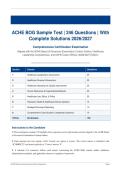
ACHE BOG Sample Test | 246 Questions | With
Complete Solutions 2026/2027
Comprehensive Certification Examination
Aligned with the ACHE Board of Governors Examination Content Outline, Healthcare
Leadership Competencies, and ACHE Code of Ethics (2026/2027 Edition)
Section Domain Questions
1 Healthcare Leadership & Governance 25
2 Healthcare Finance & Economics 25
3 Healthcare Operations & Quality Improvement 25
4 Human Resources & Organizational Behavior 20
5 Healthcare Law, Ethics, & Policy 20
6 Population Health & Healthcare Delivery Systems 15
7 Strategic Planning & Marketing 10
8 Comprehensive Case Studies & Leadership Scenarios 10
TOTAL All domains 150
Instructions to the Candidate
1. This examination contains 150 multiple-choice questions across eight domain sections aligned to the ACHE Board
of Governors Examination Content Outline.
2. Each question has four options (A-D). Exactly one option is correct. The correct answer is identified with
*[CORRECT]* and stated explicitly as "Correct Answer: X".
3. A rationale (2-4 sentences) follows each answer, referencing the ACHE BOG content outline, healthcare
administration standards, and applicable statutory or regulatory frameworks.
ACHE Board of Governors Examination Preparation Page 1
,ACHE BOG Sample Test | 246 Questions | With Complete Solutions 2026/2027 Comprehensive Certification Examination
4. Cognitive distribution: approximately 20% recall, 50% application, and 30% analysis (scenario- and case-based).
Approximately 70% of items are scenario-based; 30% are direct knowledge items.
5. Recommended study use: complete each section, review the rationale for both correct and incorrect options, and
revisit the ACHE Leadership Competency Assessment Tool and the ACHE Code of Ethics for supporting reading.
American College of Healthcare Executives · Board of Governors Examination Preparation · 2026/2027 Edition
ACHE Board of Governors Examination Preparation Page 2
,ACHE BOG Sample Test | 246 Questions | With Complete Solutions 2026/2027 Comprehensive Certification Examination
Section 1: Healthcare Leadership & Governance
Leadership theories and styles, emotional intelligence, change management, governance structures, fiduciary
duties, board composition, meeting management, and ACHE leadership competencies.
Q1: A hospital CEO is leading a major cultural transformation to adopt high-reliability
organization principles. Staff surveys show persistent skepticism and a "wait and see"
attitude. According to transformational leadership theory, which strategy is MOST effective
for the CEO to employ at this stage?
A. Issue a system-wide memo mandating compliance with the new safety protocols within 30 days
B. Delegate the change to middle managers and review progress at the next quarterly board
meeting
C. Personally model the desired behaviors, articulate a compelling vision, and connect the change
to professional meaning for staff *[CORRECT]*
D. Implement a pay-for-performance bonus tied to adoption rates to incentivize behavior change
Correct Answer: C
Rationale: Transformational leadership rests on idealized influence, inspirational motivation, intellectual stimulation,
and individualized consideration (Bass & Avolio). Modeling behaviors and connecting change to professional meaning
addresses the skepticism phase by building trust and shared purpose. Mandates (A) reflect transactional leadership,
delegation (B) abdicates the leader's role, and bonuses (D) risk extrinsic motivation crowding out intrinsic
commitment to safety culture.
Q2: An experienced CNO has built deep technical expertise but consistently misreads the
emotional climate of executive team meetings, often pressing her agenda when colleagues
are visibly distressed. According to Goleman's framework, which competency most urgently
needs development?
A. Self-awareness
B. Self-management
C. Social awareness *[CORRECT]*
D. Relationship management
Correct Answer: C
Rationale: Goleman's emotional intelligence model includes four domains: self-awareness, self-management, social
awareness, and relationship management. The CNO's deficit is reading others' emotions in the room - the hallmark of
social awareness (specifically empathy). Self-awareness (A) is internal, self-management (B) governs one's own
reactions, and relationship management (D) builds on social awareness; without social awareness, the others cannot
fully compensate. ACHE Leadership Domain 5 (Communication and Relationship Management) explicitly references
this competency.
Q3: A board chair and CEO disagree publicly during a community town hall about whether to
expand emergency services. After the meeting, the board chair emails direct operational
ACHE Board of Governors Examination Preparation Page 3
, ACHE BOG Sample Test | 246 Questions | With Complete Solutions 2026/2027 Comprehensive Certification Examination
instructions to the ED medical director. Which governance principle has been violated?
A. The principle of board independence
B. The unity-of-command principle requiring single chain of command from board to staff
C. The policy governance distinction between board governance (ends) and CEO management
(means) *[CORRECT]*
D. The fiduciary duty of loyalty owed to the corporation
Correct Answer: C
Rationale: Policy governance (Carver model) distinguishes board responsibility for ends (outcomes, beneficiary
impact) from CEO responsibility for means (operational execution). Directing the ED medical director crosses the
board-into-management line that policy governance and most contemporary governance frameworks prohibit.
Independence (A) is about individual directors; unity-of-command (B) is a military concept; duty of loyalty (D)
addresses conflicts of interest, not operational intrusion. ACHE competency 1.2 (Governance and Organizational
Dynamics) covers this distinction.
Q4: A health system is selecting a new board chair. The nominating committee wants to
maximize board effectiveness. Which candidate profile is MOST aligned with contemporary
governance research on high-performing boards?
A. A long-tenured major donor with deep community ties but no healthcare experience
B. A current executive of a supplier firm seeking expansion opportunities with the system
C. A recently retired health system CEO from another region with strong fiduciary literacy and
independence *[CORRECT]*
D. A physician on the system's active medical staff with leadership aspirations within the
organization
Correct Answer: C
Rationale: Research from the AHA Center for Healthcare Governance shows that effective boards combine
fiduciary literacy, strategic perspective, and independence from management and conflicts of interest. Option C
brings all three. Option A lacks healthcare competence; option B has an inherent conflict of interest; option D
compromises the board-staff distinction that governance best practice protects. ACHE competency 1.2 (Governance)
explicitly addresses board composition, independence, and conflicts of interest.
Q5: A COO applying situational leadership (Hersey-Blanchard) finds that a newly hired
director of patient financial services is highly competent but lacks confidence on a new
revenue-cycle system. Which leadership style should the COO apply?
A. Directing - high directive, low supportive behavior
B. Coaching - high directive, high supportive behavior
C. Supporting - low directive, high supportive behavior *[CORRECT]*
D. Delegating - low directive, low supportive behavior
Correct Answer: C
ACHE Board of Governors Examination Preparation Page 4
Complete Solutions 2026/2027
Comprehensive Certification Examination
Aligned with the ACHE Board of Governors Examination Content Outline, Healthcare
Leadership Competencies, and ACHE Code of Ethics (2026/2027 Edition)
Section Domain Questions
1 Healthcare Leadership & Governance 25
2 Healthcare Finance & Economics 25
3 Healthcare Operations & Quality Improvement 25
4 Human Resources & Organizational Behavior 20
5 Healthcare Law, Ethics, & Policy 20
6 Population Health & Healthcare Delivery Systems 15
7 Strategic Planning & Marketing 10
8 Comprehensive Case Studies & Leadership Scenarios 10
TOTAL All domains 150
Instructions to the Candidate
1. This examination contains 150 multiple-choice questions across eight domain sections aligned to the ACHE Board
of Governors Examination Content Outline.
2. Each question has four options (A-D). Exactly one option is correct. The correct answer is identified with
*[CORRECT]* and stated explicitly as "Correct Answer: X".
3. A rationale (2-4 sentences) follows each answer, referencing the ACHE BOG content outline, healthcare
administration standards, and applicable statutory or regulatory frameworks.
ACHE Board of Governors Examination Preparation Page 1
,ACHE BOG Sample Test | 246 Questions | With Complete Solutions 2026/2027 Comprehensive Certification Examination
4. Cognitive distribution: approximately 20% recall, 50% application, and 30% analysis (scenario- and case-based).
Approximately 70% of items are scenario-based; 30% are direct knowledge items.
5. Recommended study use: complete each section, review the rationale for both correct and incorrect options, and
revisit the ACHE Leadership Competency Assessment Tool and the ACHE Code of Ethics for supporting reading.
American College of Healthcare Executives · Board of Governors Examination Preparation · 2026/2027 Edition
ACHE Board of Governors Examination Preparation Page 2
,ACHE BOG Sample Test | 246 Questions | With Complete Solutions 2026/2027 Comprehensive Certification Examination
Section 1: Healthcare Leadership & Governance
Leadership theories and styles, emotional intelligence, change management, governance structures, fiduciary
duties, board composition, meeting management, and ACHE leadership competencies.
Q1: A hospital CEO is leading a major cultural transformation to adopt high-reliability
organization principles. Staff surveys show persistent skepticism and a "wait and see"
attitude. According to transformational leadership theory, which strategy is MOST effective
for the CEO to employ at this stage?
A. Issue a system-wide memo mandating compliance with the new safety protocols within 30 days
B. Delegate the change to middle managers and review progress at the next quarterly board
meeting
C. Personally model the desired behaviors, articulate a compelling vision, and connect the change
to professional meaning for staff *[CORRECT]*
D. Implement a pay-for-performance bonus tied to adoption rates to incentivize behavior change
Correct Answer: C
Rationale: Transformational leadership rests on idealized influence, inspirational motivation, intellectual stimulation,
and individualized consideration (Bass & Avolio). Modeling behaviors and connecting change to professional meaning
addresses the skepticism phase by building trust and shared purpose. Mandates (A) reflect transactional leadership,
delegation (B) abdicates the leader's role, and bonuses (D) risk extrinsic motivation crowding out intrinsic
commitment to safety culture.
Q2: An experienced CNO has built deep technical expertise but consistently misreads the
emotional climate of executive team meetings, often pressing her agenda when colleagues
are visibly distressed. According to Goleman's framework, which competency most urgently
needs development?
A. Self-awareness
B. Self-management
C. Social awareness *[CORRECT]*
D. Relationship management
Correct Answer: C
Rationale: Goleman's emotional intelligence model includes four domains: self-awareness, self-management, social
awareness, and relationship management. The CNO's deficit is reading others' emotions in the room - the hallmark of
social awareness (specifically empathy). Self-awareness (A) is internal, self-management (B) governs one's own
reactions, and relationship management (D) builds on social awareness; without social awareness, the others cannot
fully compensate. ACHE Leadership Domain 5 (Communication and Relationship Management) explicitly references
this competency.
Q3: A board chair and CEO disagree publicly during a community town hall about whether to
expand emergency services. After the meeting, the board chair emails direct operational
ACHE Board of Governors Examination Preparation Page 3
, ACHE BOG Sample Test | 246 Questions | With Complete Solutions 2026/2027 Comprehensive Certification Examination
instructions to the ED medical director. Which governance principle has been violated?
A. The principle of board independence
B. The unity-of-command principle requiring single chain of command from board to staff
C. The policy governance distinction between board governance (ends) and CEO management
(means) *[CORRECT]*
D. The fiduciary duty of loyalty owed to the corporation
Correct Answer: C
Rationale: Policy governance (Carver model) distinguishes board responsibility for ends (outcomes, beneficiary
impact) from CEO responsibility for means (operational execution). Directing the ED medical director crosses the
board-into-management line that policy governance and most contemporary governance frameworks prohibit.
Independence (A) is about individual directors; unity-of-command (B) is a military concept; duty of loyalty (D)
addresses conflicts of interest, not operational intrusion. ACHE competency 1.2 (Governance and Organizational
Dynamics) covers this distinction.
Q4: A health system is selecting a new board chair. The nominating committee wants to
maximize board effectiveness. Which candidate profile is MOST aligned with contemporary
governance research on high-performing boards?
A. A long-tenured major donor with deep community ties but no healthcare experience
B. A current executive of a supplier firm seeking expansion opportunities with the system
C. A recently retired health system CEO from another region with strong fiduciary literacy and
independence *[CORRECT]*
D. A physician on the system's active medical staff with leadership aspirations within the
organization
Correct Answer: C
Rationale: Research from the AHA Center for Healthcare Governance shows that effective boards combine
fiduciary literacy, strategic perspective, and independence from management and conflicts of interest. Option C
brings all three. Option A lacks healthcare competence; option B has an inherent conflict of interest; option D
compromises the board-staff distinction that governance best practice protects. ACHE competency 1.2 (Governance)
explicitly addresses board composition, independence, and conflicts of interest.
Q5: A COO applying situational leadership (Hersey-Blanchard) finds that a newly hired
director of patient financial services is highly competent but lacks confidence on a new
revenue-cycle system. Which leadership style should the COO apply?
A. Directing - high directive, low supportive behavior
B. Coaching - high directive, high supportive behavior
C. Supporting - low directive, high supportive behavior *[CORRECT]*
D. Delegating - low directive, low supportive behavior
Correct Answer: C
ACHE Board of Governors Examination Preparation Page 4

