
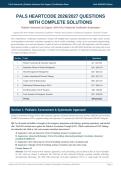
PALS Heartcode | Pediatric Advanced Life Support | Certification Exam AHA 2026/2027 Edition
PALS HEARTCODE 2026/2027 QUESTIONS
WITH COMPLETE SOLUTIONS
Pediatric Advanced Life Support | AHA PALS Heartcode Certification Examination
Aligned with AHA Pediatric Emergency Guidelines • Pediatric Resuscitation Competency Standards • 2026/2027 Edition
This comprehensive certification examination contains 100 multiple-choice questions distributed across eight content sections
covering pediatric assessment, respiratory emergencies, shock, cardiac arrhythmias, cardiac arrest resuscitation, pharmacology,
post-resuscitation care, and team dynamics. Cognitive levels are distributed as 20% recall, 50% application, and 30% analysis.
Each question includes a single best correct answer with rationale grounded in the AHA PALS Heartcode curriculum and current
evidence-based guidelines. Special inclusions: 15 rhythm strip interpretation questions, 15 medication calculation questions, and
10 complex emergency scenarios.
Section Topic Questions
1 Pediatric Assessment & Systematic Approach Q1 - Q15 (15)
2 Respiratory Distress & Failure Management Q16 - Q30 (15)
3 Shock Recognition & Management Q31 - Q42 (12)
4 Cardiac Arrhythmias & Electrical Therapy Q43 - Q57 (15)
5 Cardiac Arrest & Resuscitation Q58 - Q72 (15)
6 Medications & Pharmacology in PALS Q73 - Q84 (12)
7 Post-Resuscitation Care & Transport Q85 - Q92 (8)
8 Team Dynamics & Emergency Scenarios Q93 - Q100 (8)
TOTAL 100 Questions
Section 1: Pediatric Assessment & Systematic Approach
Pediatric Assessment Triangle (PAT), AHA systematic approach (Evaluate-Identify-Intervene), primary (ABCDE) and secondary
(SAMPLE) assessments, AVPU, equipment sizing, vital sign norms. 15 questions per AHA PALS Heartcode 2026/2027 blueprint.
Q1: An 18-month-old toddler is brought to the emergency department with lethargy, grunting respirations, and mottled
skin. The PALS-trained nurse applies the Pediatric Assessment Triangle (PAT). Which combination of PAT findings
best identifies this child as 'sick' and warrants immediate intervention?
A. Appearance: alert and interactive; Work of breathing: normal; Circulation: pink
B. Appearance: abnormal (lethargic); Work of breathing: abnormal (grunting); Circulation: abnormal
(mottled) [CORRECT]
C. Appearance: alert with strong cry; Work of breathing: retractions only; Circulation: pink
D. Appearance: lethargic; Work of breathing: normal; Circulation: pale only when crying
Correct Answer: B
Rationale: The PAT consists of three elements: appearance, work of breathing, and circulation to skin. A child is identified
as 'sick' when any element is abnormal; this child has all three abnormal (lethargic, grunting, mottled), indicating
decompensated physiology. The AHA PALS Heartcode curriculum emphasizes PAT as a rapid (under 60 seconds)
Aligned with AHA PALS Heartcode Curriculum | Pediatric Resuscitation Competency Standards Page 1
,PALS Heartcode | Pediatric Advanced Life Support | Certification Exam AHA 2026/2027 Edition
across-the-room assessment that triggers the systematic approach (evaluate, identify, intervene). Any abnormality
mandates immediate primary assessment (ABCDE).
Q2: A 4-year-old child presents with increased work of breathing but normal mental status. According to the AHA
systematic approach, after the initial PAT identifies an abnormality, what is the correct sequence of the primary
assessment?
A. ABCDE: Airway, Breathing, Circulation, Disability, Exposure [CORRECT]
B. CAB: Circulation, Airway, Breathing
C. SAMPLE: Signs/symptoms, Allergies, Medications, Past history, Last meal, Events
D. HEAD: History, Examination, Assessment, Diagnosis
Correct Answer: A
Rationale: The AHA PALS primary assessment follows the ABCDE sequence: Airway (patency, position), Breathing (rate,
effort, breath sounds, SpO2), Circulation (heart rate, pulses, capillary refill, skin temperature/color, BP), Disability
(AVPU/GCS, pupils, glucose), and Exposure (skin, signs of trauma/infection, temperature). SAMPLE is part of the
secondary assessment. CAB is the BLS sequence for pulseless arrest, not the systematic assessment of the sick child.
Q3: Which of the following correctly describes the AVPU pediatric responsiveness scale?
A. Alert, Voice, Pain, Unresponsive — escalation from awake to no response [CORRECT]
B. Airway, Ventilation, Pulse, Unresponsive
C. Awake, Verbal, Pain, Unconscious — used only for adults
D. Alert, Verbal, Pain, Unconscious — AHA PALS disability assessment tool
Correct Answer: A
Rationale: AVPU (Alert, responsive to Voice, responsive to Pain, Unresponsive) is the AHA PALS rapid disability scale
used in the primary assessment. 'Alert' = eyes open spontaneously; 'Voice' = responds to verbal stimuli; 'Pain' = responds
only to painful stimulus; 'Unresponsive' = no response. A child who is not Alert requires urgent evaluation. AVPU
correlates roughly with GCS 15, 13, 8, and 3, respectively, and is faster than full GCS in emergency settings.
Q4: A 6-month-old infant is brought in with respiratory distress. Heart rate is 180/min, respiratory rate 70/min, SpO2
88% on room air, and capillary refill 4 seconds. The child is alert but fussy. Which physiologic category best describes
this presentation?
A. Respiratory distress with compensated shock [CORRECT]
B. Respiratory failure with decompensated shock
C. Stable respiratory distress only
D. Cardiogenic shock without respiratory involvement
Correct Answer: A
Rationale: This child has respiratory distress (tachypnea, hypoxemia, increased work of breathing) with compensated
shock (tachycardia, delayed capillary refill but normal mental status and likely normal blood pressure). The AHA PALS
curriculum emphasizes that compensatory mechanisms (tachycardia, vasoconstriction) maintain blood pressure until late,
so the clinician must recognize compensated shock before hypotension develops. Interventions: oxygen, airway support,
IV/IO access, and 20 mL/kg isotonic fluid bolus.
Q5: A 2-year-old child is being evaluated after a seizure. As part of the disability assessment, which bedside test must
always be performed and treated promptly if abnormal?
A. Capillary refill
B. Blood glucose [CORRECT]
C. Pupillary response only
D. Urinalysis
Aligned with AHA PALS Heartcode Curriculum | Pediatric Resuscitation Competency Standards Page 2
, PALS Heartcode | Pediatric Advanced Life Support | Certification Exam AHA 2026/2027 Edition
Correct Answer: B
Rationale: Hypoglycemia (blood glucose <60 mg/dL in children, <40 mg/dL in neonates) is a rapidly reversible cause of
altered mental status and seizures, and must be checked in every child with altered responsiveness or seizure. Treatment:
0.5–1 g/kg of dextrose (D10 for infants 5–10 mL/kg, D25 for children 2–4 mL/kg, D50 for adolescents 1–2 mL/kg). The
AHA PALS algorithm includes hypoglycemia in the H's and T's of reversible causes, and delays in correction can cause
permanent neurologic injury.
Q6: An 8-year-old is brought to the ED unconscious. The parents report he was found unresponsive 10 minutes ago.
Pulse is 38/min, respirations 8/min and irregular, SpO2 82% on room air. According to the AHA systematic approach,
what is the FIRST priority intervention?
A. Begin chest compressions immediately at 100–120/min
B. Open the airway and provide bag-mask ventilation with 100% oxygen [CORRECT]
C. Administer atropine 0.5 mg IV push
D. Start an IV and give a 20 mL/kg fluid bolus
Correct Answer: B
Rationale: This child has bradycardia with poor perfusion (altered mental status, hypoxemia). AHA PALS states: if
bradycardia with poor perfusion persists despite adequate oxygenation and ventilation, begin chest compressions. The
FIRST step is always airway and ventilation with 100% oxygen—hypoxia is the most common cause of pediatric
bradycardia. If bradycardia persists after oxygenation/ventilation is optimized, then start compressions and consider
epinephrine. Jumping to compressions first is a common algorithm error.
Q7: Which of the following is the correct pediatric blood pressure formula for estimating the lower limit of normal
systolic BP (5th percentile) in children 1–10 years of age?
A. 70 + (2 × age in years) [CORRECT]
B. 90 + (2 × age in years)
C. 100 − (age in years)
D. 60 + (age in years × 3)
Correct Answer: A
Rationale: The formula 70 + (2 × age in years) estimates the 5th percentile systolic blood pressure for children 1–10 years.
Systolic BP below this value defines hypotension (decompensated shock). For example, a 4-year-old would be 70 + (2×4) =
78 mmHg. The AHA PALS curriculum emphasizes that hypotension is a LATE sign of shock in children—intervene earlier
based on perfusion signs (mental status, capillary refill, pulses, urine output).
Q8: A 3-year-old is assessed for capillary refill time. The environmental temperature is comfortable, and the test is
performed on the sternum with firm pressure for 5 seconds. Which capillary refill time suggests abnormal perfusion
and warrants further evaluation?
A. < 2 seconds
B. 2 seconds
C. > 3 seconds [CORRECT]
D. 5 seconds at the fingertip only
Correct Answer: C
Rationale: Capillary refill time >3 seconds (when performed properly on the sternum with 5 seconds of pressure) suggests
abnormal peripheral perfusion and is consistent with shock. However, capillary refill is influenced by ambient temperature,
age, and lighting—it must be interpreted with other perfusion signs (skin temperature, pulses, mental status, urine output).
AHA PALS does not use capillary refill in isolation; the curriculum stresses integrating multiple assessment elements.
Q9: When evaluating a child using the PAT, the work of breathing component is best assessed by which finding?
A. Heart rate alone
Aligned with AHA PALS Heartcode Curriculum | Pediatric Resuscitation Competency Standards Page 3
PALS HEARTCODE 2026/2027 QUESTIONS
WITH COMPLETE SOLUTIONS
Pediatric Advanced Life Support | AHA PALS Heartcode Certification Examination
Aligned with AHA Pediatric Emergency Guidelines • Pediatric Resuscitation Competency Standards • 2026/2027 Edition
This comprehensive certification examination contains 100 multiple-choice questions distributed across eight content sections
covering pediatric assessment, respiratory emergencies, shock, cardiac arrhythmias, cardiac arrest resuscitation, pharmacology,
post-resuscitation care, and team dynamics. Cognitive levels are distributed as 20% recall, 50% application, and 30% analysis.
Each question includes a single best correct answer with rationale grounded in the AHA PALS Heartcode curriculum and current
evidence-based guidelines. Special inclusions: 15 rhythm strip interpretation questions, 15 medication calculation questions, and
10 complex emergency scenarios.
Section Topic Questions
1 Pediatric Assessment & Systematic Approach Q1 - Q15 (15)
2 Respiratory Distress & Failure Management Q16 - Q30 (15)
3 Shock Recognition & Management Q31 - Q42 (12)
4 Cardiac Arrhythmias & Electrical Therapy Q43 - Q57 (15)
5 Cardiac Arrest & Resuscitation Q58 - Q72 (15)
6 Medications & Pharmacology in PALS Q73 - Q84 (12)
7 Post-Resuscitation Care & Transport Q85 - Q92 (8)
8 Team Dynamics & Emergency Scenarios Q93 - Q100 (8)
TOTAL 100 Questions
Section 1: Pediatric Assessment & Systematic Approach
Pediatric Assessment Triangle (PAT), AHA systematic approach (Evaluate-Identify-Intervene), primary (ABCDE) and secondary
(SAMPLE) assessments, AVPU, equipment sizing, vital sign norms. 15 questions per AHA PALS Heartcode 2026/2027 blueprint.
Q1: An 18-month-old toddler is brought to the emergency department with lethargy, grunting respirations, and mottled
skin. The PALS-trained nurse applies the Pediatric Assessment Triangle (PAT). Which combination of PAT findings
best identifies this child as 'sick' and warrants immediate intervention?
A. Appearance: alert and interactive; Work of breathing: normal; Circulation: pink
B. Appearance: abnormal (lethargic); Work of breathing: abnormal (grunting); Circulation: abnormal
(mottled) [CORRECT]
C. Appearance: alert with strong cry; Work of breathing: retractions only; Circulation: pink
D. Appearance: lethargic; Work of breathing: normal; Circulation: pale only when crying
Correct Answer: B
Rationale: The PAT consists of three elements: appearance, work of breathing, and circulation to skin. A child is identified
as 'sick' when any element is abnormal; this child has all three abnormal (lethargic, grunting, mottled), indicating
decompensated physiology. The AHA PALS Heartcode curriculum emphasizes PAT as a rapid (under 60 seconds)
Aligned with AHA PALS Heartcode Curriculum | Pediatric Resuscitation Competency Standards Page 1
,PALS Heartcode | Pediatric Advanced Life Support | Certification Exam AHA 2026/2027 Edition
across-the-room assessment that triggers the systematic approach (evaluate, identify, intervene). Any abnormality
mandates immediate primary assessment (ABCDE).
Q2: A 4-year-old child presents with increased work of breathing but normal mental status. According to the AHA
systematic approach, after the initial PAT identifies an abnormality, what is the correct sequence of the primary
assessment?
A. ABCDE: Airway, Breathing, Circulation, Disability, Exposure [CORRECT]
B. CAB: Circulation, Airway, Breathing
C. SAMPLE: Signs/symptoms, Allergies, Medications, Past history, Last meal, Events
D. HEAD: History, Examination, Assessment, Diagnosis
Correct Answer: A
Rationale: The AHA PALS primary assessment follows the ABCDE sequence: Airway (patency, position), Breathing (rate,
effort, breath sounds, SpO2), Circulation (heart rate, pulses, capillary refill, skin temperature/color, BP), Disability
(AVPU/GCS, pupils, glucose), and Exposure (skin, signs of trauma/infection, temperature). SAMPLE is part of the
secondary assessment. CAB is the BLS sequence for pulseless arrest, not the systematic assessment of the sick child.
Q3: Which of the following correctly describes the AVPU pediatric responsiveness scale?
A. Alert, Voice, Pain, Unresponsive — escalation from awake to no response [CORRECT]
B. Airway, Ventilation, Pulse, Unresponsive
C. Awake, Verbal, Pain, Unconscious — used only for adults
D. Alert, Verbal, Pain, Unconscious — AHA PALS disability assessment tool
Correct Answer: A
Rationale: AVPU (Alert, responsive to Voice, responsive to Pain, Unresponsive) is the AHA PALS rapid disability scale
used in the primary assessment. 'Alert' = eyes open spontaneously; 'Voice' = responds to verbal stimuli; 'Pain' = responds
only to painful stimulus; 'Unresponsive' = no response. A child who is not Alert requires urgent evaluation. AVPU
correlates roughly with GCS 15, 13, 8, and 3, respectively, and is faster than full GCS in emergency settings.
Q4: A 6-month-old infant is brought in with respiratory distress. Heart rate is 180/min, respiratory rate 70/min, SpO2
88% on room air, and capillary refill 4 seconds. The child is alert but fussy. Which physiologic category best describes
this presentation?
A. Respiratory distress with compensated shock [CORRECT]
B. Respiratory failure with decompensated shock
C. Stable respiratory distress only
D. Cardiogenic shock without respiratory involvement
Correct Answer: A
Rationale: This child has respiratory distress (tachypnea, hypoxemia, increased work of breathing) with compensated
shock (tachycardia, delayed capillary refill but normal mental status and likely normal blood pressure). The AHA PALS
curriculum emphasizes that compensatory mechanisms (tachycardia, vasoconstriction) maintain blood pressure until late,
so the clinician must recognize compensated shock before hypotension develops. Interventions: oxygen, airway support,
IV/IO access, and 20 mL/kg isotonic fluid bolus.
Q5: A 2-year-old child is being evaluated after a seizure. As part of the disability assessment, which bedside test must
always be performed and treated promptly if abnormal?
A. Capillary refill
B. Blood glucose [CORRECT]
C. Pupillary response only
D. Urinalysis
Aligned with AHA PALS Heartcode Curriculum | Pediatric Resuscitation Competency Standards Page 2
, PALS Heartcode | Pediatric Advanced Life Support | Certification Exam AHA 2026/2027 Edition
Correct Answer: B
Rationale: Hypoglycemia (blood glucose <60 mg/dL in children, <40 mg/dL in neonates) is a rapidly reversible cause of
altered mental status and seizures, and must be checked in every child with altered responsiveness or seizure. Treatment:
0.5–1 g/kg of dextrose (D10 for infants 5–10 mL/kg, D25 for children 2–4 mL/kg, D50 for adolescents 1–2 mL/kg). The
AHA PALS algorithm includes hypoglycemia in the H's and T's of reversible causes, and delays in correction can cause
permanent neurologic injury.
Q6: An 8-year-old is brought to the ED unconscious. The parents report he was found unresponsive 10 minutes ago.
Pulse is 38/min, respirations 8/min and irregular, SpO2 82% on room air. According to the AHA systematic approach,
what is the FIRST priority intervention?
A. Begin chest compressions immediately at 100–120/min
B. Open the airway and provide bag-mask ventilation with 100% oxygen [CORRECT]
C. Administer atropine 0.5 mg IV push
D. Start an IV and give a 20 mL/kg fluid bolus
Correct Answer: B
Rationale: This child has bradycardia with poor perfusion (altered mental status, hypoxemia). AHA PALS states: if
bradycardia with poor perfusion persists despite adequate oxygenation and ventilation, begin chest compressions. The
FIRST step is always airway and ventilation with 100% oxygen—hypoxia is the most common cause of pediatric
bradycardia. If bradycardia persists after oxygenation/ventilation is optimized, then start compressions and consider
epinephrine. Jumping to compressions first is a common algorithm error.
Q7: Which of the following is the correct pediatric blood pressure formula for estimating the lower limit of normal
systolic BP (5th percentile) in children 1–10 years of age?
A. 70 + (2 × age in years) [CORRECT]
B. 90 + (2 × age in years)
C. 100 − (age in years)
D. 60 + (age in years × 3)
Correct Answer: A
Rationale: The formula 70 + (2 × age in years) estimates the 5th percentile systolic blood pressure for children 1–10 years.
Systolic BP below this value defines hypotension (decompensated shock). For example, a 4-year-old would be 70 + (2×4) =
78 mmHg. The AHA PALS curriculum emphasizes that hypotension is a LATE sign of shock in children—intervene earlier
based on perfusion signs (mental status, capillary refill, pulses, urine output).
Q8: A 3-year-old is assessed for capillary refill time. The environmental temperature is comfortable, and the test is
performed on the sternum with firm pressure for 5 seconds. Which capillary refill time suggests abnormal perfusion
and warrants further evaluation?
A. < 2 seconds
B. 2 seconds
C. > 3 seconds [CORRECT]
D. 5 seconds at the fingertip only
Correct Answer: C
Rationale: Capillary refill time >3 seconds (when performed properly on the sternum with 5 seconds of pressure) suggests
abnormal peripheral perfusion and is consistent with shock. However, capillary refill is influenced by ambient temperature,
age, and lighting—it must be interpreted with other perfusion signs (skin temperature, pulses, mental status, urine output).
AHA PALS does not use capillary refill in isolation; the curriculum stresses integrating multiple assessment elements.
Q9: When evaluating a child using the PAT, the work of breathing component is best assessed by which finding?
A. Heart rate alone
Aligned with AHA PALS Heartcode Curriculum | Pediatric Resuscitation Competency Standards Page 3

