

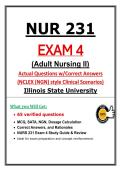
NUR 231
EXAM 4
(Adult Nursing II)
Actual Questions w/Correct Answers
(NCLEX (NGN) style Clinical Scenarios)
Illinois State University
What you Will Get:
• 65 verified questions
• MCQ, SATA, NGN, Dosage Calculation
• Correct Answers, and Rationales
• NURS 231 Exam 4 Study Guide & Review
• Ideal for exam preparation and concept reinforcement.
,Table of Contents
NUR 231 EXAM 4 ......................................................................... 2
NURS 231 Exam 4 Study Guide & Review..................................... 21
NUR 231 EXAM 4
1. A pathology report describes a breast tumor as poorly differentiated with a high
mitotic rate. Which tumor grade does this finding indicate?
A. Grade 1 (G1)
B. Grade 2 (G2)
C. Grade 3 (G3)
D. Grade 4 (G4)
Correct Answer:
C. Grade 3 (G3)
Expert Rationale:
G3 tumors are poorly differentiated and have a high mitotic rate. G1 tumors are well
differentiated, G2 tumors are moderately differentiated, and G4 tumors are undifferentiated.
2. A client asks how solid tumors are staged. Which system should the nurse identify?
A. BRCA mutation analysis
B. TNM classification system
C. Complete blood count classification
D. Bone marrow blast percentage
Correct Answer:
B. TNM classification system
Expert Rationale:
The TNM system stages solid tumors by the extent of the primary tumor (T), lymph-node
involvement (N), and extent of metastasis (M).
,3. A client newly diagnosed with breast cancer appears calm and says, “I feel fine, so I do
not think this has really affected me.” Which nursing response is most appropriate?
A. “You need to accept the seriousness of the diagnosis immediately.”
B. “People may initially appear accepting while experiencing shock or denial. I can give you
time and answer questions as they arise.”
C. “You should make all treatment decisions today.”
D. “A lack of distress means you have already adjusted to the diagnosis.”
Correct Answer:
B. “People may initially appear accepting while experiencing shock or denial. I can give
you time and answer questions as they arise.”
Expert Rationale:
After a devastating diagnosis, clients need time to process information and grieve. Shock or
denial can appear as acceptance, so the nurse should provide information gradually, make
referrals, and remain available for questions.
4. What is the primary purpose of a sentinel lymph node biopsy in breast cancer?
A. Remove all axillary lymph nodes
B. Identify the node that first drains the tumor and assess it for cancer spread
C. Prevent all future lymphedema
D. Replace the need for breast imaging
Correct Answer:
B. Identify the node that first drains the tumor and assess it for cancer spread
Expert Rationale:
The sentinel node is the lymph node responsible for draining the tumor. A negative sentinel
node may allow preservation of the remaining axillary nodes, whereas a positive node may
lead to axillary lymph-node dissection.
5. A client receiving external-beam radiation develops erythema in the treatment field.
Which instruction is appropriate?
A. Apply a heating pad to the area
B. Avoid soaps, cosmetics, perfumes, powders, lotions, ointments, and deodorants on the
treated area unless prescribed
C. Apply adhesive tape directly to the irradiated skin
D. Expose the area to direct sunlight daily
Correct Answer:
B. Avoid soaps, cosmetics, perfumes, powders, lotions, ointments, and deodorants on
the treated area unless prescribed
, Expert Rationale:
Radiation-related erythema requires protection from irritation. The treated area should also be
protected from heat, ice, adhesive tape, sunlight, and cold weather.
6. Which interventions are examples of cancer prevention strategies? Select all that
apply.
A. Avoid known carcinogens
B. Receive recommended immunizations
C. Participate in cancer screening when indicated
D. Monitor a cancer survivor for recurrence
E. Screen a cancer survivor for a second malignancy
F. Ignore lifestyle factors because cancer prevention is not modifiable
Correct Answers:
A, B, C, D, E
Expert Rationale:
Primary prevention includes avoiding carcinogens, lifestyle changes, education, dietary
changes, and immunizations. Secondary prevention includes identifying high-risk clients and
performing screening. Tertiary prevention includes monitoring for recurrence and second
malignancies in survivors.
7. A client with acute myeloid leukemia develops tumor lysis syndrome during induction
chemotherapy. Which laboratory pattern is expected?
A. Hypokalemia, hypophosphatemia, and hypouricemia
B. Hyperkalemia, hyperphosphatemia, and hyperuricemia
C. Hypernatremia, hypercalcemia, and hypoglycemia
D. Hyponatremia, hypomagnesemia, and low uric acid
Correct Answer:
B. Hyperkalemia, hyperphosphatemia, and hyperuricemia
Expert Rationale:
Rapid destruction of tumor cells releases intracellular contents. Tumor lysis syndrome is
associated with hyperuricemia, hyperkalemia, and hyperphosphatemia, so electrolyte
monitoring is essential.
8. Dosage Calculation – Fill in the Blank. A client with CML is prescribed imatinib 400 mg
orally. The tablets available are 100 mg each. How many tablets should the nurse
administer?
______________________________
Correct Answer:
4 tablets
EXAM 4
(Adult Nursing II)
Actual Questions w/Correct Answers
(NCLEX (NGN) style Clinical Scenarios)
Illinois State University
What you Will Get:
• 65 verified questions
• MCQ, SATA, NGN, Dosage Calculation
• Correct Answers, and Rationales
• NURS 231 Exam 4 Study Guide & Review
• Ideal for exam preparation and concept reinforcement.
,Table of Contents
NUR 231 EXAM 4 ......................................................................... 2
NURS 231 Exam 4 Study Guide & Review..................................... 21
NUR 231 EXAM 4
1. A pathology report describes a breast tumor as poorly differentiated with a high
mitotic rate. Which tumor grade does this finding indicate?
A. Grade 1 (G1)
B. Grade 2 (G2)
C. Grade 3 (G3)
D. Grade 4 (G4)
Correct Answer:
C. Grade 3 (G3)
Expert Rationale:
G3 tumors are poorly differentiated and have a high mitotic rate. G1 tumors are well
differentiated, G2 tumors are moderately differentiated, and G4 tumors are undifferentiated.
2. A client asks how solid tumors are staged. Which system should the nurse identify?
A. BRCA mutation analysis
B. TNM classification system
C. Complete blood count classification
D. Bone marrow blast percentage
Correct Answer:
B. TNM classification system
Expert Rationale:
The TNM system stages solid tumors by the extent of the primary tumor (T), lymph-node
involvement (N), and extent of metastasis (M).
,3. A client newly diagnosed with breast cancer appears calm and says, “I feel fine, so I do
not think this has really affected me.” Which nursing response is most appropriate?
A. “You need to accept the seriousness of the diagnosis immediately.”
B. “People may initially appear accepting while experiencing shock or denial. I can give you
time and answer questions as they arise.”
C. “You should make all treatment decisions today.”
D. “A lack of distress means you have already adjusted to the diagnosis.”
Correct Answer:
B. “People may initially appear accepting while experiencing shock or denial. I can give
you time and answer questions as they arise.”
Expert Rationale:
After a devastating diagnosis, clients need time to process information and grieve. Shock or
denial can appear as acceptance, so the nurse should provide information gradually, make
referrals, and remain available for questions.
4. What is the primary purpose of a sentinel lymph node biopsy in breast cancer?
A. Remove all axillary lymph nodes
B. Identify the node that first drains the tumor and assess it for cancer spread
C. Prevent all future lymphedema
D. Replace the need for breast imaging
Correct Answer:
B. Identify the node that first drains the tumor and assess it for cancer spread
Expert Rationale:
The sentinel node is the lymph node responsible for draining the tumor. A negative sentinel
node may allow preservation of the remaining axillary nodes, whereas a positive node may
lead to axillary lymph-node dissection.
5. A client receiving external-beam radiation develops erythema in the treatment field.
Which instruction is appropriate?
A. Apply a heating pad to the area
B. Avoid soaps, cosmetics, perfumes, powders, lotions, ointments, and deodorants on the
treated area unless prescribed
C. Apply adhesive tape directly to the irradiated skin
D. Expose the area to direct sunlight daily
Correct Answer:
B. Avoid soaps, cosmetics, perfumes, powders, lotions, ointments, and deodorants on
the treated area unless prescribed
, Expert Rationale:
Radiation-related erythema requires protection from irritation. The treated area should also be
protected from heat, ice, adhesive tape, sunlight, and cold weather.
6. Which interventions are examples of cancer prevention strategies? Select all that
apply.
A. Avoid known carcinogens
B. Receive recommended immunizations
C. Participate in cancer screening when indicated
D. Monitor a cancer survivor for recurrence
E. Screen a cancer survivor for a second malignancy
F. Ignore lifestyle factors because cancer prevention is not modifiable
Correct Answers:
A, B, C, D, E
Expert Rationale:
Primary prevention includes avoiding carcinogens, lifestyle changes, education, dietary
changes, and immunizations. Secondary prevention includes identifying high-risk clients and
performing screening. Tertiary prevention includes monitoring for recurrence and second
malignancies in survivors.
7. A client with acute myeloid leukemia develops tumor lysis syndrome during induction
chemotherapy. Which laboratory pattern is expected?
A. Hypokalemia, hypophosphatemia, and hypouricemia
B. Hyperkalemia, hyperphosphatemia, and hyperuricemia
C. Hypernatremia, hypercalcemia, and hypoglycemia
D. Hyponatremia, hypomagnesemia, and low uric acid
Correct Answer:
B. Hyperkalemia, hyperphosphatemia, and hyperuricemia
Expert Rationale:
Rapid destruction of tumor cells releases intracellular contents. Tumor lysis syndrome is
associated with hyperuricemia, hyperkalemia, and hyperphosphatemia, so electrolyte
monitoring is essential.
8. Dosage Calculation – Fill in the Blank. A client with CML is prescribed imatinib 400 mg
orally. The tablets available are 100 mg each. How many tablets should the nurse
administer?
______________________________
Correct Answer:
4 tablets

