
CDCR Sergeant Promotional Examination | 2026/2027 96 Questions - With Complete Solutions
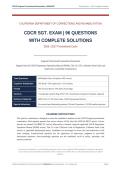
CALIFORNIA DEPARTMENT OF CORRECTIONS AND REHABILITATION
CDCR SGT. EXAM | 96 QUESTIONS
WITH COMPLETE SOLUTIONS
Promotional Cycle
Sergeant Promotional Examination Preparation
Aligned with the CDCR Department Operations Manual (DOM), Title 15 CCR, California Penal Code, and
Supervisory Leadership Competencies
Total Questions 96 Multiple Choice (4 options, ONE correct)
Cognitive Distribution 25% Recall / 50% Application / 25% Analysis
Format 70% Scenario-Based / 30% Direct Knowledge
Sections 7 (Leadership, Incident Pkg, RVR, UOF, Classification, Employee Discipline, Appeals)
Reference Materials DOM, Title 15 CCR, Penal Code, CDCR Departmental Policies
Special Inclusions 20 scenario-based leadership questions, 20 form ID questions, 15 RVR timeline questions
EXAMINEE INSTRUCTIONS
This practice examination is designed to assess the candidate's readiness for the CDCR Sergeant promotional
examination. Each question presents four answer choices (A-D); select the SINGLE BEST answer. Correct
answers are marked *[CORRECT]* and are followed by a rationale citing the applicable CDCR Department
Operations Manual (DOM) section, Title 15 of the California Code of Regulations, California Penal Code
section, or applicable departmental policy. Candidates are encouraged to review the cited authorities in full
when studying. Scenario-based questions test the application of supervisory judgment to real-world
institutional situations; direct-knowledge questions test the candidate's recall of policy, procedure, and
statutory authority.
This practice examination is an educational preparation tool. It is not an official CDCR examination and does not guarantee
success on the actual promotional examination. Always consult current DOM, Title 15, and departmental policies for official
guidance.
California Department of Corrections and Rehabilitation
Official Practice Examination - For Training Use Page 1
,CDCR Sergeant Promotional Examination | 2026/2027 96 Questions - With Complete Solutions
Section 1: Leadership, Supervision & Management Principles
First-line supervisory responsibilities, progressive discipline, performance evaluation, staff accountability, counseling
techniques, and leadership approaches.
Q1. Sergeant Reyes recently assumed supervisory authority over a housing unit after the previous sergeant
transferred. Within her first week, she notices that officers are arriving late, completing rounds inconsistently, and
failing to log 30-minute welfare checks. According to CDCR supervisory leadership principles, what is Sergeant
Reyes’ MOST appropriate first action?
A. Immediately initiate adverse action proceedings against the most chronic latecomer to set an example for
the unit.
B. Conduct individual counseling sessions with each officer, document performance expectations in writing,
and explain the rationale behind the policies being enforced. *[CORRECT]*
C. Wait 30 days to establish a baseline of conduct before taking any action, then apply discipline
retroactively.
D. Verbally warn the entire unit during roll call and rely on informal supervision to correct the behavior
without documentation.
Correct Answer: B
Rationale: CDCR supervisory doctrine emphasizes that the first-line supervisor must set clear, written performance
expectations, provide counseling that explains the rationale for policy changes, and begin continuous performance
monitoring from day one. Option A skips progressive discipline; C delays accountability and forfeits the orientation window;
D lacks the documentation required to support future action under DOM Chapter 3 and SPB disciplinary standards.
Q2. Officer Tanaka consistently fails to complete required ISU (Institutional Security Unit) logs by the end of
shift. Sergeant Lopez has verbally counseled him twice. The behavior persists. Which step in progressive
discipline is the NEXT required action?
A. Skip directly to a Letter of Instruction (LOI) because verbal counseling was already attempted.
B. Issue a formal Employee Counseling Record (ECR, Form CDCR 1123) documenting the prior counseling
and the continuing deficiency. *[CORRECT]*
C. Immediately initiate an adverse action proceeding through the Department of Human Resources.
D. Remove the officer from the schedule pending psychiatric evaluation.
Correct Answer: B
Rationale: Progressive discipline in CDCR follows a continuum: orientation, informal counseling, ECR (CDCR 1123),
Letter of Instruction (LOI), and finally adverse action. After informal counseling has been attempted and failed, the next
documented step is the ECR. Option A skips the ECR; C skips two intermediate steps; D is not a disciplinary action and
requires medical justification beyond performance issues.
Q3. A newly promoted sergeant is revising the post assignment schedule. Several officers complain that the new
schedule does not account for childcare obligations. What leadership approach BEST demonstrates the CDCR
principle of "explaining rationale for policy changes"?
A. Post the schedule without comment and tell officers to file a grievance if they disagree.
B. Hold a roll call briefing explaining the operational necessity of the schedule, acknowledge the impact on
officers, and identify available resources (EAP, flex-time options where operationally feasible).
California Department of Corrections and Rehabilitation
Official Practice Examination - For Training Use Page 2
, CDCR Sergeant Promotional Examination | 2026/2027 96 Questions - With Complete Solutions
*[CORRECT]*
C. Rescind the schedule entirely and let officers self-assign posts to avoid conflict.
D. Forward all complaints to the Warden without responding directly to the officers.
Correct Answer: B
Rationale: The CDCR leadership competency of explaining rationale requires the supervisor to articulate the operational
justification for a change, acknowledge employee impact, and identify available support resources. This maintains unit
cohesion and morale. Option A is dismissive and discourages communication; C abdicates supervisory authority and
undermines security; D inappropriately escalates routine supervisory matters and breaks the chain of command.
Q4. During a performance evaluation cycle, Sergeant Davis must evaluate an officer who has worked under her
supervision for only 45 days. The CDCR performance evaluation system requires a minimum period of
supervision before an evaluator can render a meaningful evaluation. What is the correct action?
A. Evaluate based on the 45 days available and document the abbreviated period in the comments section.
B. Defer the evaluation to the previous supervisor who supervised the officer for the majority of the rating
period. *[CORRECT]*
C. Mark all categories as "meets standards" to avoid conflict.
D. Refuse to sign the evaluation and submit a complaint to the personnel office.
Correct Answer: B
Rationale: Under CDCR performance evaluation policy, when an employee has been supervised for less than the majority of
the rating period, the rating is typically rendered by the previous supervisor who had the employee for the majority of the
cycle. The current supervisor may provide input but is not the rating official. A is premature and unfair; C is a documentation
failure; D is insubordination rather than the proper remedy.
Q5. A correctional officer under your supervision repeatedly fails to conduct required 30-minute welfare checks
in the holding cell. After informal counseling fails, you initiate an ECR. The officer refuses to sign the ECR.
What is the appropriate supervisory response?
A. Tear up the ECR and start over with a different form.
B. Note the refusal on the form, sign it yourself indicating the employee declined to sign, and forward
through the chain of command for the Watch Commander’s endorsement. *[CORRECT]*
C. Threaten the officer with suspension if they do not sign.
D. Discard the ECR because employee signature is required for validity.
Correct Answer: B
Rationale: An employee’s signature on an ECR (CDCR 1123) merely acknowledges receipt, not agreement. The supervisor
documents the refusal, signs the form, and routes it through the chain of command. Option A destroys documentation; C
constitutes coercion and violates employee rights; D misunderstands the legal effect of the signature under SPB and CDCR
personnel policy.
Q6. Sergeant Martinez observes that two officers on his shift have an ongoing personal conflict that is beginning
to affect housing unit operations. Which intervention aligns with CDCR conflict resolution and continuous
performance monitoring principles?
A. Transfer one officer immediately without discussion to eliminate the conflict source.
B. Conduct separate counseling sessions with each officer, document the operational impact, and develop a
written performance plan with measurable behavioral expectations. *[CORRECT]*
C. Ignore the conflict because personal matters are outside the scope of supervisory responsibility.
California Department of Corrections and Rehabilitation
Official Practice Examination - For Training Use Page 3
CALIFORNIA DEPARTMENT OF CORRECTIONS AND REHABILITATION
CDCR SGT. EXAM | 96 QUESTIONS
WITH COMPLETE SOLUTIONS
Promotional Cycle
Sergeant Promotional Examination Preparation
Aligned with the CDCR Department Operations Manual (DOM), Title 15 CCR, California Penal Code, and
Supervisory Leadership Competencies
Total Questions 96 Multiple Choice (4 options, ONE correct)
Cognitive Distribution 25% Recall / 50% Application / 25% Analysis
Format 70% Scenario-Based / 30% Direct Knowledge
Sections 7 (Leadership, Incident Pkg, RVR, UOF, Classification, Employee Discipline, Appeals)
Reference Materials DOM, Title 15 CCR, Penal Code, CDCR Departmental Policies
Special Inclusions 20 scenario-based leadership questions, 20 form ID questions, 15 RVR timeline questions
EXAMINEE INSTRUCTIONS
This practice examination is designed to assess the candidate's readiness for the CDCR Sergeant promotional
examination. Each question presents four answer choices (A-D); select the SINGLE BEST answer. Correct
answers are marked *[CORRECT]* and are followed by a rationale citing the applicable CDCR Department
Operations Manual (DOM) section, Title 15 of the California Code of Regulations, California Penal Code
section, or applicable departmental policy. Candidates are encouraged to review the cited authorities in full
when studying. Scenario-based questions test the application of supervisory judgment to real-world
institutional situations; direct-knowledge questions test the candidate's recall of policy, procedure, and
statutory authority.
This practice examination is an educational preparation tool. It is not an official CDCR examination and does not guarantee
success on the actual promotional examination. Always consult current DOM, Title 15, and departmental policies for official
guidance.
California Department of Corrections and Rehabilitation
Official Practice Examination - For Training Use Page 1
,CDCR Sergeant Promotional Examination | 2026/2027 96 Questions - With Complete Solutions
Section 1: Leadership, Supervision & Management Principles
First-line supervisory responsibilities, progressive discipline, performance evaluation, staff accountability, counseling
techniques, and leadership approaches.
Q1. Sergeant Reyes recently assumed supervisory authority over a housing unit after the previous sergeant
transferred. Within her first week, she notices that officers are arriving late, completing rounds inconsistently, and
failing to log 30-minute welfare checks. According to CDCR supervisory leadership principles, what is Sergeant
Reyes’ MOST appropriate first action?
A. Immediately initiate adverse action proceedings against the most chronic latecomer to set an example for
the unit.
B. Conduct individual counseling sessions with each officer, document performance expectations in writing,
and explain the rationale behind the policies being enforced. *[CORRECT]*
C. Wait 30 days to establish a baseline of conduct before taking any action, then apply discipline
retroactively.
D. Verbally warn the entire unit during roll call and rely on informal supervision to correct the behavior
without documentation.
Correct Answer: B
Rationale: CDCR supervisory doctrine emphasizes that the first-line supervisor must set clear, written performance
expectations, provide counseling that explains the rationale for policy changes, and begin continuous performance
monitoring from day one. Option A skips progressive discipline; C delays accountability and forfeits the orientation window;
D lacks the documentation required to support future action under DOM Chapter 3 and SPB disciplinary standards.
Q2. Officer Tanaka consistently fails to complete required ISU (Institutional Security Unit) logs by the end of
shift. Sergeant Lopez has verbally counseled him twice. The behavior persists. Which step in progressive
discipline is the NEXT required action?
A. Skip directly to a Letter of Instruction (LOI) because verbal counseling was already attempted.
B. Issue a formal Employee Counseling Record (ECR, Form CDCR 1123) documenting the prior counseling
and the continuing deficiency. *[CORRECT]*
C. Immediately initiate an adverse action proceeding through the Department of Human Resources.
D. Remove the officer from the schedule pending psychiatric evaluation.
Correct Answer: B
Rationale: Progressive discipline in CDCR follows a continuum: orientation, informal counseling, ECR (CDCR 1123),
Letter of Instruction (LOI), and finally adverse action. After informal counseling has been attempted and failed, the next
documented step is the ECR. Option A skips the ECR; C skips two intermediate steps; D is not a disciplinary action and
requires medical justification beyond performance issues.
Q3. A newly promoted sergeant is revising the post assignment schedule. Several officers complain that the new
schedule does not account for childcare obligations. What leadership approach BEST demonstrates the CDCR
principle of "explaining rationale for policy changes"?
A. Post the schedule without comment and tell officers to file a grievance if they disagree.
B. Hold a roll call briefing explaining the operational necessity of the schedule, acknowledge the impact on
officers, and identify available resources (EAP, flex-time options where operationally feasible).
California Department of Corrections and Rehabilitation
Official Practice Examination - For Training Use Page 2
, CDCR Sergeant Promotional Examination | 2026/2027 96 Questions - With Complete Solutions
*[CORRECT]*
C. Rescind the schedule entirely and let officers self-assign posts to avoid conflict.
D. Forward all complaints to the Warden without responding directly to the officers.
Correct Answer: B
Rationale: The CDCR leadership competency of explaining rationale requires the supervisor to articulate the operational
justification for a change, acknowledge employee impact, and identify available support resources. This maintains unit
cohesion and morale. Option A is dismissive and discourages communication; C abdicates supervisory authority and
undermines security; D inappropriately escalates routine supervisory matters and breaks the chain of command.
Q4. During a performance evaluation cycle, Sergeant Davis must evaluate an officer who has worked under her
supervision for only 45 days. The CDCR performance evaluation system requires a minimum period of
supervision before an evaluator can render a meaningful evaluation. What is the correct action?
A. Evaluate based on the 45 days available and document the abbreviated period in the comments section.
B. Defer the evaluation to the previous supervisor who supervised the officer for the majority of the rating
period. *[CORRECT]*
C. Mark all categories as "meets standards" to avoid conflict.
D. Refuse to sign the evaluation and submit a complaint to the personnel office.
Correct Answer: B
Rationale: Under CDCR performance evaluation policy, when an employee has been supervised for less than the majority of
the rating period, the rating is typically rendered by the previous supervisor who had the employee for the majority of the
cycle. The current supervisor may provide input but is not the rating official. A is premature and unfair; C is a documentation
failure; D is insubordination rather than the proper remedy.
Q5. A correctional officer under your supervision repeatedly fails to conduct required 30-minute welfare checks
in the holding cell. After informal counseling fails, you initiate an ECR. The officer refuses to sign the ECR.
What is the appropriate supervisory response?
A. Tear up the ECR and start over with a different form.
B. Note the refusal on the form, sign it yourself indicating the employee declined to sign, and forward
through the chain of command for the Watch Commander’s endorsement. *[CORRECT]*
C. Threaten the officer with suspension if they do not sign.
D. Discard the ECR because employee signature is required for validity.
Correct Answer: B
Rationale: An employee’s signature on an ECR (CDCR 1123) merely acknowledges receipt, not agreement. The supervisor
documents the refusal, signs the form, and routes it through the chain of command. Option A destroys documentation; C
constitutes coercion and violates employee rights; D misunderstands the legal effect of the signature under SPB and CDCR
personnel policy.
Q6. Sergeant Martinez observes that two officers on his shift have an ongoing personal conflict that is beginning
to affect housing unit operations. Which intervention aligns with CDCR conflict resolution and continuous
performance monitoring principles?
A. Transfer one officer immediately without discussion to eliminate the conflict source.
B. Conduct separate counseling sessions with each officer, document the operational impact, and develop a
written performance plan with measurable behavioral expectations. *[CORRECT]*
C. Ignore the conflict because personal matters are outside the scope of supervisory responsibility.
California Department of Corrections and Rehabilitation
Official Practice Examination - For Training Use Page 3

