
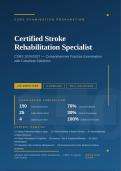
C S R S E X A M I N AT I O N P R E PA R AT I O N
Certified Stroke
Rehabilitation Specialist
CSRS 2026/2027 — Comprehensive Practice Examination
with Complete Solutions
150
150 QUESTIONS 8 DOMAINS FULL SOLUTIONS
E X A M I N AT I O N C O M P O S I T I O N
150 Total MCQ Items 70% Scenario-Based
25 Case Study Items 30% Direct Knowledge
4 Options per Item 100% Solutions Provided
CONTENT DOMAINS
S1 Stroke Pathophysiology & Types · S2 Neuroanatomy & Brain Function · S3 Neuroplasticity
& Motor Recovery
S4 Visual, Perceptual & Cognitive · S5 Balance, Gait & Functional Mobility · S6 UE/LE
Rehabilitation
S7 Spasticity, Pain & Edema Management · S8 Comprehensive Case Studies & Clinical
Scenarios
Aligned with AHA/ASA 2025 Guidelines · CSRS Program PRACTICE
Curriculum EXAM
,CSRS 2026/2027 · Practice Examination with Complete Solutions 150 Questions · 8 Domains
CERTIFIED STROKE REHABILITATION SPECIALIST
(CSRS 2026/2027)
QUESTIONS WITH COMPLETE SOLUTIONS
Comprehensive Practice Examination · 150 Questions · 8 Content Domains
Section 1: Stroke Pathophysiology & Types of Stroke
Classification of ischemic vs. hemorrhagic stroke, AHA/ASA 2025 acute management, post-stroke complications,
and secondary prevention. (20 questions)
Q1: Approximately what percentage of all strokes are ischemic versus hemorrhagic, according to
epidemiological stroke classification data referenced in the CSRS curriculum?
A. Ischemic 70% / Hemorrhagic 30%
B. Ischemic 87% / Hemorrhagic 13% *[CORRECT]*
C. Ischemic 60% / Hemorrhagic 40%
D. Ischemic 95% / Hemorrhagic 5%
Correct Answer: B
Rationale: The CSRS curriculum specifies that ischemic strokes account for approximately 87% of all strokes, while
hemorrhagic strokes account for 13%. This ratio is foundational for differential diagnosis and acute triage. The 70/30 split
overestimates hemorrhagic stroke, and 60/40 or 95/5 distributions do not reflect validated population-based registry data.
Q2: A 68-year-old patient awakens at 6:00 a.m. with right-sided weakness and slurred speech that the spouse
first noticed upon waking. The symptom onset is described as slowly progressive over the morning. Which
ischemic stroke subtype is MOST consistent with this presentation?
A. Embolic stroke
B. Lacunar infarct
C. Thrombotic stroke *[CORRECT]*
D. Subarachnoid hemorrhage
Correct Answer: C
Rationale: Thrombotic strokes (approximately 48% of ischemic strokes) classically occur during sleep or with a slow,
progressive onset due to in-situ atherosclerotic thrombosis. Embolic strokes (26%) present with sudden deficits while
awake. Lacunar infarcts (13%) produce small, discrete subcortical lesions with pure motor or pure sensory syndromes.
Subarachnoid hemorrhage is a hemorrhagic subtype, not ischemic.
CSRS 2026/2027 Practice Exam Certified Stroke Rehabilitation Specialist Page 1
,CSRS 2026/2027 · Practice Examination with Complete Solutions 150 Questions · 8 Domains
Q3: A 59-year-old patient with known atrial fibrillation suddenly collapses while eating lunch and is found to
have dense left hemiparesis, left facial droop, and slurred speech that began abruptly. Which ischemic stroke
subtype is MOST likely?
A. Thrombotic stroke
B. Embolic stroke *[CORRECT]*
C. Lacunar infarct
D. Hypertensive intracerebral hemorrhage
Correct Answer: B
Rationale: Embolic strokes (approximately 26% of ischemic strokes) occur while the patient is awake and produce sudden,
maximal-at-onset deficits, frequently in the setting of atrial fibrillation or valvular heart disease. Thrombotic strokes
typically occur during sleep with gradual progression. Lacunar infarcts present with discrete small-vessel syndromes.
Intracerebral hemorrhage is hemorrhagic, not ischemic.
Q4: A 72-year-old patient with long-standing hypertension presents with pure motor hemiparesis of the right
side affecting face, arm, and leg equally, without cortical signs. MRI reveals a small (less than 1.5 cm) infarct in
the posterior limb of the internal capsule. Which ischemic stroke subtype does this represent?
A. Thrombotic stroke
B. Embolic stroke
C. Lacunar infarct *[CORRECT]*
D. Watershed infarct
Correct Answer: C
Rationale: Lacunar infarcts (approximately 13% of ischemic strokes) result from small-vessel lipohyalinosis, produce
small (typically less than 1.5 cm) subcortical lesions, and classically present as pure motor or pure sensory syndromes
without cortical signs. Hypertension is the dominant risk factor. Thrombotic and embolic strokes produce larger cortical
lesions, and watershed infarcts occur in border zones between vascular territories.
Q5: A 64-year-old male is brought to the emergency department after developing sudden severe headache
described as the worst headache of his life, followed by nausea, vomiting, and brief loss of consciousness while
lifting heavy boxes at the gym. CT shows blood in the subarachnoid space. Which stroke subtype is MOST
likely?
A. Hypertensive intracerebral hemorrhage
B. Subarachnoid hemorrhage from aneurysm rupture *[CORRECT]*
C. Embolic stroke
D. Lacunar infarct
Correct Answer: B
Rationale: Subarachnoid hemorrhage (approximately 3% of all strokes) classically presents with thunderclap headache
during strenuous activity and is most often caused by rupture of a saccular (berry) aneurysm. Intracerebral hemorrhage
(10%) is hypertensive and produces intraparenchymal blood, not subarachnoid blood. Embolic and lacunar strokes are
ischemic and would not show acute blood on CT.
CSRS 2026/2027 Practice Exam Certified Stroke Rehabilitation Specialist Page 2
, CSRS 2026/2027 · Practice Examination with Complete Solutions 150 Questions · 8 Domains
Q6: A 71-year-old female with chronic uncontrolled hypertension suddenly develops right hemiparesis,
headache, and vomiting. CT reveals an intraparenchymal hematoma in the basal ganglia. Which hemorrhagic
stroke subtype and primary risk factor are MOST consistent with this presentation?
A. Subarachnoid hemorrhage due to aneurysm rupture
B. Intracerebral hemorrhage due to hypertension *[CORRECT]*
C. Intracerebral hemorrhage due to amyloid angiopathy
D. Subarachnoid hemorrhage due to arteriovenous malformation
Correct Answer: B
Rationale: Intracerebral hemorrhage (approximately 10% of all strokes) is most strongly associated with chronic
hypertension, with the basal ganglia being the classic hypertensive hemorrhage location. Subarachnoid hemorrhage (3%)
typically arises from aneurysm rupture. Amyloid angiopathy causes lobar hemorrhages in older patients and is not the
dominant cause of deep ganglionic bleeds.
Q7: Per the AHA/ASA 2025 acute ischemic stroke management guidelines, within what time window from
symptom onset is IV alteplase (tPA) recommended for eligible patients?
A. Within 1.5 hours
B. Within 3.0 hours
C. Within 4.5 hours *[CORRECT]*
D. Within 6.0 hours
Correct Answer: C
Rationale: The AHA/ASA 2025 guidelines continue to recommend IV alteplase (tPA) within 4.5 hours of symptom onset for
eligible ischemic stroke patients. Earlier windows (1.5 or 3.0 hours) are unnecessarily restrictive and deny eligible patients
treatment. Beyond 4.5 hours, the hemorrhagic risk outweighs benefit for most patients, although selected candidates may
qualify for endovascular therapy up to 24 hours.
Q8: A 78-year-old patient with a confirmed acute ischemic stroke arrives at the emergency department 2 hours
after symptom onset. After evaluation, the stroke team determines the patient is eligible for IV alteplase. Why
are systemic anticoagulants (such as heparin) contraindicated during this acute phase?
A. They reduce cerebral perfusion pressure.
B. They increase the risk of hemorrhagic transformation. *[CORRECT]*
C. They potentiate tPA-induced hypotension.
D. They interfere with tPA metabolism.
Correct Answer: B
Rationale: Anticoagulants are contraindicated in the acute phase of ischemic stroke because they substantially increase
the risk of hemorrhagic transformation, particularly after tPA administration when the blood-brain barrier is
compromised. They do not reduce perfusion pressure, potentiate hypotension, or meaningfully alter tPA metabolism.
Secondary prevention antithrombotic decisions are made after the acute period has passed.
CSRS 2026/2027 Practice Exam Certified Stroke Rehabilitation Specialist Page 3
Certified Stroke
Rehabilitation Specialist
CSRS 2026/2027 — Comprehensive Practice Examination
with Complete Solutions
150
150 QUESTIONS 8 DOMAINS FULL SOLUTIONS
E X A M I N AT I O N C O M P O S I T I O N
150 Total MCQ Items 70% Scenario-Based
25 Case Study Items 30% Direct Knowledge
4 Options per Item 100% Solutions Provided
CONTENT DOMAINS
S1 Stroke Pathophysiology & Types · S2 Neuroanatomy & Brain Function · S3 Neuroplasticity
& Motor Recovery
S4 Visual, Perceptual & Cognitive · S5 Balance, Gait & Functional Mobility · S6 UE/LE
Rehabilitation
S7 Spasticity, Pain & Edema Management · S8 Comprehensive Case Studies & Clinical
Scenarios
Aligned with AHA/ASA 2025 Guidelines · CSRS Program PRACTICE
Curriculum EXAM
,CSRS 2026/2027 · Practice Examination with Complete Solutions 150 Questions · 8 Domains
CERTIFIED STROKE REHABILITATION SPECIALIST
(CSRS 2026/2027)
QUESTIONS WITH COMPLETE SOLUTIONS
Comprehensive Practice Examination · 150 Questions · 8 Content Domains
Section 1: Stroke Pathophysiology & Types of Stroke
Classification of ischemic vs. hemorrhagic stroke, AHA/ASA 2025 acute management, post-stroke complications,
and secondary prevention. (20 questions)
Q1: Approximately what percentage of all strokes are ischemic versus hemorrhagic, according to
epidemiological stroke classification data referenced in the CSRS curriculum?
A. Ischemic 70% / Hemorrhagic 30%
B. Ischemic 87% / Hemorrhagic 13% *[CORRECT]*
C. Ischemic 60% / Hemorrhagic 40%
D. Ischemic 95% / Hemorrhagic 5%
Correct Answer: B
Rationale: The CSRS curriculum specifies that ischemic strokes account for approximately 87% of all strokes, while
hemorrhagic strokes account for 13%. This ratio is foundational for differential diagnosis and acute triage. The 70/30 split
overestimates hemorrhagic stroke, and 60/40 or 95/5 distributions do not reflect validated population-based registry data.
Q2: A 68-year-old patient awakens at 6:00 a.m. with right-sided weakness and slurred speech that the spouse
first noticed upon waking. The symptom onset is described as slowly progressive over the morning. Which
ischemic stroke subtype is MOST consistent with this presentation?
A. Embolic stroke
B. Lacunar infarct
C. Thrombotic stroke *[CORRECT]*
D. Subarachnoid hemorrhage
Correct Answer: C
Rationale: Thrombotic strokes (approximately 48% of ischemic strokes) classically occur during sleep or with a slow,
progressive onset due to in-situ atherosclerotic thrombosis. Embolic strokes (26%) present with sudden deficits while
awake. Lacunar infarcts (13%) produce small, discrete subcortical lesions with pure motor or pure sensory syndromes.
Subarachnoid hemorrhage is a hemorrhagic subtype, not ischemic.
CSRS 2026/2027 Practice Exam Certified Stroke Rehabilitation Specialist Page 1
,CSRS 2026/2027 · Practice Examination with Complete Solutions 150 Questions · 8 Domains
Q3: A 59-year-old patient with known atrial fibrillation suddenly collapses while eating lunch and is found to
have dense left hemiparesis, left facial droop, and slurred speech that began abruptly. Which ischemic stroke
subtype is MOST likely?
A. Thrombotic stroke
B. Embolic stroke *[CORRECT]*
C. Lacunar infarct
D. Hypertensive intracerebral hemorrhage
Correct Answer: B
Rationale: Embolic strokes (approximately 26% of ischemic strokes) occur while the patient is awake and produce sudden,
maximal-at-onset deficits, frequently in the setting of atrial fibrillation or valvular heart disease. Thrombotic strokes
typically occur during sleep with gradual progression. Lacunar infarcts present with discrete small-vessel syndromes.
Intracerebral hemorrhage is hemorrhagic, not ischemic.
Q4: A 72-year-old patient with long-standing hypertension presents with pure motor hemiparesis of the right
side affecting face, arm, and leg equally, without cortical signs. MRI reveals a small (less than 1.5 cm) infarct in
the posterior limb of the internal capsule. Which ischemic stroke subtype does this represent?
A. Thrombotic stroke
B. Embolic stroke
C. Lacunar infarct *[CORRECT]*
D. Watershed infarct
Correct Answer: C
Rationale: Lacunar infarcts (approximately 13% of ischemic strokes) result from small-vessel lipohyalinosis, produce
small (typically less than 1.5 cm) subcortical lesions, and classically present as pure motor or pure sensory syndromes
without cortical signs. Hypertension is the dominant risk factor. Thrombotic and embolic strokes produce larger cortical
lesions, and watershed infarcts occur in border zones between vascular territories.
Q5: A 64-year-old male is brought to the emergency department after developing sudden severe headache
described as the worst headache of his life, followed by nausea, vomiting, and brief loss of consciousness while
lifting heavy boxes at the gym. CT shows blood in the subarachnoid space. Which stroke subtype is MOST
likely?
A. Hypertensive intracerebral hemorrhage
B. Subarachnoid hemorrhage from aneurysm rupture *[CORRECT]*
C. Embolic stroke
D. Lacunar infarct
Correct Answer: B
Rationale: Subarachnoid hemorrhage (approximately 3% of all strokes) classically presents with thunderclap headache
during strenuous activity and is most often caused by rupture of a saccular (berry) aneurysm. Intracerebral hemorrhage
(10%) is hypertensive and produces intraparenchymal blood, not subarachnoid blood. Embolic and lacunar strokes are
ischemic and would not show acute blood on CT.
CSRS 2026/2027 Practice Exam Certified Stroke Rehabilitation Specialist Page 2
, CSRS 2026/2027 · Practice Examination with Complete Solutions 150 Questions · 8 Domains
Q6: A 71-year-old female with chronic uncontrolled hypertension suddenly develops right hemiparesis,
headache, and vomiting. CT reveals an intraparenchymal hematoma in the basal ganglia. Which hemorrhagic
stroke subtype and primary risk factor are MOST consistent with this presentation?
A. Subarachnoid hemorrhage due to aneurysm rupture
B. Intracerebral hemorrhage due to hypertension *[CORRECT]*
C. Intracerebral hemorrhage due to amyloid angiopathy
D. Subarachnoid hemorrhage due to arteriovenous malformation
Correct Answer: B
Rationale: Intracerebral hemorrhage (approximately 10% of all strokes) is most strongly associated with chronic
hypertension, with the basal ganglia being the classic hypertensive hemorrhage location. Subarachnoid hemorrhage (3%)
typically arises from aneurysm rupture. Amyloid angiopathy causes lobar hemorrhages in older patients and is not the
dominant cause of deep ganglionic bleeds.
Q7: Per the AHA/ASA 2025 acute ischemic stroke management guidelines, within what time window from
symptom onset is IV alteplase (tPA) recommended for eligible patients?
A. Within 1.5 hours
B. Within 3.0 hours
C. Within 4.5 hours *[CORRECT]*
D. Within 6.0 hours
Correct Answer: C
Rationale: The AHA/ASA 2025 guidelines continue to recommend IV alteplase (tPA) within 4.5 hours of symptom onset for
eligible ischemic stroke patients. Earlier windows (1.5 or 3.0 hours) are unnecessarily restrictive and deny eligible patients
treatment. Beyond 4.5 hours, the hemorrhagic risk outweighs benefit for most patients, although selected candidates may
qualify for endovascular therapy up to 24 hours.
Q8: A 78-year-old patient with a confirmed acute ischemic stroke arrives at the emergency department 2 hours
after symptom onset. After evaluation, the stroke team determines the patient is eligible for IV alteplase. Why
are systemic anticoagulants (such as heparin) contraindicated during this acute phase?
A. They reduce cerebral perfusion pressure.
B. They increase the risk of hemorrhagic transformation. *[CORRECT]*
C. They potentiate tPA-induced hypotension.
D. They interfere with tPA metabolism.
Correct Answer: B
Rationale: Anticoagulants are contraindicated in the acute phase of ischemic stroke because they substantially increase
the risk of hemorrhagic transformation, particularly after tPA administration when the blood-brain barrier is
compromised. They do not reduce perfusion pressure, potentiate hypotension, or meaningfully alter tPA metabolism.
Secondary prevention antithrombotic decisions are made after the acute period has passed.
CSRS 2026/2027 Practice Exam Certified Stroke Rehabilitation Specialist Page 3

