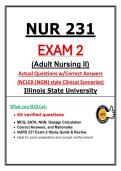
NUR 231
EXAM 2
(Adult Nursing II)
Actual Questions w/Correct Answers
(NCLEX (NGN) style Clinical Scenarios)
Illinois State University
What you Will Get:
• 65 verified questions
• MCQ, SATA, NGN, Dosage Calculation
• Correct Answers, and Rationales
• NURS 231 Exam 2 Study Guide & Review
• Ideal for exam preparation and concept reinforcement.
,Table of Contents
NUR 231 EXAM 2....................................................................................... 2
NURS 231 Exam 2 Study Guide & Review .................................................. 34
NUR 231 EXAM 2
1. A nurse is reviewing the laboratory results of a patient admitted with severe epigastric
pain. Which finding is MOST specific to confirming a diagnosis of acute pancreatitis?
A. White blood cell count of 12,000/mm³
B. Serum amylase and lipase elevated more than three times the normal value
C. Alanine aminotransferase (ALT) of 85 U/L
D. Serum albumin of 2.8 g/dL
Correct Answer: B
Expert Rationale:
In acute pancreatitis, premature activation of pancreatic enzymes (especially trypsin) causes
autodigestion of pancreatic tissue. Serum amylase and lipase levels elevated more than three
times the normal value are the most specific diagnostic indicators. While leukocytosis (A) may
occur due to inflammation, it is nonspecific. Elevated ALT (C) suggests hepatic involvement.
Low albumin (D) indicates chronic liver disease or malnutrition but is not diagnostic of acute
pancreatitis.
,2. A patient with acute pancreatitis has severe abdominal pain, a rigid abdomen, and
bruising around the umbilicus. How should the nurse interpret the periumbilical
bruising?
A. It is associated with a severe case of pancreatitis.
B. It indicates uncomplicated cholelithiasis.
C. It is an expected finding in mild diverticulitis.
D. It indicates that pancreatic inflammation has resolved.
Correct Answer: A. It is associated with a severe case of pancreatitis.
Expert Rationale:
Bruising around the umbilicus is identified as a finding associated with severe pancreatitis. A
rigid abdomen can also indicate peritoneal irritation and requires close assessment for
complications.
3. A patient is scheduled for an esophagogastroduodenoscopy (EGD). Which
preoperative instruction is the PRIORITY for the nurse to verify?
A. The patient has fasted for at least 8 hours prior to the procedure
B. The patient has taken the bowel preparation solution
C. The patient has removed all jewelry and nail polish
D. The patient has signed the consent for general anesthesia
Correct Answer: A
Expert Rationale:
An EGD requires the patient to be NPO for at least 8 hours prior to the procedure to reduce the
risk of aspiration during moderate sedation and to ensure adequate visualization of the upper GI
tract. Bowel preparation (B) is required for colonoscopy, not EGD. Removing jewelry and nail
polish (C) is important but secondary to NPO status. EGD is performed under moderate
sedation, not general anesthesia (D), though informed consent for the procedure is required.
, 4. A nurse is caring for a patient with a new colostomy in the sigmoid colon. The nurse
expects the effluent to be:
A. Liquid and continuous
B. Soft and unformed
C. Semi-formed to formed
D. Bloody and mucoid
Correct Answer: C
Expert Rationale:
The consistency of stomal effluent depends on the anatomical location of the stoma. A
cecostomy or ascending colostomy produces liquid to soft/unformed stool due to minimal water
absorption. A transverse colostomy produces soft to semi-formed stool. A descending or
sigmoid colostomy produces semi-formed to formed stool because most water absorption has
occurred by the time chyme reaches the distal colon. Bloody, mucoid effluent is abnormal and
requires assessment.
EXAM 2
(Adult Nursing II)
Actual Questions w/Correct Answers
(NCLEX (NGN) style Clinical Scenarios)
Illinois State University
What you Will Get:
• 65 verified questions
• MCQ, SATA, NGN, Dosage Calculation
• Correct Answers, and Rationales
• NURS 231 Exam 2 Study Guide & Review
• Ideal for exam preparation and concept reinforcement.
,Table of Contents
NUR 231 EXAM 2....................................................................................... 2
NURS 231 Exam 2 Study Guide & Review .................................................. 34
NUR 231 EXAM 2
1. A nurse is reviewing the laboratory results of a patient admitted with severe epigastric
pain. Which finding is MOST specific to confirming a diagnosis of acute pancreatitis?
A. White blood cell count of 12,000/mm³
B. Serum amylase and lipase elevated more than three times the normal value
C. Alanine aminotransferase (ALT) of 85 U/L
D. Serum albumin of 2.8 g/dL
Correct Answer: B
Expert Rationale:
In acute pancreatitis, premature activation of pancreatic enzymes (especially trypsin) causes
autodigestion of pancreatic tissue. Serum amylase and lipase levels elevated more than three
times the normal value are the most specific diagnostic indicators. While leukocytosis (A) may
occur due to inflammation, it is nonspecific. Elevated ALT (C) suggests hepatic involvement.
Low albumin (D) indicates chronic liver disease or malnutrition but is not diagnostic of acute
pancreatitis.
,2. A patient with acute pancreatitis has severe abdominal pain, a rigid abdomen, and
bruising around the umbilicus. How should the nurse interpret the periumbilical
bruising?
A. It is associated with a severe case of pancreatitis.
B. It indicates uncomplicated cholelithiasis.
C. It is an expected finding in mild diverticulitis.
D. It indicates that pancreatic inflammation has resolved.
Correct Answer: A. It is associated with a severe case of pancreatitis.
Expert Rationale:
Bruising around the umbilicus is identified as a finding associated with severe pancreatitis. A
rigid abdomen can also indicate peritoneal irritation and requires close assessment for
complications.
3. A patient is scheduled for an esophagogastroduodenoscopy (EGD). Which
preoperative instruction is the PRIORITY for the nurse to verify?
A. The patient has fasted for at least 8 hours prior to the procedure
B. The patient has taken the bowel preparation solution
C. The patient has removed all jewelry and nail polish
D. The patient has signed the consent for general anesthesia
Correct Answer: A
Expert Rationale:
An EGD requires the patient to be NPO for at least 8 hours prior to the procedure to reduce the
risk of aspiration during moderate sedation and to ensure adequate visualization of the upper GI
tract. Bowel preparation (B) is required for colonoscopy, not EGD. Removing jewelry and nail
polish (C) is important but secondary to NPO status. EGD is performed under moderate
sedation, not general anesthesia (D), though informed consent for the procedure is required.
, 4. A nurse is caring for a patient with a new colostomy in the sigmoid colon. The nurse
expects the effluent to be:
A. Liquid and continuous
B. Soft and unformed
C. Semi-formed to formed
D. Bloody and mucoid
Correct Answer: C
Expert Rationale:
The consistency of stomal effluent depends on the anatomical location of the stoma. A
cecostomy or ascending colostomy produces liquid to soft/unformed stool due to minimal water
absorption. A transverse colostomy produces soft to semi-formed stool. A descending or
sigmoid colostomy produces semi-formed to formed stool because most water absorption has
occurred by the time chyme reaches the distal colon. Bloody, mucoid effluent is abnormal and
requires assessment.