NASM CPT 7 Exam Questions & A+ Graded Answers | Updated 2026 | Instant Download
Prepare efficiently for the NASM Certified Personal Trainer (NASM CPT) examination with this comprehensive, exam-focused study resource covering essential NASM CPT 7 concepts, terminology, training principles, assessments, anatomy, biomechanics, exercise physiology, OPT Model programming, flexibility, corrective exercise, cardiorespiratory training, nutrition, behavior change, and professional development.
This resource is designed for students and aspiring personal trainers who want a concentrated review of high-value NASM CPT 7 concepts in a convenient question-and-answer format. The supplied material covers definitions, principles, assessment concepts, exercise science terminology, training variables, OPT Model phases, cardiovascular concepts, muscle function, flexibility, behavior-change strategies, and other important areas relevant to NASM CPT preparation.
KEY TOPICS COVERED:
• NASM CPT 7 exam questions and answers
• NASM CPT 7 study guide concepts
• OPT Model and its primary training levels
• Stabilization, strength, and power training
• OPT Model Phase 1 Stabilization Endurance
• OPT Model Phase 2 Strength Endurance
• OPT Model Phase 3 Muscular Development
• OPT Model Phase 4 Maximal Strength
• OPT Model Phase 5 Power
• Specificity principle
• Davis's Law
• Wolff's Law
• Archimedes' Principle
• TRX Rip Trainer applications
• Program design fundamentals
• Training frequency
• Training intensity
• Training volume
• Training duration
• Acute and chronic training variables
• Stretch-shortening cycle
• Loading phase
• Amortization phase
• Unloading/concentric phase
• Reactive training concepts
• Speed and force generation
• Core stability
• Core stabilization
• Kinesiology
• Biomechanics
• Osteokinematics
• Arthrokinematics
• Roll, slide, and spin joint motions
• Open-chain exercises
• Closed-chain exercises
• Lever systems
• First-class levers
• Second-class levers
• Third-class levers
• Muscle contractions
• Concentric contraction
• Eccentric contraction
• Muscle spindle function
• Golgi tendon organ function
• Type I muscle fibers
• Type II muscle fibers
• Type IIa and Type IIx fibers
• Fascia layers
• Epimysium
• Perimysium
• Endomysium
• Shoulder internal rotation muscles
• Shoulder extension muscles
• Knee valgus
• Knee varus
• Pelvic tilt
• Anterior pelvic tilt
• Posterior pelvic tilt
• Deep Longitudinal Subsystem
• DLS and gait mechanics
• Backside mechanics
• Myofascial rolling
• Neurophysiological effects of foam rolling
• Tissue relaxation and pain reduction
• Flexibility and mobility concepts
• Cardiorespiratory training
• Cardiorespiratory training stages
• Stage 1 aerobic training
• Stage 2 interval training
• Stage 3 HIIT concepts
• VT1 and training intensity
• Work-to-rest ratios
• Heart-rate concepts
• Resting heart rate
• Tanaka maximal heart-rate formula
• Frank-Starling Law of the Heart
• Peripheral resistance
• Venous pooling
• Valsalva maneuver
• Coronary heart disease
• Atherosclerosis
• Body composition assessment
• Waist-to-hip ratio
• PAR-Q health indicators
• Exercise readiness
• Low-back pain concepts
• DOMS
• Osteoporosis
• Osteopenia
• Bone remodeling
• Wolff's Law and bone adaptation
• Vitamin C
• Folate
• Iron and trace minerals
• Nutrition fundamentals
• Behavior-change stages
• Precontemplation
• Contemplation
• Preparation
• Action
• Maintenance
• Amotivation
• Implementation intentions
• Cognitive fusion
• Mental imagery
• Reverse listening
• Exercise barriers
• Convenience barriers
• Environmental barriers
• Physical limitations
• Lack of time
• Boredom and lack of enjoyment
• Socioeconomic status
• Professional development
• SWOT analysis
• Fitness career pathways
• Functional movement
• Stability and mobility
• Athletic performance
• Strength
• Hypertrophy
• Power
• SAQ training
• Endurance
• Antirotational exercise
• Unilateral movement
• Mechanical specificity
• Neuromuscular concepts
• Functional training principles
• Exercise programming terminology
OPT MODEL REVIEW
The material includes detailed review of the NASM Optimum Performance Training Model, including its three primary levels—Stabilization, Strength, and Power—and the progression through the five phases. It covers Stabilization Endurance Training, Strength Endurance Training, Muscular Development, Maximal Strength, and Power Training, helping learners organize the major OPT Model terminology and programming concepts.
ANATOMY, KINESIOLOGY & BIOMECHANICS
Review fundamental movement-science concepts including kinesiology, biomechanics, osteokinematics, arthrokinematics, joint motion, roll, slide, spin, open-chain and closed-chain exercises, lever systems, muscle contractions, anatomical movement, shoulder mechanics, pelvic positioning, knee alignment, and functional movement.
MUSCLE PHYSIOLOGY & FASCIA
The study material covers muscle spindle function, Golgi tendon organs, muscle-fiber characteristics, Type I slow-twitch fibers, Type II fast-twitch fibers, Type IIa and Type IIx fibers, concentric and eccentric contractions, fascia organization, and the sequence of epimysium, perimysium, and endomysium.
ASSESSMENT & CORRECTIVE EXERCISE CONCEPTS
Review assessment-related topics such as core stability, body composition measurement, waist-to-hip ratio, pelvic tilt, knee varus, knee valgus, underactive and overactive muscles, shoulder internal rotation, movement mechanics, and the relationship between mobility, stability, and functional performance.
CARDIORESPIRATORY TRAINING
The resource includes cardiorespiratory training stages, aerobic base development, interval training, higher-intensity conditioning, VT1 concepts, work-to-rest ratios, steady-state training, HIIT concepts, maximal heart-rate estimation, resting heart rate, venous pooling, peripheral resistance, the Frank-Starling Law, and the Valsalva maneuver.
EXERCISE PHYSIOLOGY & PERFORMANCE
Important performance concepts include speed, force generation, reactive performance, the stretch-shortening cycle, loading and amortization phases, training volume, intensity, frequency, duration, eccentric loading, concentric actions, and exercise-specific adaptations.
MYOFASCIAL ROLLING & FLEXIBILITY
Review myofascial rolling concepts, including mechanical compression, tissue relaxation, blood-flow considerations, nerve-receptor stimulation, and the neurophysiological mechanisms associated with temporary changes in tissue sensation and mobility.
BEHAVIOR CHANGE & CLIENT MOTIVATION
The material covers the stages of behavior change, including precontemplation, contemplation, preparation, action, and maintenance. It also includes amotivation, implementation intentions, cognitive fusion, mental imagery, reverse listening, and common barriers to exercise.
HEALTH, NUTRITION & WELLNESS
Review coronary heart disease and atherosclerosis, osteoporosis and osteopenia, bone remodeling, DOMS, vitamin C, folate, iron, trace minerals, body composition, exercise readiness, and other health-related concepts relevant to personal-training practice.
PROFESSIONAL DEVELOPMENT
The resource also addresses fitness-industry career considerations, socioeconomic status, SWOT analysis, professional development, and strategies for building a sustainable career as a fitness professional.
WHY THIS NASM CPT RESOURCE IS USEFUL
Comprehensive NASM CPT 7 terminology review
Question-and-answer study format
Covers major NASM CPT 7 subject areas
OPT Model phases and training concepts
Anatomy, biomechanics, and kinesiology review
Exercise physiology and muscle-function concepts
Assessment and corrective-exercise terminology
Cardiorespiratory training concepts
Nutrition and wellness terminology
Behavior-change and motivation concepts
Training variables and program-design terminology
Convenient exam-preparation resource
Updated 2026 study material
Instant-download format
Ideal for students preparing for NASM CPT certification, NASM CPT 7 coursework, personal trainer certification studies, exercise science review, fitness assessment preparation, OPT Model study, anatomy and physiology review, and comprehensive last-minute exam preparation.
Use this resource to reinforce terminology, identify important concepts, review major NASM frameworks, and organize your study sessions around the subjects most relevant to NASM CPT 7 preparation.
Vista previa del contenido
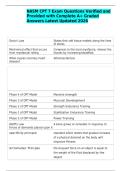
NASM CPT 7 Exam Questions Verified and
Provided with Complete A+ Graded
Answers Latest Updated 2026
Davis's Law States that soft tissue models along the lines
of stress
Mechanical effect that occurs Compress to the local myofascia, relaxes the
from myofascial rolling tissues by increasing bloodflow
What causes coronary heart atherosclerosis
disease?
Phase 4 of OPT Model Maximal strength
Phase 3 of OPT Model Muscular Development
Phase 2 of OPT Model Strength Endurance Training
Phase 1 of OPT Model Stabilization Endurance Training
Phase 5 of OPT Model Power Training
Wolff's Law A bone grows or remodels in response to
forces or demands placed upon it
specificity principle standard which states that gradual increase
of a physical demand on the body will
improve fitness
Archimedes' Principle the buoyant force on an object is equal to
the weight of the fluid displaced by the
object
, The TRX Rip Trainer should be most
beneficial to which Phases 1,
2, and 5 of the following phases of the
OPT model?
What are the primary levels of the OPT model Stabilization, Strength, Power
What does the electron transport chain do? uses the high-energy electrons from
glycolysis and the Krebs cycle to convert
ADP into ATP
maintenance stage has been consistently exercising for 6
months or more-less tempted to stop-
continues indefinitely
action stage has been exercising for up to 6 months
contemplation stage stage of change in which people are
considering changing behavior in the next 6
months but have taken no steps to start
precontemplation stage stage of change in which people have made
no changes or plans to change
preparation stage stage of change in which people are getting
ready to make a change within the next
month
To quantify body compositional (fat mass loss)
changes Body composition
measurement (A Fitness assessment measure)
Core stability is defined as The ability to maintain position stabilizing spine
while extremities are moving