
GRADUATE NURSING • ADVANCED PATHOPHYSIOLOGY
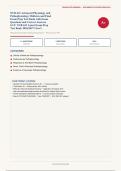
NUR 631 Advanced Physiology and
Pathophysiology Midterm and Final
Exam Prep Test Bank with Exam
Questions and Correct Answers A+
GCU NUR 631 Latest Exam Prep
Test Bank 2026/2027 (New!)
Official-Style Graduate Nursing Examination • Passing Score 80%
A+ QUESTIONS 5 SECTIONS 100%
VERIFIED BALANCED RATIONALES
CATEGORIES
Cellular & Molecular Pathophysiology
Cardiovascular Pathophysiology
Respiratory & Acid-Base Pathophysiology
Renal, Fluid & Electrolyte Pathophysiology
Endocrine & Neurologic Pathophysiology
EXAM FORMAT & SCORING
• Question Format: Multiple-choice (A–D) | 1 mark per question
• Total Marks: 50 | Passing Score: 80% (40/50)
• Difficulty: Advanced Graduate Nursing — Application & Analysis level
• High-yield pathophysiology domains prioritized for midterm/final success
• Answer Distribution: Balanced A/B/C/D | Full item-specific rationales
• Brand: STUVIAACTUALEXAM | Year: 2026/2027 | GCU NUR 631 aligned
STUVIAACTUALEXAM
, SECTION: CELLULAR & MOLECULAR PATHOPHYSIOLOGY
Q1. A 68-year-old patient with progressive heart failure undergoes myocardial biopsy. Histology reveals myocytes with
swollen mitochondria, disrupted cristae, and accumulation of lipid droplets. These cellular changes are most consistent
with reversible hypoxic injury mediated by impaired ATP-dependent membrane pumps.
A. Reversible cellular swelling and fatty change secondary to ATP depletion
B. Irreversible coagulative necrosis with nuclear pyknosis and karyorrhexis
C. Apoptotic cell death characterized by cytoplasmic blebbing and DNA laddering
D. Caseous necrosis with granulomatous inflammation and giant cells
Correct Answer: A
Rationale: Swollen mitochondria, disrupted cristae, and lipid accumulation represent classic reversible hypoxic injury caused by
failure of Na+/K+-ATPase and consequent osmotic swelling plus impaired fatty-acid oxidation. Nuclear changes of necrosis or
apoptotic features are absent, ruling out irreversible or programmed death pathways.
Q2. During an inflammatory response to bacterial pneumonia, circulating neutrophils marginate, roll, and firmly adhere
to activated endothelium before transmigrating into alveolar spaces. The firm adhesion step is primarily mediated by
interaction between leukocyte integrins and endothelial immunoglobulin-family adhesion molecules.
A. Selectin–carbohydrate interactions that slow leukocyte velocity (rolling)
B. Integrin–ICAM-1 binding that produces firm adhesion prior to diapedesis
C. Chemokine gradients that direct chemotaxis after extravasation
D. Complement C5a receptors that trigger oxidative burst inside the tissue
Correct Answer: B
Rationale: Firm adhesion is the integrin-dependent step (LFA-1/Mac-1 binding to ICAM-1). Selectins mediate the preceding rolling
phase, chemokines guide subsequent directed migration, and C5a participates in activation but is not the primary adhesion ligand
pair.
Q3. A research study examines the consequences of sustained endoplasmic-reticulum stress in pancreatic beta cells.
Persistent unfolded-protein accumulation activates the PERK–eIF2α–ATF4–CHOP axis, ultimately tipping the cell from
adaptive unfolded-protein response toward apoptosis. The critical pro-apoptotic transcription factor induced under
prolonged stress is CHOP.
A. NF-κB translocation that promotes pro-survival inflammatory gene expression
B. HIF-1α stabilization that increases glycolytic enzyme expression
C. CHOP (GADD153) induction that drives transcription of pro-apoptotic Bcl-2 family members
D. Nrf2 activation that up-regulates antioxidant response element genes
Correct Answer: C
Rationale: Under prolonged ER stress the adaptive UPR fails and CHOP is transcriptionally induced; CHOP represses anti-apoptotic
Bcl-2 and promotes expression of pro-apoptotic BH3-only proteins, committing the beta cell to apoptosis. The other pathways are not
the dominant terminal effectors of unresolved ER stress in this context.
Q4. A patient with alpha-1 antitrypsin deficiency develops pan-acinar emphysema and hepatic cirrhosis. Liver biopsy
shows periodic-acid-Schiff-positive, diastase-resistant globules within hepatocytes. These globules represent retained,
misfolded protein that cannot exit the endoplasmic reticulum.
A. Excessive lysosomal degradation of normal alpha-1 antitrypsin protein
B. Autoimmune destruction of hepatocytes by cytotoxic T lymphocytes
C. Copper overload secondary to impaired biliary excretion
D. Accumulation of misfolded Z-variant protein within the rough endoplasmic reticulum
Correct Answer: D
Rationale: The common Z mutation causes protein misfolding and polymerization; the abnormal protein is retained in the ER, forming
the characteristic PAS-positive globules and triggering hepatocyte injury. The lung disease results from unopposed protease activity,
but the hepatic pathology is a classic protein-retention disorder.
Page 1 of 13 | STUVIAACTUALEXAM
NUR 631 Advanced Physiology and
Pathophysiology Midterm and Final
Exam Prep Test Bank with Exam
Questions and Correct Answers A+
GCU NUR 631 Latest Exam Prep
Test Bank 2026/2027 (New!)
Official-Style Graduate Nursing Examination • Passing Score 80%
A+ QUESTIONS 5 SECTIONS 100%
VERIFIED BALANCED RATIONALES
CATEGORIES
Cellular & Molecular Pathophysiology
Cardiovascular Pathophysiology
Respiratory & Acid-Base Pathophysiology
Renal, Fluid & Electrolyte Pathophysiology
Endocrine & Neurologic Pathophysiology
EXAM FORMAT & SCORING
• Question Format: Multiple-choice (A–D) | 1 mark per question
• Total Marks: 50 | Passing Score: 80% (40/50)
• Difficulty: Advanced Graduate Nursing — Application & Analysis level
• High-yield pathophysiology domains prioritized for midterm/final success
• Answer Distribution: Balanced A/B/C/D | Full item-specific rationales
• Brand: STUVIAACTUALEXAM | Year: 2026/2027 | GCU NUR 631 aligned
STUVIAACTUALEXAM
, SECTION: CELLULAR & MOLECULAR PATHOPHYSIOLOGY
Q1. A 68-year-old patient with progressive heart failure undergoes myocardial biopsy. Histology reveals myocytes with
swollen mitochondria, disrupted cristae, and accumulation of lipid droplets. These cellular changes are most consistent
with reversible hypoxic injury mediated by impaired ATP-dependent membrane pumps.
A. Reversible cellular swelling and fatty change secondary to ATP depletion
B. Irreversible coagulative necrosis with nuclear pyknosis and karyorrhexis
C. Apoptotic cell death characterized by cytoplasmic blebbing and DNA laddering
D. Caseous necrosis with granulomatous inflammation and giant cells
Correct Answer: A
Rationale: Swollen mitochondria, disrupted cristae, and lipid accumulation represent classic reversible hypoxic injury caused by
failure of Na+/K+-ATPase and consequent osmotic swelling plus impaired fatty-acid oxidation. Nuclear changes of necrosis or
apoptotic features are absent, ruling out irreversible or programmed death pathways.
Q2. During an inflammatory response to bacterial pneumonia, circulating neutrophils marginate, roll, and firmly adhere
to activated endothelium before transmigrating into alveolar spaces. The firm adhesion step is primarily mediated by
interaction between leukocyte integrins and endothelial immunoglobulin-family adhesion molecules.
A. Selectin–carbohydrate interactions that slow leukocyte velocity (rolling)
B. Integrin–ICAM-1 binding that produces firm adhesion prior to diapedesis
C. Chemokine gradients that direct chemotaxis after extravasation
D. Complement C5a receptors that trigger oxidative burst inside the tissue
Correct Answer: B
Rationale: Firm adhesion is the integrin-dependent step (LFA-1/Mac-1 binding to ICAM-1). Selectins mediate the preceding rolling
phase, chemokines guide subsequent directed migration, and C5a participates in activation but is not the primary adhesion ligand
pair.
Q3. A research study examines the consequences of sustained endoplasmic-reticulum stress in pancreatic beta cells.
Persistent unfolded-protein accumulation activates the PERK–eIF2α–ATF4–CHOP axis, ultimately tipping the cell from
adaptive unfolded-protein response toward apoptosis. The critical pro-apoptotic transcription factor induced under
prolonged stress is CHOP.
A. NF-κB translocation that promotes pro-survival inflammatory gene expression
B. HIF-1α stabilization that increases glycolytic enzyme expression
C. CHOP (GADD153) induction that drives transcription of pro-apoptotic Bcl-2 family members
D. Nrf2 activation that up-regulates antioxidant response element genes
Correct Answer: C
Rationale: Under prolonged ER stress the adaptive UPR fails and CHOP is transcriptionally induced; CHOP represses anti-apoptotic
Bcl-2 and promotes expression of pro-apoptotic BH3-only proteins, committing the beta cell to apoptosis. The other pathways are not
the dominant terminal effectors of unresolved ER stress in this context.
Q4. A patient with alpha-1 antitrypsin deficiency develops pan-acinar emphysema and hepatic cirrhosis. Liver biopsy
shows periodic-acid-Schiff-positive, diastase-resistant globules within hepatocytes. These globules represent retained,
misfolded protein that cannot exit the endoplasmic reticulum.
A. Excessive lysosomal degradation of normal alpha-1 antitrypsin protein
B. Autoimmune destruction of hepatocytes by cytotoxic T lymphocytes
C. Copper overload secondary to impaired biliary excretion
D. Accumulation of misfolded Z-variant protein within the rough endoplasmic reticulum
Correct Answer: D
Rationale: The common Z mutation causes protein misfolding and polymerization; the abnormal protein is retained in the ER, forming
the characteristic PAS-positive globules and triggering hepatocyte injury. The lung disease results from unopposed protease activity,
but the hepatic pathology is a classic protein-retention disorder.
Page 1 of 13 | STUVIAACTUALEXAM

