
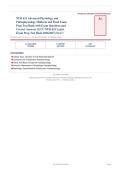
GRADUATE NURSING PATHOPHYSIOLOGY
NUR 631 Advanced Physiology and A+
Pathophysiology Midterm and Final Exam
Prep Test Bank with Exam Questions and
Correct Answers | GCU NUR 631 Latest
Exam Prep Test Bank 2026/2027 (New!)
Grand Canyon University — Advanced Physiology & Pathophysiology
A+ QUESTIONS 5 CONTENT 100%
VERIFIED SECTIONS RATIONALES
CATEGORIES
■ Cellular Injury, Genetics & Fluid-Electrolyte Balance
■ Cardiovascular & Respiratory Pathophysiology
■ Renal, Acid-Base & Endocrine Pathophysiology
■ Immune, Inflammatory & Hematologic Pathophysiology
■ Neurologic, Gastrointestinal & Multisystem Pathophysiology
STUVIAACTUALEXAM
Original graduate-level examination aligned to advanced physiology & pathophysiology domains.
Passing score: 80% | 1 mark per question
STUVIAACTUALEXAM Page 1
, SECTION 1: Cellular Injury, Genetics & Fluid-Electrolyte Balance
Q1. A 58-year-old patient with prolonged hypotension develops acute tubular necrosis. The nurse practitioner reviews the
cellular mechanisms of ischemic injury. Which process most directly leads to irreversible cell death in this setting?
A. Enhanced oxidative phosphorylation that restores membrane potential
B. Transient swelling of the endoplasmic reticulum that resolves with reperfusion
C. Increased protein synthesis driven by elevated cytosolic calcium
D. Membrane rupture secondary to ATP depletion and calcium influx activating proteases and phospholipases
Correct Answer: D
Rationale: Severe ATP depletion impairs Na/K-ATPase, causing cellular swelling; calcium influx then activates destructive enzymes,
culminating in membrane rupture and necrosis. Reversible injury involves only mild swelling without membrane failure.
Q2. A newborn is diagnosed with cystic fibrosis after a positive newborn screen and confirmatory genetic testing. The parents
ask how a single gene defect produces multi-organ disease. Which molecular mechanism best explains the pathophysiology?
A. X-linked deficiency of surfactant protein B causes alveolar collapse and pancreatic fibrosis
B. Autosomal-dominant gain-of-function mutation increases mucus production systemically
C. Mitochondrial DNA mutation reduces ATP generation exclusively in airway epithelium
D. Defective CFTR chloride channel impairs transepithelial ion transport, producing thick secretions in lungs, pancreas, and
other organs
Correct Answer: D
Rationale: CF is caused by autosomal-recessive mutations in CFTR, a cAMP-regulated chloride channel. Impaired chloride (and secondarily
sodium/water) transport dehydrates secretions, leading to obstruction and infection in multiple organs.
Q3. A 72-year-old woman with heart failure is receiving loop diuretics and develops muscle weakness and U waves on ECG.
Serum potassium is 2.6 mEq/L. Which cellular consequence of hypokalemia most contributes to the cardiac findings?
A. Shortened action-potential duration that stabilizes the membrane
B. Increased sodium-potassium pump activity that accelerates conduction velocity
C. Hyperpolarization of the resting membrane potential that delays depolarization and predisposes to arrhythmias
D. Enhanced calcium entry into myocytes that strengthens contractility
Correct Answer: C
Rationale: Low extracellular potassium increases the potassium equilibrium potential (more negative), hyperpolarizing the resting membrane
and slowing phase-0 depolarization. This, together with delayed ventricular repolarization, produces U waves and arrhythmogenicity.
Q4. A patient with severe burns develops marked interstitial edema. The nurse reviews Starling forces. Which change most
strongly favors fluid movement out of the capillary into the interstitium?
A. Increased plasma oncotic pressure from hemoconcentration
B. Increased interstitial hydrostatic pressure from lymphatic obstruction alone
C. Decreased capillary hydrostatic pressure from hypovolemia
D. Decreased plasma oncotic pressure from loss of albumin through damaged capillaries
Correct Answer: D
Rationale: Burn injury increases vascular permeability, allowing albumin to leak into the interstitium and thereby lowering plasma oncotic
pressure. The resulting imbalance of Starling forces drives fluid into the tissues, producing edema.
Q5. A 45-year-old man with a known BRCA1 mutation is counseled about cancer risk. The nurse practitioner explains the
normal function of BRCA1. Which statement correctly describes its physiologic role?
A. BRCA1 participates in homologous recombination repair of double-strand DNA breaks, maintaining genomic stability
B. BRCA1 encodes a growth-factor receptor that stimulates cell proliferation when activated
C. BRCA1 is a mitochondrial enzyme that detoxifies reactive oxygen species
D. BRCA1 functions solely as a cell-cycle inhibitor at the G2/M checkpoint
Correct Answer: A
Rationale: BRCA1 (and BRCA2) are critical for error-free repair of double-strand breaks via homologous recombination. Loss of function allows
accumulation of mutations and markedly elevates lifetime risk of breast and ovarian cancers.
STUVIAACTUALEXAM Page 2
NUR 631 Advanced Physiology and A+
Pathophysiology Midterm and Final Exam
Prep Test Bank with Exam Questions and
Correct Answers | GCU NUR 631 Latest
Exam Prep Test Bank 2026/2027 (New!)
Grand Canyon University — Advanced Physiology & Pathophysiology
A+ QUESTIONS 5 CONTENT 100%
VERIFIED SECTIONS RATIONALES
CATEGORIES
■ Cellular Injury, Genetics & Fluid-Electrolyte Balance
■ Cardiovascular & Respiratory Pathophysiology
■ Renal, Acid-Base & Endocrine Pathophysiology
■ Immune, Inflammatory & Hematologic Pathophysiology
■ Neurologic, Gastrointestinal & Multisystem Pathophysiology
STUVIAACTUALEXAM
Original graduate-level examination aligned to advanced physiology & pathophysiology domains.
Passing score: 80% | 1 mark per question
STUVIAACTUALEXAM Page 1
, SECTION 1: Cellular Injury, Genetics & Fluid-Electrolyte Balance
Q1. A 58-year-old patient with prolonged hypotension develops acute tubular necrosis. The nurse practitioner reviews the
cellular mechanisms of ischemic injury. Which process most directly leads to irreversible cell death in this setting?
A. Enhanced oxidative phosphorylation that restores membrane potential
B. Transient swelling of the endoplasmic reticulum that resolves with reperfusion
C. Increased protein synthesis driven by elevated cytosolic calcium
D. Membrane rupture secondary to ATP depletion and calcium influx activating proteases and phospholipases
Correct Answer: D
Rationale: Severe ATP depletion impairs Na/K-ATPase, causing cellular swelling; calcium influx then activates destructive enzymes,
culminating in membrane rupture and necrosis. Reversible injury involves only mild swelling without membrane failure.
Q2. A newborn is diagnosed with cystic fibrosis after a positive newborn screen and confirmatory genetic testing. The parents
ask how a single gene defect produces multi-organ disease. Which molecular mechanism best explains the pathophysiology?
A. X-linked deficiency of surfactant protein B causes alveolar collapse and pancreatic fibrosis
B. Autosomal-dominant gain-of-function mutation increases mucus production systemically
C. Mitochondrial DNA mutation reduces ATP generation exclusively in airway epithelium
D. Defective CFTR chloride channel impairs transepithelial ion transport, producing thick secretions in lungs, pancreas, and
other organs
Correct Answer: D
Rationale: CF is caused by autosomal-recessive mutations in CFTR, a cAMP-regulated chloride channel. Impaired chloride (and secondarily
sodium/water) transport dehydrates secretions, leading to obstruction and infection in multiple organs.
Q3. A 72-year-old woman with heart failure is receiving loop diuretics and develops muscle weakness and U waves on ECG.
Serum potassium is 2.6 mEq/L. Which cellular consequence of hypokalemia most contributes to the cardiac findings?
A. Shortened action-potential duration that stabilizes the membrane
B. Increased sodium-potassium pump activity that accelerates conduction velocity
C. Hyperpolarization of the resting membrane potential that delays depolarization and predisposes to arrhythmias
D. Enhanced calcium entry into myocytes that strengthens contractility
Correct Answer: C
Rationale: Low extracellular potassium increases the potassium equilibrium potential (more negative), hyperpolarizing the resting membrane
and slowing phase-0 depolarization. This, together with delayed ventricular repolarization, produces U waves and arrhythmogenicity.
Q4. A patient with severe burns develops marked interstitial edema. The nurse reviews Starling forces. Which change most
strongly favors fluid movement out of the capillary into the interstitium?
A. Increased plasma oncotic pressure from hemoconcentration
B. Increased interstitial hydrostatic pressure from lymphatic obstruction alone
C. Decreased capillary hydrostatic pressure from hypovolemia
D. Decreased plasma oncotic pressure from loss of albumin through damaged capillaries
Correct Answer: D
Rationale: Burn injury increases vascular permeability, allowing albumin to leak into the interstitium and thereby lowering plasma oncotic
pressure. The resulting imbalance of Starling forces drives fluid into the tissues, producing edema.
Q5. A 45-year-old man with a known BRCA1 mutation is counseled about cancer risk. The nurse practitioner explains the
normal function of BRCA1. Which statement correctly describes its physiologic role?
A. BRCA1 participates in homologous recombination repair of double-strand DNA breaks, maintaining genomic stability
B. BRCA1 encodes a growth-factor receptor that stimulates cell proliferation when activated
C. BRCA1 is a mitochondrial enzyme that detoxifies reactive oxygen species
D. BRCA1 functions solely as a cell-cycle inhibitor at the G2/M checkpoint
Correct Answer: A
Rationale: BRCA1 (and BRCA2) are critical for error-free repair of double-strand breaks via homologous recombination. Loss of function allows
accumulation of mutations and markedly elevates lifetime risk of breast and ovarian cancers.
STUVIAACTUALEXAM Page 2

