
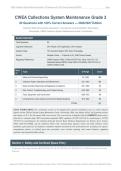
CWEA Collections System Maintenance Grade 3 | 82 Questions with 100% Correct Answers 2026/2027 Page 1
CWEA Collections System Maintenance Grade 3
82 Questions with 100% Correct Answers — 2026/2027 Edition
California Water Environment Association | Journeyman-Level Certification Examination
Prerequisite: CWEA Collection System Maintenance Grade 2 Certification
EXAM OVERVIEW
Total Questions: 82
Cognitive Distribution: 25% Recall | 50% Application | 25% Analysis
Question Style: 70% Scenario-Based | 30% Direct Knowledge
Format: Multiple Choice — 4 Options (A-D), ONE Correct Answer
Regulatory References: CWEA Grade 3 KSAs | OSHA 29 CFR 1910.146 & 1910.147 | CA
Statewide General WDRs (Order 2022-0103-DWQ) | MUTCD Part 6 |
California Water Code
Secti
Topic Q Range Count
on
1 Safety and Confined Space Entry Q1–Q20 20
2 Collection System Operations and Maintenance Q21–Q40 20
3 Sewer Overflow Reporting and Regulatory Compliance Q41–Q52 12
4 Odor Control, Troubleshooting, and Problem-Solving Q53–Q62 10
5 Tools, Equipment, and Construction Q63–Q72 10
6 Comprehensive Case Studies and Scenario-Based Questions Q73–Q82 10
TOTAL 82
EXAM INSTRUCTIONS: This examination consists of 82 multiple-choice questions distributed across six content domains
aligned with the CWEA Collection System Maintenance Grade 3 Knowledge, Skills, and Abilities (KSAs). Each question presents
four options (A, B, C, D) with exactly ONE correct answer. The correct answer is identified with the [CORRECT] marker and is
followed by a rationale citing CWEA certification standards, OSHA regulations (29 CFR 1910.146 for confined spaces, 29 CFR
1910.147 for lockout/tagout), the California Statewide General Waste Discharge Requirements for Sanitary Sewer Systems
(Order 2022-0103-DWQ), and the California Water Code. Scenario-based questions reflect real-world collection system
operations, safety protocols, and regulatory compliance situations encountered at the journeyman level. A passing score requires
comprehensive mastery of confined space entry procedures, sewer overflow reporting, odor control chemistry, equipment
operation, and integrated problem-solving.
Section 1: Safety and Confined Space Entry
20 Questions | Knowledge Domain: OSHA 29 CFR 1910.146, 29 CFR 1910.147, MUTCD Part 6, CWEA Collection System Safety
Standards
Aligned with CWEA Collection System Maintenance Grade 3 KSAs | OSHA Confined Space Standards | California Water Code (2026/2027 Edition)
, CWEA Collections System Maintenance Grade 3 | 82 Questions with 100% Correct Answers 2026/2027 Page 2
Q1: A permit-required confined space is defined as a confined space that has or potentially
contains which of the following hazards?
A. Only atmospheric hazards
B. Atmospheric, engulfment, configuration, or other serious health/safety hazards [CORRECT]
C. Only engulfment hazards
D. Only fall and electrical hazards
Correct Answer: B
Rationale: OSHA 29 CFR 1910.146 defines a permit-required confined space as one that contains or has the potential to contain a
hazardous atmosphere, material with engulfment potential, an internal configuration that could trap or asphyxiate (configuration
hazard), or any other recognized serious safety or health hazard. CWEA Grade 3 candidates must correctly distinguish
permit-required spaces from non-permit spaces to apply proper entry protocols.
Q2: Personnel involved in a confined space entry operation typically include which of the
following roles?
A. Authorized entrants, attendants, and entry supervisors [CORRECT]
B. Authorized entrants and rescue personnel only
C. Attendants, supervisors, and rescue personnel
D. Authorized entrants, attendants, and observers
Correct Answer: A
Rationale: Under OSHA 1910.146(d), the three primary roles in permit-required confined space entry are the authorized entrant, the
attendant, and the entry supervisor. Each has specific duties defined by regulation; rescue personnel are separate and are activated
only in an emergency. CWEA Grade 3 candidates must understand these roles to coordinate entries safely and legally.
Q3: A Grade 3 collection system crew is setting up traffic control near an open manhole on a
two-lane arterial road. According to standard flagging practices, where should the flagger stand?
A. In the open traffic lane directly facing oncoming vehicles to maximize visibility
B. On the shoulder adjacent to the traffic being controlled or in the closed lane before stopping vehicle traffic
[CORRECT]
C. Behind the work zone, facing away from oncoming traffic
D. On the opposite side of the road from the work zone
Correct Answer: B
Rationale: Per MUTCD Part 6 and CWEA safety guidance, the flagger should stand on the shoulder adjacent to the traffic being
controlled or in the closed lane before stopping vehicles, ensuring visibility while maintaining a safe escape path. Standing in the open
lane (A) exposes the flagger to traffic; positions behind the work zone (C) or across the road (D) reduce visibility and effectiveness.
Q4: A crew is preparing to enter a manhole that receives flow from a residential area. The entrant
is ready to remove the manhole cover. When should the first test for explosive gases be
performed?
A. After the cover is removed and the entrant has descended one rung
B. Before removing the manhole cover [CORRECT]
C. After the entrant has reached the bench
D. Only after ventilation has been running for 10 minutes
Correct Answer: B
Rationale: CWEA confined space procedures require the first atmospheric test for explosive gases (LEL) to be performed before
removing the manhole cover, because combustible gases such as methane may have accumulated in the headspace and could ignite
when the cover is moved (creating sparks). Testing after entry (A, C) or after ventilation (D) would miss the pre-entry hazard
Aligned with CWEA Collection System Maintenance Grade 3 KSAs | OSHA Confined Space Standards | California Water Code (2026/2027 Edition)
, CWEA Collections System Maintenance Grade 3 | 82 Questions with 100% Correct Answers 2026/2027 Page 3
assessment required by OSHA 1910.146(c)(5).
Q5: During entry into a deep manhole, the gas monitor shows oxygen at 19.0%. The entrant
reports dizziness. Which atmospheric hazard is most likely occurring?
A. Excess carbon monoxide
B. Excess hydrogen sulfide
C. Oxygen deficiency [CORRECT]
D. Excess methane
Correct Answer: C
Rationale: OSHA defines an oxygen-deficient atmosphere as one with less than 19.5% oxygen. At 19.0%, the entrant is in an
oxygen-deficient environment, which causes dizziness and impaired judgment. Carbon monoxide (A) and hydrogen sulfide (B) would
be detected by their respective sensors; methane (D) is typically detected as an LEL reading. The CWEA Grade 3 standard requires
immediate evacuation when oxygen falls below 19.5%.
Q6: When ventilating a manhole with a blower, the air inlet should be positioned at what minimum
height above street level?
A. 1.0 foot
B. 1.5 feet
C. 2.0 feet [CORRECT]
D. 3.0 feet
Correct Answer: C
Rationale: Per CWEA collection system standards and standard confined space ventilation practice, the air inlet of the ventilation
blower should be positioned at least 2.0 feet above street level to draw fresh air above the heavier-than-air gases (such as CO2 and
H2S vapors) that pool at street level near the manhole. Lower inlets (A, B) would recirculate contaminated air; 3.0 feet (D) is
unnecessarily restrictive.
Q7: Why should water-based substances never be used to extinguish electrical fires?
A. They cause chemical smoke that obscures visibility
B. They cool the fire too rapidly, causing re-ignition
C. They conduct electricity and pose a serious shock hazard to the user [CORRECT]
D. They contaminate the area and require HAZMAT cleanup
Correct Answer: C
Rationale: Water is an electrical conductor; applying it to an energized electrical fire creates a path for current to flow back to the
responder, resulting in serious or fatal electrical shock. OSHA and NFPA 10 require Class C-rated extinguishers (CO2 or dry
chemical) for energized electrical fires. The other options describe secondary concerns but do not address the primary safety hazard.
Q8: A crew is preparing to perform welding inside a wet well. The supervisor selects a standard
LED drop light. Why is this inappropriate?
A. LED lights generate too much heat in confined spaces
B. Explosion-proof lighting is required when working in confined spaces or sewers because flammable gases may be
present [CORRECT]
C. LED lights are not bright enough for confined space work
D. LED lights require 220V power not available at manholes
Correct Answer: B
Rationale: CWEA Grade 3 standards and OSHA 1910.146 require explosion-proof lighting (Class I, Division 1 rated) in confined
spaces or sewers because ignitable concentrations of flammable gases (methane, gasoline vapors, H2S) may be present. A standard
Aligned with CWEA Collection System Maintenance Grade 3 KSAs | OSHA Confined Space Standards | California Water Code (2026/2027 Edition)
CWEA Collections System Maintenance Grade 3
82 Questions with 100% Correct Answers — 2026/2027 Edition
California Water Environment Association | Journeyman-Level Certification Examination
Prerequisite: CWEA Collection System Maintenance Grade 2 Certification
EXAM OVERVIEW
Total Questions: 82
Cognitive Distribution: 25% Recall | 50% Application | 25% Analysis
Question Style: 70% Scenario-Based | 30% Direct Knowledge
Format: Multiple Choice — 4 Options (A-D), ONE Correct Answer
Regulatory References: CWEA Grade 3 KSAs | OSHA 29 CFR 1910.146 & 1910.147 | CA
Statewide General WDRs (Order 2022-0103-DWQ) | MUTCD Part 6 |
California Water Code
Secti
Topic Q Range Count
on
1 Safety and Confined Space Entry Q1–Q20 20
2 Collection System Operations and Maintenance Q21–Q40 20
3 Sewer Overflow Reporting and Regulatory Compliance Q41–Q52 12
4 Odor Control, Troubleshooting, and Problem-Solving Q53–Q62 10
5 Tools, Equipment, and Construction Q63–Q72 10
6 Comprehensive Case Studies and Scenario-Based Questions Q73–Q82 10
TOTAL 82
EXAM INSTRUCTIONS: This examination consists of 82 multiple-choice questions distributed across six content domains
aligned with the CWEA Collection System Maintenance Grade 3 Knowledge, Skills, and Abilities (KSAs). Each question presents
four options (A, B, C, D) with exactly ONE correct answer. The correct answer is identified with the [CORRECT] marker and is
followed by a rationale citing CWEA certification standards, OSHA regulations (29 CFR 1910.146 for confined spaces, 29 CFR
1910.147 for lockout/tagout), the California Statewide General Waste Discharge Requirements for Sanitary Sewer Systems
(Order 2022-0103-DWQ), and the California Water Code. Scenario-based questions reflect real-world collection system
operations, safety protocols, and regulatory compliance situations encountered at the journeyman level. A passing score requires
comprehensive mastery of confined space entry procedures, sewer overflow reporting, odor control chemistry, equipment
operation, and integrated problem-solving.
Section 1: Safety and Confined Space Entry
20 Questions | Knowledge Domain: OSHA 29 CFR 1910.146, 29 CFR 1910.147, MUTCD Part 6, CWEA Collection System Safety
Standards
Aligned with CWEA Collection System Maintenance Grade 3 KSAs | OSHA Confined Space Standards | California Water Code (2026/2027 Edition)
, CWEA Collections System Maintenance Grade 3 | 82 Questions with 100% Correct Answers 2026/2027 Page 2
Q1: A permit-required confined space is defined as a confined space that has or potentially
contains which of the following hazards?
A. Only atmospheric hazards
B. Atmospheric, engulfment, configuration, or other serious health/safety hazards [CORRECT]
C. Only engulfment hazards
D. Only fall and electrical hazards
Correct Answer: B
Rationale: OSHA 29 CFR 1910.146 defines a permit-required confined space as one that contains or has the potential to contain a
hazardous atmosphere, material with engulfment potential, an internal configuration that could trap or asphyxiate (configuration
hazard), or any other recognized serious safety or health hazard. CWEA Grade 3 candidates must correctly distinguish
permit-required spaces from non-permit spaces to apply proper entry protocols.
Q2: Personnel involved in a confined space entry operation typically include which of the
following roles?
A. Authorized entrants, attendants, and entry supervisors [CORRECT]
B. Authorized entrants and rescue personnel only
C. Attendants, supervisors, and rescue personnel
D. Authorized entrants, attendants, and observers
Correct Answer: A
Rationale: Under OSHA 1910.146(d), the three primary roles in permit-required confined space entry are the authorized entrant, the
attendant, and the entry supervisor. Each has specific duties defined by regulation; rescue personnel are separate and are activated
only in an emergency. CWEA Grade 3 candidates must understand these roles to coordinate entries safely and legally.
Q3: A Grade 3 collection system crew is setting up traffic control near an open manhole on a
two-lane arterial road. According to standard flagging practices, where should the flagger stand?
A. In the open traffic lane directly facing oncoming vehicles to maximize visibility
B. On the shoulder adjacent to the traffic being controlled or in the closed lane before stopping vehicle traffic
[CORRECT]
C. Behind the work zone, facing away from oncoming traffic
D. On the opposite side of the road from the work zone
Correct Answer: B
Rationale: Per MUTCD Part 6 and CWEA safety guidance, the flagger should stand on the shoulder adjacent to the traffic being
controlled or in the closed lane before stopping vehicles, ensuring visibility while maintaining a safe escape path. Standing in the open
lane (A) exposes the flagger to traffic; positions behind the work zone (C) or across the road (D) reduce visibility and effectiveness.
Q4: A crew is preparing to enter a manhole that receives flow from a residential area. The entrant
is ready to remove the manhole cover. When should the first test for explosive gases be
performed?
A. After the cover is removed and the entrant has descended one rung
B. Before removing the manhole cover [CORRECT]
C. After the entrant has reached the bench
D. Only after ventilation has been running for 10 minutes
Correct Answer: B
Rationale: CWEA confined space procedures require the first atmospheric test for explosive gases (LEL) to be performed before
removing the manhole cover, because combustible gases such as methane may have accumulated in the headspace and could ignite
when the cover is moved (creating sparks). Testing after entry (A, C) or after ventilation (D) would miss the pre-entry hazard
Aligned with CWEA Collection System Maintenance Grade 3 KSAs | OSHA Confined Space Standards | California Water Code (2026/2027 Edition)
, CWEA Collections System Maintenance Grade 3 | 82 Questions with 100% Correct Answers 2026/2027 Page 3
assessment required by OSHA 1910.146(c)(5).
Q5: During entry into a deep manhole, the gas monitor shows oxygen at 19.0%. The entrant
reports dizziness. Which atmospheric hazard is most likely occurring?
A. Excess carbon monoxide
B. Excess hydrogen sulfide
C. Oxygen deficiency [CORRECT]
D. Excess methane
Correct Answer: C
Rationale: OSHA defines an oxygen-deficient atmosphere as one with less than 19.5% oxygen. At 19.0%, the entrant is in an
oxygen-deficient environment, which causes dizziness and impaired judgment. Carbon monoxide (A) and hydrogen sulfide (B) would
be detected by their respective sensors; methane (D) is typically detected as an LEL reading. The CWEA Grade 3 standard requires
immediate evacuation when oxygen falls below 19.5%.
Q6: When ventilating a manhole with a blower, the air inlet should be positioned at what minimum
height above street level?
A. 1.0 foot
B. 1.5 feet
C. 2.0 feet [CORRECT]
D. 3.0 feet
Correct Answer: C
Rationale: Per CWEA collection system standards and standard confined space ventilation practice, the air inlet of the ventilation
blower should be positioned at least 2.0 feet above street level to draw fresh air above the heavier-than-air gases (such as CO2 and
H2S vapors) that pool at street level near the manhole. Lower inlets (A, B) would recirculate contaminated air; 3.0 feet (D) is
unnecessarily restrictive.
Q7: Why should water-based substances never be used to extinguish electrical fires?
A. They cause chemical smoke that obscures visibility
B. They cool the fire too rapidly, causing re-ignition
C. They conduct electricity and pose a serious shock hazard to the user [CORRECT]
D. They contaminate the area and require HAZMAT cleanup
Correct Answer: C
Rationale: Water is an electrical conductor; applying it to an energized electrical fire creates a path for current to flow back to the
responder, resulting in serious or fatal electrical shock. OSHA and NFPA 10 require Class C-rated extinguishers (CO2 or dry
chemical) for energized electrical fires. The other options describe secondary concerns but do not address the primary safety hazard.
Q8: A crew is preparing to perform welding inside a wet well. The supervisor selects a standard
LED drop light. Why is this inappropriate?
A. LED lights generate too much heat in confined spaces
B. Explosion-proof lighting is required when working in confined spaces or sewers because flammable gases may be
present [CORRECT]
C. LED lights are not bright enough for confined space work
D. LED lights require 220V power not available at manholes
Correct Answer: B
Rationale: CWEA Grade 3 standards and OSHA 1910.146 require explosion-proof lighting (Class I, Division 1 rated) in confined
spaces or sewers because ignitable concentrations of flammable gases (methane, gasoline vapors, H2S) may be present. A standard
Aligned with CWEA Collection System Maintenance Grade 3 KSAs | OSHA Confined Space Standards | California Water Code (2026/2027 Edition)

