
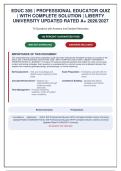
EDUC 305 | PROFESSIONAL EDUCATOR QUIZ
| WITH COMPLETE SOLUTION | LIBERTY
UNIVERSITY UPDATED RATED A+ 2026/2027
79 Questions with Answers and Detailed Rationales
100 PERCENT GUARANTEED PASS
INSTANT DOWNLOAD ANSWERS INCLUDED
IMPORTANCE OF THIS DOCUMENT
This comprehensive examination preparation guide has been meticulously developed to help you succeed in the
EDUC 305 | PROFESSIONAL EDUCATOR QUIZ | WITH COMPLETE SOLUTION | LIBERTY UNIVERSITY
UPDATED RATED A+ 2026/2027. It contains 79 carefully selected questions that reflect the most current exam
content and testing strategies. Each question is accompanied by a correct answer and a detailed rationale that
explains the underlying pathophysiology, pharmacology, or clinical reasoning.
Self-Assessment – Test your knowledge and Exam Preparation – Familiarize yourself with the
identify areas requiring further question format and content
study areas
Concept Reinforcement – Deepen your Confidence Building – Develop test-taking
understanding through strategies and reduce
evidence-based exam anxiety
rationales
Time Management – Practice answering
questions under simulated
exam conditions
Review Summary 79 Questions
Foundations - Application - EDUC 305 Professional Educator WITH Complete Solution Liberty University
Updated Rated A 2026/2027 EDUC 305 Professional Educator WITH Complete Solution Liberty University
Updated Rated A 2026/2027 University
All answers with rationales
,Table of Contents
Content Area Questions Key Topics
Foundations OF 1-14 Teacher, Student, Learning, Instruction, School
Professionalism AND Ethics
Legal AND Ethical 15-28 Teacher, According, Student, Classroom, School
Responsibilities IN Education
Diversity AND Cultural 29-42 Teacher, School, Student, Approach, Wants
Competence
Classroom Management AND 43-56 Teacher, Student, District, Learning, Curriculum
Learning Environment
Instructional Strategies AND 57-70 Teacher, Classroom, School, Education, Notices
Assessment
Communication AND 71-79 School, Model, Teacher, Likely, Student
Collaboration
TOTAL 79 All questions include answers and detailed rationales
,Section A - Foundations OF Professionalism AND Ethics
Q1.
A school district is implementing a multi-tiered system of supports (MTSS) and must
decide which evidence-based reading intervention to adopt for Tier 2. Which approach is
most strongly supported by recent meta-analyses for upper elementary students with
reading difficulties?
A. Whole-class silent reading with periodic B. Explicit, systematic phonics instruction
comprehension checks embedded in small-group settings
C. Computer-based adaptive software used D. Peer-assisted learning strategies with
independently for 20 minutes daily structured partner reading
Correct: B - Explicit, systematic phonics instruction embedded in small-group settings
Rationale:Recent meta-analyses (e.g., Gersten et al., 2020) find that explicit, systematic
instruction in phonics and decoding, delivered in small groups, yields the largest effect sizes
for upper elementary struggling readers. Whole-class silent reading lacks targeted intensity,
adaptive software alone is less effective without teacher guidance, and peer-assisted
learning, while beneficial, is not as consistently effective for foundational decoding.
Why the other answers are wrong:
A. Whole-class silent reading lacks the intensity and explicit focus needed for Tier 2
intervention.
C. Adaptive software alone is insufficient; teacher-led explicit instruction is critical for
foundational skills.
D. Peer-assisted learning is more effective for comprehension than for explicit decoding
instruction.
Reference: Gersten, R., et al. (2020). Assisting Students Struggling with Reading: Response to
Intervention and Multi-Tier Intervention. IES Practice Guide.
Q2.
A teacher notices that a student from a collectivist cultural background consistently
avoids individual praise and prefers group recognition. According to culturally responsive
teaching frameworks, what is the most appropriate interpretation and response?
A. The student may have low self-esteem B. The student's behavior reflects a cultural
and needs individual encouragement to value system where group harmony takes
build confidence. precedence over individual recognition.
C. The student is likely demonstrating a lack D. The student's preference is a sign of
of motivation that requires a behavior social anxiety that should be addressed
intervention plan. through counseling.
Correct: B - The student's behavior reflects a cultural value system where group harmony
Page 3
, Section A - Foundations OF Professionalism AND Ethics
takes precedence over individual recognition.
Rationale:Culturally responsive teaching (Gay, 2018; Ladson-Billings, 2021) emphasizes
understanding that students from collectivist cultures may prioritize group over individual
recognition. The appropriate response is to align instructional practices with that value, such
as using group praise and collaborative goals, rather than pathologizing the behavior.
Why the other answers are wrong:
A. Avoiding individual praise is not necessarily an indicator of low self-esteem; it may reflect
cultural norms.
C. There is no evidence of lack of motivation; the behavior is culturally normative.
D. Social anxiety is a clinical diagnosis; cultural preference for group recognition is not a
disorder.
Reference: Gay, G. (2018). Culturally Responsive Teaching: Theory, Research, and Practice. 3rd ed.
Teachers College Press.
Q3.
An IEP team is developing a transition plan for a student with an intellectual disability.
Under IDEA 2004, which component is legally required to be included in the transition
plan?
A. A guaranteed job placement after B. Measurable post-secondary goals based
graduation on age-appropriate transition assessments
C. A statement of the student's IQ score and D. A list of all available vocational
adaptive behavior profile rehabilitation services in the community
Correct: B - Measurable post-secondary goals based on age-appropriate transition
assessments
Rationale:IDEA 2004 mandates that transition plans include measurable post-secondary
goals in education/training, employment, and independent living (where appropriate), based
on age-appropriate transition assessments. Job placement is not guaranteed, IQ scores are
not required in the plan, and listing services is insufficient without goals.
Why the other answers are wrong:
A. IDEA does not guarantee employment outcomes.
C. IQ scores are not required elements of a transition plan.
D. A list of services is not a substitute for measurable goals.
Reference: Individuals with Disabilities Education Act, 20 U.S.C. § 1414(d)(1)(A)(i)(VIII).
Q4.
A professional learning community (PLC) is analyzing student work to identify common
misconceptions in fraction operations. Which discussion protocol best promotes a focus
on student thinking rather than teacher performance?
Page 4
| WITH COMPLETE SOLUTION | LIBERTY
UNIVERSITY UPDATED RATED A+ 2026/2027
79 Questions with Answers and Detailed Rationales
100 PERCENT GUARANTEED PASS
INSTANT DOWNLOAD ANSWERS INCLUDED
IMPORTANCE OF THIS DOCUMENT
This comprehensive examination preparation guide has been meticulously developed to help you succeed in the
EDUC 305 | PROFESSIONAL EDUCATOR QUIZ | WITH COMPLETE SOLUTION | LIBERTY UNIVERSITY
UPDATED RATED A+ 2026/2027. It contains 79 carefully selected questions that reflect the most current exam
content and testing strategies. Each question is accompanied by a correct answer and a detailed rationale that
explains the underlying pathophysiology, pharmacology, or clinical reasoning.
Self-Assessment – Test your knowledge and Exam Preparation – Familiarize yourself with the
identify areas requiring further question format and content
study areas
Concept Reinforcement – Deepen your Confidence Building – Develop test-taking
understanding through strategies and reduce
evidence-based exam anxiety
rationales
Time Management – Practice answering
questions under simulated
exam conditions
Review Summary 79 Questions
Foundations - Application - EDUC 305 Professional Educator WITH Complete Solution Liberty University
Updated Rated A 2026/2027 EDUC 305 Professional Educator WITH Complete Solution Liberty University
Updated Rated A 2026/2027 University
All answers with rationales
,Table of Contents
Content Area Questions Key Topics
Foundations OF 1-14 Teacher, Student, Learning, Instruction, School
Professionalism AND Ethics
Legal AND Ethical 15-28 Teacher, According, Student, Classroom, School
Responsibilities IN Education
Diversity AND Cultural 29-42 Teacher, School, Student, Approach, Wants
Competence
Classroom Management AND 43-56 Teacher, Student, District, Learning, Curriculum
Learning Environment
Instructional Strategies AND 57-70 Teacher, Classroom, School, Education, Notices
Assessment
Communication AND 71-79 School, Model, Teacher, Likely, Student
Collaboration
TOTAL 79 All questions include answers and detailed rationales
,Section A - Foundations OF Professionalism AND Ethics
Q1.
A school district is implementing a multi-tiered system of supports (MTSS) and must
decide which evidence-based reading intervention to adopt for Tier 2. Which approach is
most strongly supported by recent meta-analyses for upper elementary students with
reading difficulties?
A. Whole-class silent reading with periodic B. Explicit, systematic phonics instruction
comprehension checks embedded in small-group settings
C. Computer-based adaptive software used D. Peer-assisted learning strategies with
independently for 20 minutes daily structured partner reading
Correct: B - Explicit, systematic phonics instruction embedded in small-group settings
Rationale:Recent meta-analyses (e.g., Gersten et al., 2020) find that explicit, systematic
instruction in phonics and decoding, delivered in small groups, yields the largest effect sizes
for upper elementary struggling readers. Whole-class silent reading lacks targeted intensity,
adaptive software alone is less effective without teacher guidance, and peer-assisted
learning, while beneficial, is not as consistently effective for foundational decoding.
Why the other answers are wrong:
A. Whole-class silent reading lacks the intensity and explicit focus needed for Tier 2
intervention.
C. Adaptive software alone is insufficient; teacher-led explicit instruction is critical for
foundational skills.
D. Peer-assisted learning is more effective for comprehension than for explicit decoding
instruction.
Reference: Gersten, R., et al. (2020). Assisting Students Struggling with Reading: Response to
Intervention and Multi-Tier Intervention. IES Practice Guide.
Q2.
A teacher notices that a student from a collectivist cultural background consistently
avoids individual praise and prefers group recognition. According to culturally responsive
teaching frameworks, what is the most appropriate interpretation and response?
A. The student may have low self-esteem B. The student's behavior reflects a cultural
and needs individual encouragement to value system where group harmony takes
build confidence. precedence over individual recognition.
C. The student is likely demonstrating a lack D. The student's preference is a sign of
of motivation that requires a behavior social anxiety that should be addressed
intervention plan. through counseling.
Correct: B - The student's behavior reflects a cultural value system where group harmony
Page 3
, Section A - Foundations OF Professionalism AND Ethics
takes precedence over individual recognition.
Rationale:Culturally responsive teaching (Gay, 2018; Ladson-Billings, 2021) emphasizes
understanding that students from collectivist cultures may prioritize group over individual
recognition. The appropriate response is to align instructional practices with that value, such
as using group praise and collaborative goals, rather than pathologizing the behavior.
Why the other answers are wrong:
A. Avoiding individual praise is not necessarily an indicator of low self-esteem; it may reflect
cultural norms.
C. There is no evidence of lack of motivation; the behavior is culturally normative.
D. Social anxiety is a clinical diagnosis; cultural preference for group recognition is not a
disorder.
Reference: Gay, G. (2018). Culturally Responsive Teaching: Theory, Research, and Practice. 3rd ed.
Teachers College Press.
Q3.
An IEP team is developing a transition plan for a student with an intellectual disability.
Under IDEA 2004, which component is legally required to be included in the transition
plan?
A. A guaranteed job placement after B. Measurable post-secondary goals based
graduation on age-appropriate transition assessments
C. A statement of the student's IQ score and D. A list of all available vocational
adaptive behavior profile rehabilitation services in the community
Correct: B - Measurable post-secondary goals based on age-appropriate transition
assessments
Rationale:IDEA 2004 mandates that transition plans include measurable post-secondary
goals in education/training, employment, and independent living (where appropriate), based
on age-appropriate transition assessments. Job placement is not guaranteed, IQ scores are
not required in the plan, and listing services is insufficient without goals.
Why the other answers are wrong:
A. IDEA does not guarantee employment outcomes.
C. IQ scores are not required elements of a transition plan.
D. A list of services is not a substitute for measurable goals.
Reference: Individuals with Disabilities Education Act, 20 U.S.C. § 1414(d)(1)(A)(i)(VIII).
Q4.
A professional learning community (PLC) is analyzing student work to identify common
misconceptions in fraction operations. Which discussion protocol best promotes a focus
on student thinking rather than teacher performance?
Page 4

