
Georgette Review PMHNP - 388 Questions with Complete Solutions 2026/2027
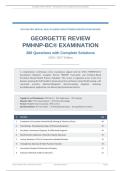
PSYCHIATRIC MENTAL HEALTH NURSE PRACTITIONER CERTIFICATION REVIEW
GEORGETTE REVIEW
PMHNP-BC® EXAMINATION
388 Questions with Complete Solutions
Edition
A comprehensive certification review examination aligned with the ANCC PMHNP-BC®
Examination Blueprint, Georgette Review PMHNP Curriculum, and Evidence-Based
Psychiatric Mental Health Practice Standards. This review is organized across twelve (12)
domains spanning the full breadth of advanced practice psychiatric-mental health nursing, with
case-based scenarios, pharmacotherapeutic decision-making, diagnostic reasoning,
psychotherapeutic applications, and ethical-legal professional practice.
Cognitive Level Distribution: 20% Recall | 50% Application | 30% Analysis
Question Style: 75% Scenario-Based | 25% Direct Knowledge
Format: Multiple Choice (4 options, ONE correct)
Special Inclusions: 40 Case Studies | 50 Psychopharmacology | 20 Legal/Ethical Scenarios
# Section Qs
1 Foundations of Psychiatric Mental Health Nursing & Theoretical Fram... 40
2 Neurobiology, Psychopharmacology, & Pharmacotherapeutics 50
3 Psychiatric Assessment, Diagnosis, & Differential Diagnosis 45
4 Mood Disorders (Depressive Disorders, Bipolar Spectrum) 35
5 Anxiety Disorders, OCD, & Trauma/Stress-Related Disorders 35
6 Schizophrenia Spectrum & Other Psychotic Disorders 30
7 Personality Disorders & Dissociative Disorders 25
8 Substance-Related & Addictive Disorders 25
ANCC PMHNP-BC Examination Review Georgette Review Page 1
, Georgette Review PMHNP - 388 Questions with Complete Solutions 2026/2027
9 Neurocognitive Disorders, Eating Disorders, & Somatic Symptom Disor... 25
10 Child, Adolescent, & Geriatric Mental Health 30
11 Psychotherapy, Therapeutic Modalities, & Crisis Intervention 20
12 Professional Practice, Ethics, Law, & Healthcare Systems 28
TOTAL 388
Aligned with ANCC PMHNP-BC® Examination Blueprint • Georgette Review PMHNP Curriculum • DSM-5-TR •
Evidence-Based Psychiatric Practice Standards
ANCC PMHNP-BC Examination Review Georgette Review Page 2
, Georgette Review PMHNP - 388 Questions with Complete Solutions 2026/2027
Section 1: Foundations of Psychiatric Mental Health Nursing &
Theoretical Frameworks (Q1 - Q40)
Q1: A PMHNP is developing a treatment plan for a patient with recurrent major depressive disorder.
The patient's symptoms include anhedonia, psychomotor retardation, and a significant interpersonal
loss six months ago. Which theoretical framework best explains the interplay of biological
vulnerability, psychological distress, and social context in this patient's presentation?
A. Biomedical model focusing exclusively on neurotransmitter dysfunction
B. Biopsychosocial model integrating biological, psychological, and social factors *[CORRECT]
C. Psychodynamic model emphasizing unconscious conflicts from early childhood
D. Cognitive-behavioral model targeting distorted thought patterns only
Correct Answer: B
Rationale: The biopsychosocial model, articulated by Engel (1977), integrates biological vulnerability (e.g.,
neurotransmitter dysregulation), psychological factors (e.g., grief, cognitive appraisal), and social context (e.g.,
interpersonal loss, support systems). The Georgette Review PMHNP curriculum and ANCC PMHNP-BC blueprint
emphasize this model as foundational to holistic psychiatric care. The biomedical model is reductionist; psychodynamic
and cognitive-behavioral models address only one dimension of the patient's experience.
Q2: A 32-year-old patient states, "I keep thinking I'm worthless because my father told me so when I
was a child." Which theoretical framework best explains this patient's belief system as an internalized
representation influencing current self-perception?
A. Object relations theory (Mahler, Kernberg) *[CORRECT]
B. Behavioral conditioning theory (Skinner)
C. Humanistic self-actualization theory (Maslow)
D. Biological neurotransmitter theory
Correct Answer: A
Rationale: Object relations theory (Mahler, Kernberg, Winnicott) posits that early relationships with caregivers are
internalized as mental representations ('objects') that shape later self-concept and interpersonal functioning. The patient
has internalized a punitive 'object' (father) that distorts self-worth. Behavioral theory focuses on observable
conditioning, humanistic theory emphasizes growth potential, and biological theory addresses neurochemistry — none of
which explains the internalized representational dynamic described.
Q3: A PMHNP employs Peplau's Theory of Interpersonal Relations when working with a newly
admitted patient experiencing acute mania. Which phase of the therapeutic relationship is
characterized by the patient testing the PMHNP's trustworthiness and boundaries?
A. Orientation phase *[CORRECT]
B. Identification phase
C. Exploitation phase
D. Resolution phase
Correct Answer: A
Rationale: In Peplau's Interpersonal Relations theory, the orientation phase is the initial stage where the patient tests the
nurse's trustworthiness, establishes rapport, and defines the problem. The identification phase follows, where the patient
identifies with the nurse and clarifies expectations. The exploitation phase involves active use of services for goal
attainment, and the resolution phase ends the relationship as needs are met. ANCC-aligned PMHNP education requires
ANCC PMHNP-BC Examination Review Georgette Review Page 3
, Georgette Review PMHNP - 388 Questions with Complete Solutions 2026/2027
mastery of these phases for therapeutic alliance building.
Q4: When applying Beck's cognitive triad to a patient with major depressive disorder, the PMHNP
assesses which three components?
A. Negative views about oneself, the world, and the future *[CORRECT]
B. Id, ego, and superego functioning
C. Past, present, and anticipated stressors
D. Biological, psychological, and social risk factors
Correct Answer: A
Rationale: Aaron Beck's cognitive triad in depression comprises negative schemas about (1) oneself ('I am worthless'),
(2) the world ('The world is unfair and harsh'), and (3) the future ('Nothing will ever improve'). These automatic
cognitions maintain depressive affect and are primary targets of cognitive-behavioral therapy (CBT). The
id/ego/superego is Freud's structural model; past/present/future stressors and biopsychosocial factors are useful
framings but are not Beck's triad.
Q5: A patient with borderline personality disorder repeatedly engages in self-injury after perceived
abandonment. From a dialectical behavior therapy (DBT) perspective, which biosocial theory concept
best explains the etiology of this patient's emotion dysregulation?
A. Invalidating environment interacting with biological emotional vulnerability *[CORRECT]
B. Classical conditioning of self-injurious behavior
C. Excess dopamine in the mesolimbic pathway
D. Unresolved Oedipal complex from childhood
Correct Answer: A
Rationale: Linehan's biosocial theory posits that borderline personality disorder arises from the transaction between a
biological predisposition toward emotional vulnerability (high sensitivity, high reactivity, slow return to baseline) and an
invalidating environment (where emotional experiences are dismissed, punished, or trivialized). This combination
impairs emotion regulation skills. Conditioning, dopamine dysregulation, and Oedipal conflict do not capture the
transactional etiology central to DBT theory and the Georgette PMHNP curriculum.
Q6: A PMHNP is utilizing Hildegard Peplau's therapeutic communication principles. Which nurse
response best demonstrates the technique of 'clarification'?
A. "You seem upset today."
B. I'm not sure I understand. Could you tell me more about what you mean by 'the walls are closing
in'?" *[CORRECT]
C. I can see this has been very difficult for you.
D. What I'm hearing is that you're feeling hopeless about your situation."
Correct Answer: B
Rationale: Clarification is a Peplau-aligned therapeutic communication technique used when the message is ambiguous,
vague, or contradictory; the nurse asks the patient to elaborate or restate to ensure accurate understanding. Option B
explicitly requests further explanation of an unclear phrase. Option A is interpreting/observing, Option C is reflecting,
and Option D is paraphrasing/restating — all useful but distinct techniques. The ANCC blueprint and Georgette Review
emphasize precise use of these techniques in clinical practice.
ANCC PMHNP-BC Examination Review Georgette Review Page 4
PSYCHIATRIC MENTAL HEALTH NURSE PRACTITIONER CERTIFICATION REVIEW
GEORGETTE REVIEW
PMHNP-BC® EXAMINATION
388 Questions with Complete Solutions
Edition
A comprehensive certification review examination aligned with the ANCC PMHNP-BC®
Examination Blueprint, Georgette Review PMHNP Curriculum, and Evidence-Based
Psychiatric Mental Health Practice Standards. This review is organized across twelve (12)
domains spanning the full breadth of advanced practice psychiatric-mental health nursing, with
case-based scenarios, pharmacotherapeutic decision-making, diagnostic reasoning,
psychotherapeutic applications, and ethical-legal professional practice.
Cognitive Level Distribution: 20% Recall | 50% Application | 30% Analysis
Question Style: 75% Scenario-Based | 25% Direct Knowledge
Format: Multiple Choice (4 options, ONE correct)
Special Inclusions: 40 Case Studies | 50 Psychopharmacology | 20 Legal/Ethical Scenarios
# Section Qs
1 Foundations of Psychiatric Mental Health Nursing & Theoretical Fram... 40
2 Neurobiology, Psychopharmacology, & Pharmacotherapeutics 50
3 Psychiatric Assessment, Diagnosis, & Differential Diagnosis 45
4 Mood Disorders (Depressive Disorders, Bipolar Spectrum) 35
5 Anxiety Disorders, OCD, & Trauma/Stress-Related Disorders 35
6 Schizophrenia Spectrum & Other Psychotic Disorders 30
7 Personality Disorders & Dissociative Disorders 25
8 Substance-Related & Addictive Disorders 25
ANCC PMHNP-BC Examination Review Georgette Review Page 1
, Georgette Review PMHNP - 388 Questions with Complete Solutions 2026/2027
9 Neurocognitive Disorders, Eating Disorders, & Somatic Symptom Disor... 25
10 Child, Adolescent, & Geriatric Mental Health 30
11 Psychotherapy, Therapeutic Modalities, & Crisis Intervention 20
12 Professional Practice, Ethics, Law, & Healthcare Systems 28
TOTAL 388
Aligned with ANCC PMHNP-BC® Examination Blueprint • Georgette Review PMHNP Curriculum • DSM-5-TR •
Evidence-Based Psychiatric Practice Standards
ANCC PMHNP-BC Examination Review Georgette Review Page 2
, Georgette Review PMHNP - 388 Questions with Complete Solutions 2026/2027
Section 1: Foundations of Psychiatric Mental Health Nursing &
Theoretical Frameworks (Q1 - Q40)
Q1: A PMHNP is developing a treatment plan for a patient with recurrent major depressive disorder.
The patient's symptoms include anhedonia, psychomotor retardation, and a significant interpersonal
loss six months ago. Which theoretical framework best explains the interplay of biological
vulnerability, psychological distress, and social context in this patient's presentation?
A. Biomedical model focusing exclusively on neurotransmitter dysfunction
B. Biopsychosocial model integrating biological, psychological, and social factors *[CORRECT]
C. Psychodynamic model emphasizing unconscious conflicts from early childhood
D. Cognitive-behavioral model targeting distorted thought patterns only
Correct Answer: B
Rationale: The biopsychosocial model, articulated by Engel (1977), integrates biological vulnerability (e.g.,
neurotransmitter dysregulation), psychological factors (e.g., grief, cognitive appraisal), and social context (e.g.,
interpersonal loss, support systems). The Georgette Review PMHNP curriculum and ANCC PMHNP-BC blueprint
emphasize this model as foundational to holistic psychiatric care. The biomedical model is reductionist; psychodynamic
and cognitive-behavioral models address only one dimension of the patient's experience.
Q2: A 32-year-old patient states, "I keep thinking I'm worthless because my father told me so when I
was a child." Which theoretical framework best explains this patient's belief system as an internalized
representation influencing current self-perception?
A. Object relations theory (Mahler, Kernberg) *[CORRECT]
B. Behavioral conditioning theory (Skinner)
C. Humanistic self-actualization theory (Maslow)
D. Biological neurotransmitter theory
Correct Answer: A
Rationale: Object relations theory (Mahler, Kernberg, Winnicott) posits that early relationships with caregivers are
internalized as mental representations ('objects') that shape later self-concept and interpersonal functioning. The patient
has internalized a punitive 'object' (father) that distorts self-worth. Behavioral theory focuses on observable
conditioning, humanistic theory emphasizes growth potential, and biological theory addresses neurochemistry — none of
which explains the internalized representational dynamic described.
Q3: A PMHNP employs Peplau's Theory of Interpersonal Relations when working with a newly
admitted patient experiencing acute mania. Which phase of the therapeutic relationship is
characterized by the patient testing the PMHNP's trustworthiness and boundaries?
A. Orientation phase *[CORRECT]
B. Identification phase
C. Exploitation phase
D. Resolution phase
Correct Answer: A
Rationale: In Peplau's Interpersonal Relations theory, the orientation phase is the initial stage where the patient tests the
nurse's trustworthiness, establishes rapport, and defines the problem. The identification phase follows, where the patient
identifies with the nurse and clarifies expectations. The exploitation phase involves active use of services for goal
attainment, and the resolution phase ends the relationship as needs are met. ANCC-aligned PMHNP education requires
ANCC PMHNP-BC Examination Review Georgette Review Page 3
, Georgette Review PMHNP - 388 Questions with Complete Solutions 2026/2027
mastery of these phases for therapeutic alliance building.
Q4: When applying Beck's cognitive triad to a patient with major depressive disorder, the PMHNP
assesses which three components?
A. Negative views about oneself, the world, and the future *[CORRECT]
B. Id, ego, and superego functioning
C. Past, present, and anticipated stressors
D. Biological, psychological, and social risk factors
Correct Answer: A
Rationale: Aaron Beck's cognitive triad in depression comprises negative schemas about (1) oneself ('I am worthless'),
(2) the world ('The world is unfair and harsh'), and (3) the future ('Nothing will ever improve'). These automatic
cognitions maintain depressive affect and are primary targets of cognitive-behavioral therapy (CBT). The
id/ego/superego is Freud's structural model; past/present/future stressors and biopsychosocial factors are useful
framings but are not Beck's triad.
Q5: A patient with borderline personality disorder repeatedly engages in self-injury after perceived
abandonment. From a dialectical behavior therapy (DBT) perspective, which biosocial theory concept
best explains the etiology of this patient's emotion dysregulation?
A. Invalidating environment interacting with biological emotional vulnerability *[CORRECT]
B. Classical conditioning of self-injurious behavior
C. Excess dopamine in the mesolimbic pathway
D. Unresolved Oedipal complex from childhood
Correct Answer: A
Rationale: Linehan's biosocial theory posits that borderline personality disorder arises from the transaction between a
biological predisposition toward emotional vulnerability (high sensitivity, high reactivity, slow return to baseline) and an
invalidating environment (where emotional experiences are dismissed, punished, or trivialized). This combination
impairs emotion regulation skills. Conditioning, dopamine dysregulation, and Oedipal conflict do not capture the
transactional etiology central to DBT theory and the Georgette PMHNP curriculum.
Q6: A PMHNP is utilizing Hildegard Peplau's therapeutic communication principles. Which nurse
response best demonstrates the technique of 'clarification'?
A. "You seem upset today."
B. I'm not sure I understand. Could you tell me more about what you mean by 'the walls are closing
in'?" *[CORRECT]
C. I can see this has been very difficult for you.
D. What I'm hearing is that you're feeling hopeless about your situation."
Correct Answer: B
Rationale: Clarification is a Peplau-aligned therapeutic communication technique used when the message is ambiguous,
vague, or contradictory; the nurse asks the patient to elaborate or restate to ensure accurate understanding. Option B
explicitly requests further explanation of an unclear phrase. Option A is interpreting/observing, Option C is reflecting,
and Option D is paraphrasing/restating — all useful but distinct techniques. The ANCC blueprint and Georgette Review
emphasize precise use of these techniques in clinical practice.
ANCC PMHNP-BC Examination Review Georgette Review Page 4

