
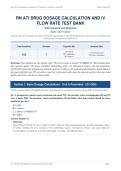
RN ATI Drug Dosage Calculation & IV Flow Rate Test Bank | 2026/2027 Edition 2026/2027
RN ATI DRUG DOSAGE CALCULATION AND IV
FLOW RATE TEST BANK
With Answers and Rationale
Edition
Aligned with the ATI Dosage Calculation Proctored Exam Blueprint, NCLEX-RN Medication Administration Standards, and
Nursing Math Competencies (2026/2027)
Total Questions Sections Cognitive Mix Question Style
20% Recall
70% Scenario-based
60% Application
150 7 20% Analysis
30% Direct calculation
Directions: Each question has four options (A-D). The correct option is marked *[CORRECT]*. The rationale below
each question applies ATI dosage calculation methodology (D/H x Q, dimensional analysis, and ratio-proportion),
NCLEX-RN medication administration standards, and the six rights of safe medication administration. Round tablets to
the nearest half tablet per ATI convention; round mL to the nearest tenth unless the question specifies otherwise; round
gtt/min and mL/hr to the nearest whole number.
Section 1: Basic Dosage Calculations - Oral & Parenteral (Q1-Q30)
Tablets, capsules, liquids, IM/SubQ/ID injections, metric-apothecary-household conversions, and the D/H x Q formula method.
Q1: A postoperative patient reports incisional pain rated 7/10. The provider orders acetaminophen 650 mg PO
every 6 hours PRN. The pharmacy stocks acetaminophen 325 mg tablets. How many tablets should the nurse
administer per dose?
A. 1 tablet
B. 1.5 tablets
C. 2 tablets *[CORRECT]*
D. 3 tablets
Correct Answer: C
Rationale:
Using D/H x Q: 650 mg / 325 mg x 1 tablet = 2 tablets. Option A reflects administering only one tablet (underdose); option
D reflects doubling the dose (overdose). ATI methodology requires verifying the 24-hour total stays within the
acetaminophen safe maximum of 4 g/day; 650 mg q6h = 2.6 g/day, well within the limit.
ATI / NCLEX-RN Aligned | Answers & Rationale Provided Page 1
,RN ATI Drug Dosage Calculation & IV Flow Rate Test Bank | 2026/2027 Edition 2026/2027
Q2: A provider orders amoxicillin 500 mg PO. The pharmacy supplies amoxicillin oral suspension 250 mg/5 mL.
How many mL should the nurse draw up in the oral syringe?
A. 5 mL
B. 10 mL *[CORRECT]*
C. 2.5 mL
D. 15 mL
Correct Answer: B
Rationale:
D/H x Q = 500 mg / 250 mg x 5 mL = 10 mL. Option A is the volume per 250 mg dose (underdose), option C reverses the
ratio (250/500 x 5 = 2.5), and option D doubles the calculation. Per ATI oral-liquid convention, mL answers are rounded to
the nearest tenth; here 10 mL is exact.
Q3: An 82-year-old patient with atrial fibrillation and heart failure is prescribed digoxin 0.25 mg PO daily. The
pharmacy stocks digoxin 0.125 mg tablets. How many tablets should the nurse administer?
A. 0.5 tablet
B. 1 tablet
C. 1.5 tablets
D. 2 tablets *[CORRECT]*
Correct Answer: D
Rationale:
D/H x Q = 0.25 mg / 0.125 mg x 1 tablet = 2 tablets. Option A halves the dose (common error when confusing 0.125 with
0.25), option B is one tablet (a 50% underdose), and option C reflects an arithmetical rounding error. Because digoxin has a
narrow therapeutic index, the nurse must also assess apical pulse for 1 full minute and hold the dose if HR < 60 bpm.
Q4: A patient with congestive heart failure is prescribed furosemide 40 mg PO daily. The medication is available
as 20 mg tablets. How many tablets should the nurse administer?
A. 0.5 tablet
B. 1 tablet
C. 2 tablets *[CORRECT]*
D. 4 tablets
Correct Answer: C
Rationale:
D/H x Q = 40 mg / 20 mg x 1 tablet = 2 tablets. Option A reverses the ratio (20/40), option B is one tablet (underdose), and
option D quadruples the dose. The nurse should also plan to monitor daily weights, intake and output, and serum potassium,
because furosemide is a loop diuretic that wastes potassium.
ATI / NCLEX-RN Aligned | Answers & Rationale Provided Page 2
,RN ATI Drug Dosage Calculation & IV Flow Rate Test Bank | 2026/2027 Edition 2026/2027
Q5: A provider orders levothyroxine 0.075 mg PO daily. The medication is available as 25 mcg tablets. How
many tablets should the nurse administer?
A. 1 tablet
B. 2 tablets
C. 3 tablets *[CORRECT]*
D. 4 tablets
Correct Answer: C
Rationale:
First convert the order to mcg: 0.075 mg x 1000 mcg/mg = 75 mcg. Then D/H x Q = 75 mcg / 25 mcg x 1 tablet = 3 tablets.
Options A and B reflect failure to convert mg to mcg (a high-alert conversion error), and option D overestimates the dose.
ATI reinforces that the dose ordered and the dose on hand must be in the same unit before the formula is applied.
Q6: A provider orders metformin 1 g PO daily with the evening meal. The medication is supplied as 500 mg
tablets. How many tablets should the nurse administer?
A. 0.5 tablet
B. 1 tablet
C. 5 tablets
D. 2 tablets *[CORRECT]*
Correct Answer: D
Rationale:
Convert 1 g to 1000 mg, then D/H x Q = 1000 mg / 500 mg x 1 tablet = 2 tablets. Option A reflects reversing the ratio,
option B underdoses by half, and option C confuses grams with milligrams (1 g is not 5000 mg). Per ATI, conversions
between metric units must be performed before the formula is applied.
Q7: A patient on warfarin therapy is prescribed 7.5 mg PO daily. The medication is available as 5 mg scored
tablets. How many tablets should the nurse administer?
A. 1 tablet
B. 1.5 tablets *[CORRECT]*
C. 2 tablets
D. 0.5 tablet
Correct Answer: B
Rationale:
D/H x Q = 7.5 mg / 5 mg x 1 tablet = 1.5 tablets. ATI permits tablet doses to the nearest half tablet when tablets are scored;
option A underdoses, option C exceeds the order, and option D halves the dose. Warfarin requires a double-check of the
INR before administration and patient education on bleeding precautions.
ATI / NCLEX-RN Aligned | Answers & Rationale Provided Page 3
, RN ATI Drug Dosage Calculation & IV Flow Rate Test Bank | 2026/2027 Edition 2026/2027
Q8: A postoperative patient reports pain rated 8/10. The provider orders morphine 4 mg IM q4h PRN. The
medication is available as 10 mg/mL. How many mL should the nurse draw up?
A. 0.2 mL
B. 0.4 mL *[CORRECT]*
C. 0.5 mL
D. 1 mL
Correct Answer: B
Rationale:
D/H x Q = 4 mg / 10 mg x 1 mL = 0.4 mL. Option A reverses the ratio (4/10 confused with 1/5), option C reflects
rounding up to the nearest 0.5 mL (a rounding error), and option D is the volume for 10 mg (a 150% overdose). For IM
morphine, the nurse should rotate injection sites and monitor respiratory status.
Q9: A provider orders lorazepam 2 mg IM for preoperative sedation. The medication is available as 4 mg/mL.
How many mL should the nurse administer?
A. 0.25 mL
B. 1 mL
C. 0.5 mL *[CORRECT]*
D. 2 mL
Correct Answer: C
Rationale:
D/H x Q = 2 mg / 4 mg x 1 mL = 0.5 mL. Option A halves the dose again (2/4 confused with 1/4), option B is the volume
per 4 mg, and option D doubles the order. Per ATI, when the dose on hand exceeds the dose ordered, the volume
administered must be less than 1 mL.
Q10: A provider orders ketorolac 30 mg IM for acute pain. The medication is available as 15 mg/mL. How many
mL should the nurse administer?
A. 2 mL *[CORRECT]*
B. 1 mL
C. 1.5 mL
D. 3 mL
Correct Answer: A
Rationale:
D/H x Q = 30 mg / 15 mg x 1 mL = 2 mL. Option B underdoses (15 mg), option C reflects an arithmetic error (30/15 = 1.5
misread), and option D doubles the dose. Ketorolac is restricted to short-term (<=5 days) use due to GI bleeding and renal
toxicity risks.
ATI / NCLEX-RN Aligned | Answers & Rationale Provided Page 4
RN ATI DRUG DOSAGE CALCULATION AND IV
FLOW RATE TEST BANK
With Answers and Rationale
Edition
Aligned with the ATI Dosage Calculation Proctored Exam Blueprint, NCLEX-RN Medication Administration Standards, and
Nursing Math Competencies (2026/2027)
Total Questions Sections Cognitive Mix Question Style
20% Recall
70% Scenario-based
60% Application
150 7 20% Analysis
30% Direct calculation
Directions: Each question has four options (A-D). The correct option is marked *[CORRECT]*. The rationale below
each question applies ATI dosage calculation methodology (D/H x Q, dimensional analysis, and ratio-proportion),
NCLEX-RN medication administration standards, and the six rights of safe medication administration. Round tablets to
the nearest half tablet per ATI convention; round mL to the nearest tenth unless the question specifies otherwise; round
gtt/min and mL/hr to the nearest whole number.
Section 1: Basic Dosage Calculations - Oral & Parenteral (Q1-Q30)
Tablets, capsules, liquids, IM/SubQ/ID injections, metric-apothecary-household conversions, and the D/H x Q formula method.
Q1: A postoperative patient reports incisional pain rated 7/10. The provider orders acetaminophen 650 mg PO
every 6 hours PRN. The pharmacy stocks acetaminophen 325 mg tablets. How many tablets should the nurse
administer per dose?
A. 1 tablet
B. 1.5 tablets
C. 2 tablets *[CORRECT]*
D. 3 tablets
Correct Answer: C
Rationale:
Using D/H x Q: 650 mg / 325 mg x 1 tablet = 2 tablets. Option A reflects administering only one tablet (underdose); option
D reflects doubling the dose (overdose). ATI methodology requires verifying the 24-hour total stays within the
acetaminophen safe maximum of 4 g/day; 650 mg q6h = 2.6 g/day, well within the limit.
ATI / NCLEX-RN Aligned | Answers & Rationale Provided Page 1
,RN ATI Drug Dosage Calculation & IV Flow Rate Test Bank | 2026/2027 Edition 2026/2027
Q2: A provider orders amoxicillin 500 mg PO. The pharmacy supplies amoxicillin oral suspension 250 mg/5 mL.
How many mL should the nurse draw up in the oral syringe?
A. 5 mL
B. 10 mL *[CORRECT]*
C. 2.5 mL
D. 15 mL
Correct Answer: B
Rationale:
D/H x Q = 500 mg / 250 mg x 5 mL = 10 mL. Option A is the volume per 250 mg dose (underdose), option C reverses the
ratio (250/500 x 5 = 2.5), and option D doubles the calculation. Per ATI oral-liquid convention, mL answers are rounded to
the nearest tenth; here 10 mL is exact.
Q3: An 82-year-old patient with atrial fibrillation and heart failure is prescribed digoxin 0.25 mg PO daily. The
pharmacy stocks digoxin 0.125 mg tablets. How many tablets should the nurse administer?
A. 0.5 tablet
B. 1 tablet
C. 1.5 tablets
D. 2 tablets *[CORRECT]*
Correct Answer: D
Rationale:
D/H x Q = 0.25 mg / 0.125 mg x 1 tablet = 2 tablets. Option A halves the dose (common error when confusing 0.125 with
0.25), option B is one tablet (a 50% underdose), and option C reflects an arithmetical rounding error. Because digoxin has a
narrow therapeutic index, the nurse must also assess apical pulse for 1 full minute and hold the dose if HR < 60 bpm.
Q4: A patient with congestive heart failure is prescribed furosemide 40 mg PO daily. The medication is available
as 20 mg tablets. How many tablets should the nurse administer?
A. 0.5 tablet
B. 1 tablet
C. 2 tablets *[CORRECT]*
D. 4 tablets
Correct Answer: C
Rationale:
D/H x Q = 40 mg / 20 mg x 1 tablet = 2 tablets. Option A reverses the ratio (20/40), option B is one tablet (underdose), and
option D quadruples the dose. The nurse should also plan to monitor daily weights, intake and output, and serum potassium,
because furosemide is a loop diuretic that wastes potassium.
ATI / NCLEX-RN Aligned | Answers & Rationale Provided Page 2
,RN ATI Drug Dosage Calculation & IV Flow Rate Test Bank | 2026/2027 Edition 2026/2027
Q5: A provider orders levothyroxine 0.075 mg PO daily. The medication is available as 25 mcg tablets. How
many tablets should the nurse administer?
A. 1 tablet
B. 2 tablets
C. 3 tablets *[CORRECT]*
D. 4 tablets
Correct Answer: C
Rationale:
First convert the order to mcg: 0.075 mg x 1000 mcg/mg = 75 mcg. Then D/H x Q = 75 mcg / 25 mcg x 1 tablet = 3 tablets.
Options A and B reflect failure to convert mg to mcg (a high-alert conversion error), and option D overestimates the dose.
ATI reinforces that the dose ordered and the dose on hand must be in the same unit before the formula is applied.
Q6: A provider orders metformin 1 g PO daily with the evening meal. The medication is supplied as 500 mg
tablets. How many tablets should the nurse administer?
A. 0.5 tablet
B. 1 tablet
C. 5 tablets
D. 2 tablets *[CORRECT]*
Correct Answer: D
Rationale:
Convert 1 g to 1000 mg, then D/H x Q = 1000 mg / 500 mg x 1 tablet = 2 tablets. Option A reflects reversing the ratio,
option B underdoses by half, and option C confuses grams with milligrams (1 g is not 5000 mg). Per ATI, conversions
between metric units must be performed before the formula is applied.
Q7: A patient on warfarin therapy is prescribed 7.5 mg PO daily. The medication is available as 5 mg scored
tablets. How many tablets should the nurse administer?
A. 1 tablet
B. 1.5 tablets *[CORRECT]*
C. 2 tablets
D. 0.5 tablet
Correct Answer: B
Rationale:
D/H x Q = 7.5 mg / 5 mg x 1 tablet = 1.5 tablets. ATI permits tablet doses to the nearest half tablet when tablets are scored;
option A underdoses, option C exceeds the order, and option D halves the dose. Warfarin requires a double-check of the
INR before administration and patient education on bleeding precautions.
ATI / NCLEX-RN Aligned | Answers & Rationale Provided Page 3
, RN ATI Drug Dosage Calculation & IV Flow Rate Test Bank | 2026/2027 Edition 2026/2027
Q8: A postoperative patient reports pain rated 8/10. The provider orders morphine 4 mg IM q4h PRN. The
medication is available as 10 mg/mL. How many mL should the nurse draw up?
A. 0.2 mL
B. 0.4 mL *[CORRECT]*
C. 0.5 mL
D. 1 mL
Correct Answer: B
Rationale:
D/H x Q = 4 mg / 10 mg x 1 mL = 0.4 mL. Option A reverses the ratio (4/10 confused with 1/5), option C reflects
rounding up to the nearest 0.5 mL (a rounding error), and option D is the volume for 10 mg (a 150% overdose). For IM
morphine, the nurse should rotate injection sites and monitor respiratory status.
Q9: A provider orders lorazepam 2 mg IM for preoperative sedation. The medication is available as 4 mg/mL.
How many mL should the nurse administer?
A. 0.25 mL
B. 1 mL
C. 0.5 mL *[CORRECT]*
D. 2 mL
Correct Answer: C
Rationale:
D/H x Q = 2 mg / 4 mg x 1 mL = 0.5 mL. Option A halves the dose again (2/4 confused with 1/4), option B is the volume
per 4 mg, and option D doubles the order. Per ATI, when the dose on hand exceeds the dose ordered, the volume
administered must be less than 1 mL.
Q10: A provider orders ketorolac 30 mg IM for acute pain. The medication is available as 15 mg/mL. How many
mL should the nurse administer?
A. 2 mL *[CORRECT]*
B. 1 mL
C. 1.5 mL
D. 3 mL
Correct Answer: A
Rationale:
D/H x Q = 30 mg / 15 mg x 1 mL = 2 mL. Option B underdoses (15 mg), option C reflects an arithmetic error (30/15 = 1.5
misread), and option D doubles the dose. Ketorolac is restricted to short-term (<=5 days) use due to GI bleeding and renal
toxicity risks.
ATI / NCLEX-RN Aligned | Answers & Rationale Provided Page 4

