
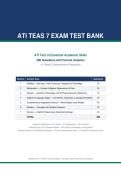
ATI TEAS 7 EXAM TEST BANK
()
ATI Test of Essential Academic Skills
300 Questions with Correct Answers
A+ Rated Comprehensive Preparation
Section Content Area Questions
1 Reading — Key Ideas, Craft & Structure, Integration of Knowledge 50
2 Mathematics — Number & Algebra, Measurement & Data 50
3 Science — Anatomy & Physiology, Life & Physical Sciences, Reasoning 75
4 English & Language Usage — Conventions, Vocabulary, Language Knowledge 40
5 Comprehensive Integrated Scenarios — Mixed Subject Case Studies 45
6 Reading — Passages with Multiple Questions 20
7 Science — Scientific Reasoning & Experimental Design 20
TOTAL 300
Cognitive Distribution: 25% Recall · 45% Application · 30% Analysis
Question Style: 60% Scenario-Based · 40% Direct Knowledge & Computation
Special Inclusions: 20 Reading Passages · 15 Data Interpretation Items · 10 Scientific Reasoning Items
Aligned with ATI TEAS 7 Exam Blueprint • Nursing Program Admission Standards
, About This Test Bank
This comprehensive ATI TEAS 7 Exam Test Bank has been constructed to align with the official ATI TEAS 7
Exam Blueprint and the academic standards expected of candidates seeking admission to nursing and allied
health programs. The test bank contains exactly 300 multiple-choice questions distributed across seven
sections that mirror the structure and cognitive demands of the actual examination. Each question is
accompanied by the correct answer and a concise rationale that explains both why the chosen option is correct
and why the remaining distractors reflect common misconceptions.
The cognitive distribution approximates the blueprint target of 25 percent recall, 45 percent application, and 30
percent analysis. Approximately 60 percent of items are scenario-based, requiring candidates to interpret
passages, data sets, experimental setups, and real-world healthcare contexts; the remaining 40 percent assess
direct knowledge and computation. Distractors are deliberately constructed from the most frequently observed
student errors in reading comprehension, mathematical computation, scientific reasoning, and English
conventions, providing an authentic rehearsal of the challenges encountered on test day.
Candidates are encouraged to work through the test bank in timed conditions, reviewing the rationale for every
item — including those answered correctly — to consolidate understanding of the underlying academic
standards and to identify recurring error patterns. Repeated exposure to scenario-based items strengthens the
integration of knowledge across reading, mathematics, science, and English that the ATI TEAS 7 examination
is designed to measure.
Section 1: Reading — Key Ideas, Craft & Structure, Integration of
Knowledge
This section assesses the candidate's ability to identify main ideas and supporting details, analyze an author's
purpose and tone, recognize text structure, draw logical inferences, distinguish primary from secondary
sources, evaluate arguments and bias, and determine vocabulary meaning from context. Items align with the
ATI TEAS 7 Reading blueprint and reflect both informational and literary passages.
Q1: A paragraph about the discovery of penicillin describes how Alexander Fleming noticed a
mold inhibiting bacterial growth on a contaminated petri dish, traces the subsequent isolation of
penicillin by Florey and Chain, and outlines the drug's role in reducing wartime infection mortality.
Which statement best expresses the main idea?
A. Alexander Fleming was the most important scientist of the twentieth century.
B. The accidental discovery and subsequent development of penicillin transformed the
treatment of bacterial infections. *[CORRECT]*
C. Mold can grow on petri dishes if laboratory conditions are not carefully controlled.
D. Florey and Chain deserve more recognition than Fleming for the discovery of penicillin.
Correct Answer: B
Rationale: The main idea must encompass the whole paragraph: accidental discovery, isolation by Florey and
Chain, and impact on infection mortality. Option B is the only choice that integrates all three elements. Options
A and D introduce unsupported value judgments, while Option C focuses on a minor supporting detail rather
than the central claim.
ATI TEAS 7 Exam Test Bank (2026/2027) — A+ Rated Comprehensive Preparation Page 2
, Q2: Read the sentence: "Asthma, a chronic inflammatory disorder of the airways, affects roughly
one in thirteen Americans and is a leading cause of pediatric emergency department visits." Which
detail from the sentence is a supporting detail rather than the main idea?
A. Asthma is a chronic inflammatory disorder of the airways.
B. Asthma is a leading cause of pediatric emergency department visits.
C. Asthma affects approximately one in thirteen Americans. *[CORRECT]*
D. Asthma is a serious public health concern.
Correct Answer: C
Rationale: The prevalence statistic (one in thirteen Americans) is a supporting detail that quantifies the scope of
asthma; the main idea is that asthma is a significant chronic inflammatory disorder with serious health
consequences. Options A and B identify the disorder and one of its consequences, both of which are central.
Option D is an interpretation rather than a detail from the sentence.
Q3: A passage about hand hygiene in hospitals opens with "Proper hand hygiene remains the
single most effective measure to prevent healthcare-associated infections" and then provides
statistics on infection rates, descriptions of proper technique, and barriers to compliance. The
main idea is best stated as:
A. Healthcare-associated infections are a serious problem in hospitals.
B. Hand hygiene is the most effective way to reduce healthcare-associated infections,
although compliance remains imperfect. *[CORRECT]*
C. Many healthcare workers do not wash their hands as often as they should.
D. Alcohol-based hand sanitizer is preferable to soap and water in most situations.
Correct Answer: B
Rationale: Option B captures both the central claim of the opening sentence and the recurring theme of
imperfect compliance addressed in the body of the passage. Option A is too broad, Option C focuses only on a
supporting detail about barriers, and Option D introduces a specific comparison not established as the
passage's central claim.
Q4: Which strategy most reliably identifies the main idea of an unfamiliar informational paragraph?
A. Reading only the first and last sentences of the paragraph.
B. Locating the sentence that all other sentences explain, illustrate, or support. *[CORRECT]*
C. Identifying the longest sentence in the paragraph.
D. Choosing the sentence that contains the most unfamiliar vocabulary.
Correct Answer: B
Rationale: The main idea is the sentence that the rest of the paragraph explains, illustrates, or supports; this is
a foundational ATI TEAS 7 reading comprehension strategy. Option A is unreliable because the topic sentence
may appear in the middle. Options C and D confuse surface features with conceptual importance, a common
misconception about main idea identification.
ATI TEAS 7 Exam Test Bank (2026/2027) — A+ Rated Comprehensive Preparation Page 3
, Q5: An author writes: "The new electronic health record system reduced medication errors by 30
percent in the first six months, shortened documentation time by 25 percent, and improved nurse
satisfaction scores by 15 percent." The main idea of this sentence is that the new EHR system:
A. Is popular with most nurses.
B. Produced measurable improvements in safety, efficiency, and staff satisfaction.
*[CORRECT]*
C. Should be implemented in every hospital.
D. Reduced medication errors by 30 percent.
Correct Answer: B
Rationale: Option B synthesizes all three outcomes reported in the sentence; it is the umbrella statement under
which the three statistics serve as supporting evidence. Option A focuses narrowly on satisfaction, Option C is
an evaluative claim not directly stated, and Option D isolates only one of three pieces of evidence, which is a
supporting detail rather than the main idea.
Q6: In a paragraph describing the stages of wound healing, the first sentence states that wound
healing proceeds in overlapping but recognizable phases. The remaining sentences describe
hemostasis, inflammation, proliferation, and remodeling. The main idea is best expressed as:
A. Hemostasis is the first stage of wound healing.
B. Wound healing is a complex process that proceeds through several recognizable phases.
*[CORRECT]*
C. Inflammation must occur before proliferation can begin.
D. Remodeling can continue for many months after injury.
Correct Answer: B
Rationale: Option B restates the topic sentence and reflects the organizational structure of the paragraph.
Options A, C, and D each pull out a single supporting detail about one phase, which is a common error when
readers mistake a detail for the central claim. The ATI TEAS 7 blueprint requires candidates to distinguish the
umbrella main idea from specific supporting statements.
Q7: A passage states: "Although influenza and the common cold are both viral respiratory
illnesses, influenza typically produces a sudden onset of fever, severe body aches, and profound
fatigue, whereas cold symptoms develop gradually and are usually milder." The main idea is:
A. Influenza and the common cold are caused by different viruses.
B. Influenza and colds share features but differ in onset and severity. *[CORRECT]*
C. Influenza is more dangerous than the common cold.
D. Fever is the most reliable sign that an illness is influenza.
Correct Answer: B
Rationale: Option B captures the contrast structure of the sentence: shared category but different onset and
severity. Option A may be true but is not the focus of the sentence, Option C is an evaluative comparison not
explicitly stated, and Option D overgeneralizes from a single symptom mentioned in the sentence.
ATI TEAS 7 Exam Test Bank (2026/2027) — A+ Rated Comprehensive Preparation Page 4
()
ATI Test of Essential Academic Skills
300 Questions with Correct Answers
A+ Rated Comprehensive Preparation
Section Content Area Questions
1 Reading — Key Ideas, Craft & Structure, Integration of Knowledge 50
2 Mathematics — Number & Algebra, Measurement & Data 50
3 Science — Anatomy & Physiology, Life & Physical Sciences, Reasoning 75
4 English & Language Usage — Conventions, Vocabulary, Language Knowledge 40
5 Comprehensive Integrated Scenarios — Mixed Subject Case Studies 45
6 Reading — Passages with Multiple Questions 20
7 Science — Scientific Reasoning & Experimental Design 20
TOTAL 300
Cognitive Distribution: 25% Recall · 45% Application · 30% Analysis
Question Style: 60% Scenario-Based · 40% Direct Knowledge & Computation
Special Inclusions: 20 Reading Passages · 15 Data Interpretation Items · 10 Scientific Reasoning Items
Aligned with ATI TEAS 7 Exam Blueprint • Nursing Program Admission Standards
, About This Test Bank
This comprehensive ATI TEAS 7 Exam Test Bank has been constructed to align with the official ATI TEAS 7
Exam Blueprint and the academic standards expected of candidates seeking admission to nursing and allied
health programs. The test bank contains exactly 300 multiple-choice questions distributed across seven
sections that mirror the structure and cognitive demands of the actual examination. Each question is
accompanied by the correct answer and a concise rationale that explains both why the chosen option is correct
and why the remaining distractors reflect common misconceptions.
The cognitive distribution approximates the blueprint target of 25 percent recall, 45 percent application, and 30
percent analysis. Approximately 60 percent of items are scenario-based, requiring candidates to interpret
passages, data sets, experimental setups, and real-world healthcare contexts; the remaining 40 percent assess
direct knowledge and computation. Distractors are deliberately constructed from the most frequently observed
student errors in reading comprehension, mathematical computation, scientific reasoning, and English
conventions, providing an authentic rehearsal of the challenges encountered on test day.
Candidates are encouraged to work through the test bank in timed conditions, reviewing the rationale for every
item — including those answered correctly — to consolidate understanding of the underlying academic
standards and to identify recurring error patterns. Repeated exposure to scenario-based items strengthens the
integration of knowledge across reading, mathematics, science, and English that the ATI TEAS 7 examination
is designed to measure.
Section 1: Reading — Key Ideas, Craft & Structure, Integration of
Knowledge
This section assesses the candidate's ability to identify main ideas and supporting details, analyze an author's
purpose and tone, recognize text structure, draw logical inferences, distinguish primary from secondary
sources, evaluate arguments and bias, and determine vocabulary meaning from context. Items align with the
ATI TEAS 7 Reading blueprint and reflect both informational and literary passages.
Q1: A paragraph about the discovery of penicillin describes how Alexander Fleming noticed a
mold inhibiting bacterial growth on a contaminated petri dish, traces the subsequent isolation of
penicillin by Florey and Chain, and outlines the drug's role in reducing wartime infection mortality.
Which statement best expresses the main idea?
A. Alexander Fleming was the most important scientist of the twentieth century.
B. The accidental discovery and subsequent development of penicillin transformed the
treatment of bacterial infections. *[CORRECT]*
C. Mold can grow on petri dishes if laboratory conditions are not carefully controlled.
D. Florey and Chain deserve more recognition than Fleming for the discovery of penicillin.
Correct Answer: B
Rationale: The main idea must encompass the whole paragraph: accidental discovery, isolation by Florey and
Chain, and impact on infection mortality. Option B is the only choice that integrates all three elements. Options
A and D introduce unsupported value judgments, while Option C focuses on a minor supporting detail rather
than the central claim.
ATI TEAS 7 Exam Test Bank (2026/2027) — A+ Rated Comprehensive Preparation Page 2
, Q2: Read the sentence: "Asthma, a chronic inflammatory disorder of the airways, affects roughly
one in thirteen Americans and is a leading cause of pediatric emergency department visits." Which
detail from the sentence is a supporting detail rather than the main idea?
A. Asthma is a chronic inflammatory disorder of the airways.
B. Asthma is a leading cause of pediatric emergency department visits.
C. Asthma affects approximately one in thirteen Americans. *[CORRECT]*
D. Asthma is a serious public health concern.
Correct Answer: C
Rationale: The prevalence statistic (one in thirteen Americans) is a supporting detail that quantifies the scope of
asthma; the main idea is that asthma is a significant chronic inflammatory disorder with serious health
consequences. Options A and B identify the disorder and one of its consequences, both of which are central.
Option D is an interpretation rather than a detail from the sentence.
Q3: A passage about hand hygiene in hospitals opens with "Proper hand hygiene remains the
single most effective measure to prevent healthcare-associated infections" and then provides
statistics on infection rates, descriptions of proper technique, and barriers to compliance. The
main idea is best stated as:
A. Healthcare-associated infections are a serious problem in hospitals.
B. Hand hygiene is the most effective way to reduce healthcare-associated infections,
although compliance remains imperfect. *[CORRECT]*
C. Many healthcare workers do not wash their hands as often as they should.
D. Alcohol-based hand sanitizer is preferable to soap and water in most situations.
Correct Answer: B
Rationale: Option B captures both the central claim of the opening sentence and the recurring theme of
imperfect compliance addressed in the body of the passage. Option A is too broad, Option C focuses only on a
supporting detail about barriers, and Option D introduces a specific comparison not established as the
passage's central claim.
Q4: Which strategy most reliably identifies the main idea of an unfamiliar informational paragraph?
A. Reading only the first and last sentences of the paragraph.
B. Locating the sentence that all other sentences explain, illustrate, or support. *[CORRECT]*
C. Identifying the longest sentence in the paragraph.
D. Choosing the sentence that contains the most unfamiliar vocabulary.
Correct Answer: B
Rationale: The main idea is the sentence that the rest of the paragraph explains, illustrates, or supports; this is
a foundational ATI TEAS 7 reading comprehension strategy. Option A is unreliable because the topic sentence
may appear in the middle. Options C and D confuse surface features with conceptual importance, a common
misconception about main idea identification.
ATI TEAS 7 Exam Test Bank (2026/2027) — A+ Rated Comprehensive Preparation Page 3
, Q5: An author writes: "The new electronic health record system reduced medication errors by 30
percent in the first six months, shortened documentation time by 25 percent, and improved nurse
satisfaction scores by 15 percent." The main idea of this sentence is that the new EHR system:
A. Is popular with most nurses.
B. Produced measurable improvements in safety, efficiency, and staff satisfaction.
*[CORRECT]*
C. Should be implemented in every hospital.
D. Reduced medication errors by 30 percent.
Correct Answer: B
Rationale: Option B synthesizes all three outcomes reported in the sentence; it is the umbrella statement under
which the three statistics serve as supporting evidence. Option A focuses narrowly on satisfaction, Option C is
an evaluative claim not directly stated, and Option D isolates only one of three pieces of evidence, which is a
supporting detail rather than the main idea.
Q6: In a paragraph describing the stages of wound healing, the first sentence states that wound
healing proceeds in overlapping but recognizable phases. The remaining sentences describe
hemostasis, inflammation, proliferation, and remodeling. The main idea is best expressed as:
A. Hemostasis is the first stage of wound healing.
B. Wound healing is a complex process that proceeds through several recognizable phases.
*[CORRECT]*
C. Inflammation must occur before proliferation can begin.
D. Remodeling can continue for many months after injury.
Correct Answer: B
Rationale: Option B restates the topic sentence and reflects the organizational structure of the paragraph.
Options A, C, and D each pull out a single supporting detail about one phase, which is a common error when
readers mistake a detail for the central claim. The ATI TEAS 7 blueprint requires candidates to distinguish the
umbrella main idea from specific supporting statements.
Q7: A passage states: "Although influenza and the common cold are both viral respiratory
illnesses, influenza typically produces a sudden onset of fever, severe body aches, and profound
fatigue, whereas cold symptoms develop gradually and are usually milder." The main idea is:
A. Influenza and the common cold are caused by different viruses.
B. Influenza and colds share features but differ in onset and severity. *[CORRECT]*
C. Influenza is more dangerous than the common cold.
D. Fever is the most reliable sign that an illness is influenza.
Correct Answer: B
Rationale: Option B captures the contrast structure of the sentence: shared category but different onset and
severity. Option A may be true but is not the focus of the sentence, Option C is an evaluative comparison not
explicitly stated, and Option D overgeneralizes from a single symptom mentioned in the sentence.
ATI TEAS 7 Exam Test Bank (2026/2027) — A+ Rated Comprehensive Preparation Page 4

