
CH.6-CONTROL AND COORDINATION
1. Name the structural and functional unit of nervous system.
Ans- Neuron
2. Give a brief account of the transmission of nerve impulse .
Ans
a) All information from the environment is detected by receptors.
b) The information is acquired at the end of the dendritic tip that causes a chemical reaction that
produces an impulse.
c) This impulse travels from the dendrite of the neuron to the cell body and then along the axon to its
end.
d) At the end of the axon the electrical impulse causes the release of chemicals (neurotransmitters)
e) The chemicals cross the gap synapse and start a similar electrical impulse in the next neuron.
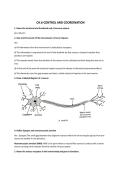
3. Draw a labeled diagram of a neuron
4. Define Synapse and neuromuscular junction
Ans : Synapse:The small gap between two adjacent neurons where the nerve impulse passes from one
neuron to another in one direction.
Neuromuscular Junction (NMJ): NMJ is the point where a muscle fibre comes in contact with a motor
neuron carrying nerve impulse from the control nervous system.
5. Name the various receptors in the human body and give its functions.
, i) Phonoreceptors – These are responsible for hearing. It is found in the ears.
(ii) Photoreceptors - These are responsible for visual stimulus. It is present in the eyes.
(iii) Olfactory receptors - Its function is smell detection. It is found in the nose.
(iv) Thermo receptors. These receptors are responsible for pain, touch and heat stimuli. It is present in
the skin.
(v) Gustatory receptors - Its function is to detect Taste. It is present in the tongue.
6. Define Reflex action.
Ans-Spontaneous, involuntary and automatic response to a stimulus to protect us from harmful
situations. Eg. On touching a hot object unknowingly, we instantly withdraw our hand.
7. Define reflex arc
Ans- The path through which nerves signals, involved in a reflex action travel is called the reflex arc.
8. Represent schematically the components of a reflex arc.
9. What are the components of reflex Arc.
Reflex Arc involves
i) Sense organs -To receive stimulus
ii) Sensory(Afferent) neuron -conveys the stimulus to the spinal cord.
iii) The relay neuron- makes a synapse with motor neurons
iv) Motor neuron (effector)- conveys response command to effectors.
v) Effectors or muscles- execute the effect by neuromuscular movements.

