INDIAN PUBLIC SCHOOL KUWAIT
CLASS X PHYSICS
CH: HUMAN EYE AND THE COLOURFUL WORLD
HUMAN EYE
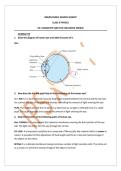
1. Draw the diagram of human eye and label the parts of it.
Ans:
2. How does the iris and pupil help in the functioning of the human eye?
Ans: IRIS-It is a dark coloured muscular diaphragm located between the cornea and the eye lens.
Iris controls the size of the pupil and thereby controlling the amount of light entering the eye.
PUPIL-The middle point of the iris which is a black hole as no light is reflected from it is called
pupil. The pupil regulates and controls the amount of light entering the eye.
3. State the function of the following parts of human eye.
Ans: CORNEA-It is a transparent thin spherical membrane covering the front portion of the eye
ball. The light rays enter into the eye through the cornea.
EYE LENS- A transparent crystalline lens composed of fibrous jelly like material which is convex in
nature. It provides the fine adjustment of focal length and forms a real and inverted image of
the object on the retina.
RETINA-It is a delicate membrane having enormous number of light sensitive cells. The retina act
as a screen on which the inverted image of the object is formed.
, LIGHT SENSITIVE CELLS-The rod cells and cone cells are together called light sensitive cells. Rods
are rod-shaped cells respond to the intensity(dimness) of the light and cones are cone-shaped
cells respond to the colour and brightness of the light. These light sensitive cells get activated
upon illumination and generate electric signals.
OPTIC NERVES-A bundle of millions of nerves which gathers information as electric signals
generated by the light sensitive cells. These signals are sent to the brain through the optic
nerves.
Finally the brain interprets these signals and process the information to make the images in a
normal way.
4. Write short note on the following terms.
SCLERA-A white layer of tissue that wraps over most of the eyeball. It protects and supports the
eye.
CILIARY MUSCLES-The muscles to which the lens is attached and it can alter the curvature and
the thickness of the lens by changing the shape of the lens.
AQUEOUS HUMOUR-The fluid that fills the space between the cornea and the lens of the eye. It
supplies nutrients to the cornea and the lens. It also helps to maintain the shape of the eye. It is
produced and renewed every 4 hours by the ciliary body.
VITREOUS HUMOUR-The colour less jelly that fills the space between the lens and the retina
through which the light travels to fall on the retina. It also helps to maintain the shape of the
eye ball.
BLIND SPOT-The least sensitive point on the retina where rods and cones are absent and through
which blood vessels and nerve fibres enter into the optic nerve.
PERSISTENCE OF VISION -The time for which an impression or sensation of an object continues or
sustains in the eye is called the persistence of vision. It is about 1/16 th of a second.
DEFECTS OF EYE
1. What is meant by defective vision?
Ans. Any eye which is not able to see objects between the near point and far point is said to
have defective vision.
2. Explain the defects of vision and their correction with the support of labelled diagrams.
Ans.a. MYOPIA (u = ∞) Refer and learn diagrams given in reader.