
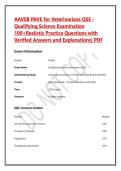
AAVSB PAVE for Veterinarians QSE -
Qualifying Science Examination
100+Realistic Practice Questions with
Verified Answers and Explanations| PDF
Exam Information
Feature Details
Exam Name Qualifying Science Examination (QSE)
Administering Body American Association of Veterinary State Boards (AAVSB)
Format 200 operational + 25 pilot questions (225 total)
Time 220 minutes
Domains 6 major domains
QSE Content Outline
Domain Weight
Normal Structure and Function 24%
Concepts of Disease 18%
Diagnostics 23%
Therapeutic Intervention 20%
,Domain Weight
Public Health and Disease Prevention 11%
Professional Skills 4%
Section 1: Normal Structure and Function (24%)
This section covers gross anatomy, physiology, biochemistry, histology, embryology,
endocrinology, immunology, genetics, and animal behavior.
1. Which layer of the adrenal gland secretes mineralocorticoids?
A) Zona fasciculata
B) Zona reticularis
C) Zona glomerulosa
D) Adrenal medulla
Answer: C
Rationale: The zona glomerulosa, the outermost layer of the adrenal cortex, produces
mineralocorticoids (aldosterone). The zona fasciculata produces glucocorticoids, and the
zona reticularis produces androgens .
2. During normal inspiration in a healthy dog, which pressure change occurs?
A) Intrapleural pressure becomes more positive
B) Intrapleural pressure becomes more negative
C) Alveolar pressure becomes greater than atmospheric
D) Intrapleural pressure equals atmospheric pressure
Answer: B
,Rationale: During inspiration, diaphragm contraction increases thoracic volume, causing
intrapleural pressure to become more negative (subatmospheric), which draws air into
the lungs .
3. Which cell type in the gastric mucosa produces hydrochloric acid?
A) Chief cells
B) Parietal cells
C) G cells
D) Mucous neck cells
Answer: B
Rationale: Parietal (oxyntic) cells secrete hydrochloric acid and intrinsic factor. Chief
cells secrete pepsinogen, and G cells secrete gastrin .
4. Which immunoglobulin is most abundant in canine colostrum?
A) IgA
B) IgG
C) IgM
D) IgE
Answer: B
Rationale: IgG is the predominant immunoglobulin in colostrum across most domestic
species, providing passive immunity to neonates. In ruminants, colostral IgG is critical
because no placental transfer occurs .
5. The sinoatrial (SA) node is located in which cardiac chamber?
A) Left ventricle
B) Right ventricle
C) Left atrium
D) Right atrium
, Answer: D
Rationale: The sinoatrial node, the heart's primary pacemaker, is located in the wall of
the right atrium near the opening of the cranial vena cava.
6. Which cranial nerve is responsible for parasympathetic innervation of thoracic
and abdominal viscera?
A) Trigeminal nerve (CN V)
B) Vagus nerve (CN X)
C) Hypoglossal nerve (CN XII)
D) Facial nerve (CN VII)
Answer: B
Rationale: The vagus nerve (CN X) provides parasympathetic innervation to thoracic
and abdominal viscera (except the distal colon), regulating heart rate, digestion, and
bronchial tone .
7. A cow is unable to stand after calving. Serum biochemistry reveals
hypocalcemia. Which hormone is primarily responsible for calcium homeostasis in
this scenario?
A) Calcitonin
B) Parathyroid hormone (PTH)
C) Thyroid stimulating hormone
D) Insulin
Answer: B
Rationale: Parathyroid hormone increases blood calcium by mobilizing bone stores,
increasing intestinal absorption, and enhancing renal reabsorption. Hypocalcemia at
parturition (milk fever) occurs when calcium demands exceed PTH response .
Qualifying Science Examination
100+Realistic Practice Questions with
Verified Answers and Explanations| PDF
Exam Information
Feature Details
Exam Name Qualifying Science Examination (QSE)
Administering Body American Association of Veterinary State Boards (AAVSB)
Format 200 operational + 25 pilot questions (225 total)
Time 220 minutes
Domains 6 major domains
QSE Content Outline
Domain Weight
Normal Structure and Function 24%
Concepts of Disease 18%
Diagnostics 23%
Therapeutic Intervention 20%
,Domain Weight
Public Health and Disease Prevention 11%
Professional Skills 4%
Section 1: Normal Structure and Function (24%)
This section covers gross anatomy, physiology, biochemistry, histology, embryology,
endocrinology, immunology, genetics, and animal behavior.
1. Which layer of the adrenal gland secretes mineralocorticoids?
A) Zona fasciculata
B) Zona reticularis
C) Zona glomerulosa
D) Adrenal medulla
Answer: C
Rationale: The zona glomerulosa, the outermost layer of the adrenal cortex, produces
mineralocorticoids (aldosterone). The zona fasciculata produces glucocorticoids, and the
zona reticularis produces androgens .
2. During normal inspiration in a healthy dog, which pressure change occurs?
A) Intrapleural pressure becomes more positive
B) Intrapleural pressure becomes more negative
C) Alveolar pressure becomes greater than atmospheric
D) Intrapleural pressure equals atmospheric pressure
Answer: B
,Rationale: During inspiration, diaphragm contraction increases thoracic volume, causing
intrapleural pressure to become more negative (subatmospheric), which draws air into
the lungs .
3. Which cell type in the gastric mucosa produces hydrochloric acid?
A) Chief cells
B) Parietal cells
C) G cells
D) Mucous neck cells
Answer: B
Rationale: Parietal (oxyntic) cells secrete hydrochloric acid and intrinsic factor. Chief
cells secrete pepsinogen, and G cells secrete gastrin .
4. Which immunoglobulin is most abundant in canine colostrum?
A) IgA
B) IgG
C) IgM
D) IgE
Answer: B
Rationale: IgG is the predominant immunoglobulin in colostrum across most domestic
species, providing passive immunity to neonates. In ruminants, colostral IgG is critical
because no placental transfer occurs .
5. The sinoatrial (SA) node is located in which cardiac chamber?
A) Left ventricle
B) Right ventricle
C) Left atrium
D) Right atrium
, Answer: D
Rationale: The sinoatrial node, the heart's primary pacemaker, is located in the wall of
the right atrium near the opening of the cranial vena cava.
6. Which cranial nerve is responsible for parasympathetic innervation of thoracic
and abdominal viscera?
A) Trigeminal nerve (CN V)
B) Vagus nerve (CN X)
C) Hypoglossal nerve (CN XII)
D) Facial nerve (CN VII)
Answer: B
Rationale: The vagus nerve (CN X) provides parasympathetic innervation to thoracic
and abdominal viscera (except the distal colon), regulating heart rate, digestion, and
bronchial tone .
7. A cow is unable to stand after calving. Serum biochemistry reveals
hypocalcemia. Which hormone is primarily responsible for calcium homeostasis in
this scenario?
A) Calcitonin
B) Parathyroid hormone (PTH)
C) Thyroid stimulating hormone
D) Insulin
Answer: B
Rationale: Parathyroid hormone increases blood calcium by mobilizing bone stores,
increasing intestinal absorption, and enhancing renal reabsorption. Hypocalcemia at
parturition (milk fever) occurs when calcium demands exceed PTH response .

